A consequence of liturgical reform

Amy Welborn, in a discussion of David Lodge’s novels:

My mother stopped going to Mass in the early 1970’s, just about the time that Souls and Bodies ends. It is not that she lost her faith. It is, as she probably would have said, that her faith lost her. She just could not stand it anymore. It broke her heart to go to Mass, to be forced to hold hands and listen to banalities and hear the blustery aging cantor belt out Kris Kristofferson’s “Lord, Help Me Jesus,” she who was raised by an aunt and uncle, skilled amateur musicians who played classical sacred music on organ and violin in their small French-Canadian parish in Maine. She stopped going, she would have told you, because there was no use in confessing that she had missed Mass, since she had no firm purpose of amendment. She had no intention of going back. And she never really did, until she died in 2001, her Requiem Mass in the funeral home chapel, led by some splinter SSPX fellow from somewhere in East Tennessee, not mentioned in the obituary since they were convinced the diocese would shut it down if they heard.

Fifty years ago today

The golden age of progressive rock began on this day in 1969 with the release of two classic albums, Frank Zappa’s Hot Rats and King Crimson’s In the Court of the Crimson King.1

Also released on that day was the Kinks’ Arthur. It doesn’t quite qualify as “prog rock,” though it was a “concept album.”

I suppose I ought to comment about the historical significance of these works, with analysis of the musical techniques employed and explication of lyrics2, plus some personal notes…. Nah. The music speaks for itself.

Sudden, violent comedy

Wonderduck points out that we’ve had Monty Python for fifty years now. I discovered them late. Their show didn’t arrive in Kansas until years after I quit watching teevee. It wasn’t until a friend handed me the scripts for the shows that I found that they were pretty good. Reading the scripts alone doesn’t give you a complete idea of what they were — “Ministry of Silly Walks” seems like a dumb little skit on paper, but John Cleese perambulating transforms it. However, the words to “The Spanish Inquisition,” “The Cheese Shop” and a good proportion of the other skits are funny on the page as well as in performance, and that is still largely how I know them.

Enjoy the Pythons now, because in the very near future the punchline to all jokes, not just “how many feminists does it take to change a lightbulb?” will be “That’s not funny.”

(The title is from here.)

Miscellany

Chainmail Bikini is back online.

***

Art or garbage? It’s hard to tell sometimes.

***

Derek Lowe recently added nitro groups to his “Things I won’t work with” category. You don’t need to be a chemist to enjoy his Lowe’s appreciations of azides, FOOF and other exceeding noisy or smelly substances.

***

William Briggs:

“Any organization not explicitly right-wing sooner or later becomes left-wing.” This is, as everybody knows, Conquest’s Second Law. It is a true law, as all modern experience shows. But it says nothing about the pace or rate of the flight from Reality and Tradition.

A rock thrown upwards at the top of its flight is stationary. For a moment it neither goes up nor down. Then, a fraction of a second later, it begins it descent, but slowly, slowly. The speeds picks up, the rocks plummets faster and faster. It eventually crashes to the ground.

That’s the progress of rocks, a good but imperfect metaphor for the “progress” of human institutions. The imperfection comes in recalling a law Conquest didn’t mention: motus in fine velocior. Things accelerate toward the end. A falling rock has constant acceleration. Human failure is a force that feeds on itself.

***

100 things Mark Evanier learned about the comics industry….

93. If your character wears a cape, it should be more or less the same length in every panel and it should not get shredded more than twice a year.

***

Dr. Boli has completed his serial, Devil King Kun. From the 20th installment:

“Actually,” said Weyland, “good people generally don’t try to conquer the world. It’s not done, you know.”

“But if you don’t conquer the world, then won’t the evil people take over every time?”

“We generally prefer to let people choose their own government, and trust them to make the right choice.”

“Well,” said Miss Kun, “I’m willing to be good, but I’m not willing to be an idiot….”

The story begins here.

***

Saw Ginger Baker’s Jazz Confusion a couple of years ago and when a bloke in the audience shouted out for ‘Toad’ Baker asked if he’d ever had a drumstick shoved up his nostril.

The lovable Ginger Baker has been hospitalized, critically ill. Here’s an 1970 interview with the easy-going drummer, and a more recent look at the gentle soul.

Update: Ginger Baker has died at the age of 80.

Professor Mondo, a drummer himself, on Baker in 1990:

The other thing that struck me was that Ginger looked like a mad wizard from a fantasy novel, impossibly aged, but terrifyingly powerful. He was three years younger than I am now. I think both his mistakes as a human being and his phenomenal talent aged him in dog years.

See also Shabby Road for an overview of Baker’s life.

Have a Spoonful of Cream.

Wayback and forward

Jorma Kaukonen’s Catholic joke, via Stevie Coyle3 of the Quitters:

Q. How many Catholics does it take to change a lightbulb?
A. (Raises hand, extending three fingers) One.

I discovered a couple of acts worth investigating at this year’s Walnut Valley Festival. Muriel Anderson, who wrangled chickens for Chet Atkins, plays a hypertrophied harp guitar that combines guitar, bass and music box into a single instrument. Feel like dancing? Can you count thirteen?

Continue reading “Wayback and forward”

Let’s get small

Although there were some mid-size to large blooms at this month’s orchid society show-and-tell, the stand-out for me was the smallest, Platystele umbellata, above. The entire cluster of burgundy flowers was roughly a quarter-inch in diameter. It was difficult to photograph — I really needed a macro lens (ideally with another lens stacked in front, and with the camera connected to the computer for focus stacking) and a tripod — but after several tries I managed to get a passable picture.

The Platystele was dwarfed by Stelis viridipurpurata, which was nevertheless quite small itself. Each flower was about a quarter-inch across.

There are more pictures here, including Habenarias.

In addition to the usual close-up photos, I also made some panoramas of the botanical garden this past weekend, such as this view of the lily pond. (Panoramas look best in the full-screen mode.)

There are more views of Botanica at my panorama page. (Click the “recent” tab.)

Continue reading “Let’s get small”

That new church smell …


St. Joseph Church, Andale, Kansas

… is curing varnish.

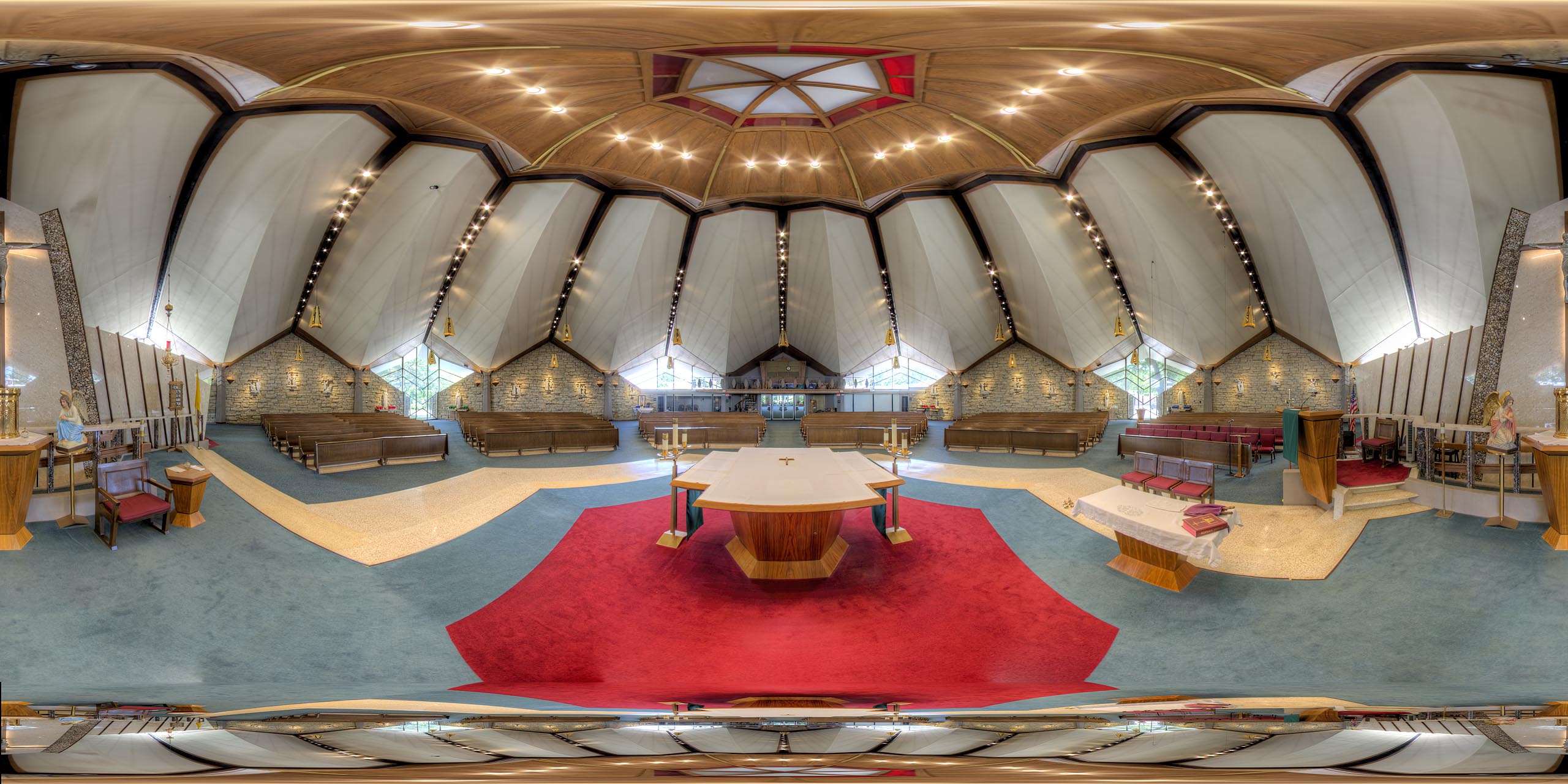
St. Joseph Church in Andale, Kansas, isn’t actually a “new” church. The current building was probably built during the first quarter of the 20th century (the parish history is vague on specific dates). However, it was damaged by a lightning-caused fire last year and has only recently been reopened after repairs and renovations.

Unlike most of the churches that I’ve been photographing, St. Joseph actually looks like a Catholic church, not a box or a spaceship.

The panorama is best viewed in the full-screen mode.

Not exactly Spanish castle magic

Fillyjonk triggered one of my stranger memories. A long, long time ago I spent a summer in Spain. One day my group traveled to Segovia (by bus, not dragonfly) to see the Alcázar. It was a spectacular place, everything a Spanish castle ought to be. My most vivid memory, though, is not of the Alcázar itself. I spent some time on the terrace at the top of the tower surveying the region. While I was there, someone with a tape recorder played two songs over and over, loudly. One was “American Woman,” and the other was “Spirit in the Sky.” I felt a certain slight dissonance between what I saw and what I heard.4

Literary notes

Gary Saul Morson:

Why is it, Solzhenitsyn asks, that Macbeth, Iago, and other Shakespearean evildoers stopped short at a dozen corpses, while Lenin and Stalin did in millions? The answer is that Macbeth and Iago “had no ideology.” Ideology makes the killer and torturer an agent of good, “so that he won’t hear reproaches and curses but will receive praise and honors.” Ideology never achieved such power and scale before the twentieth century.

Joseph Moore:

Up until current times, it would have been scandalous for a woman in a Catholic country to arrange her own marriage in defiance of her father. Romeo & Juliet is a cautionary tale against just such presumption. The nurse and the friar are the villains of the story, overstepping their rightful duties. Until modern times, readers of the play all understood this.

***

For literature of a different sort, see Dr. Boli.

Good taste …

… doesn’t apply here, except maybe in a Cramps sense. (Right-click and open in a new window to see every lurid detail.) A friend spotted this vehicle in a college parking lot near his place and sent the picture with the comment that “Anime can be dangerous.” Well, maybe. There are better ways of advertising your enthusiasms — though if that’s the sort of anime you like, it might be better if you kept it to yourself.

Update: the rest of the story.

The Joe DiMaggio of bloggers

For years, one of my first stops every morning after cranking up the computer was Dustbury. There would always be something new and worth reading. The proprietor, Charles G. Hill, a self-described “generalist and occasional wiseguy,” was intelligent and insightful. He was witty and clever, too, very good with bad puns, and an unabashed brony. He was always a pleasure to read. One of the few things I looked forward to on Mondays was his weekly survey of search terms leading to his site, with a wisecrack for each item. His familiarity with obscure popular music rivaled that of the Professor, and he had a healthy appreciation of fine stemware.

Dawn Eden and Charles Hill at an Oklahoma bloggers’ meet-up in 2005.

It wasn’t all wisecracks at Dustbury, though. Hill struggled with depression all his life. During the past few years he faced worsening problems with health and mobility. His “Vents” were often painful to read, and other posts could be disturbing. Although our interaction was limited to occasionally leaving a comment at each other’s site, I worried about him.

Charles Hill passed away yesterday from injuries received in an accident.

Dusty Sage

If there is such a thing as a “national treasure” on the internet, it’s Charles G. Hill’s site. The text deserves to be printed on acid-free paper and available in libraries for ages to come. I hope someone capable steps up to preserve Dustbury, as Pixy Misa and J Greely did for Steven Den Beste’s sites.

When perusing Dustbury, be sure to check the tabs at the top of the page, as well as the main blog. There you will find much else of interest, such as his profile with Norm Geras:

What would you do with the UN?
I’m not quite sure, but I expect it involves dynamite….

Do you have any prejudices you’re willing to acknowledge?
I shun anyone who can speak the word ‘multicultural’ with a straight face.

Update
Tributes to Dustbury: Roger Green; Steve Lackmeyer; Rob O’Hara.

(The post title is from John Salmon; the picture of Dawn Eden and Charles G. Hill is from Michael Bates.)

Bright lights and strange sights

Stromboli has gotten friskier of late. You can see and hear the activity here. It’s particularly dramatic during night on the Tyrrhenian Sea.

***

I’m losing my enthusiasm for Macintosh computers. My iMac should last a few more years, but after that I may replace it with a different brand. Perhaps I’ll install Linux.

Perhaps not.

(Via J Greely and the Brickmuppet.)

Back again to the garden

Tricyrtis

I spent yesterday afternoon at the botanical garden, this time with an ordinary zoom lens. There was relatively little color outside, but I found some. There was more at the orchid society meeting inside, where the room was refrigerated air-conditioned. There are more pictures here.

Trichocentrum jonesianum

Continue reading “Back again to the garden”

The sky below

When I last visited the botanical garden, I took the fisheye lens instead of the macro. Unfortunately, I didn’t have the panorama tripod head with me, so all the garden panoramas came out too glitchy to post. The above was salvaged from one of the waterlily pond.

***

A few odds and ends:

Zappa fans might find this old advertisement oddly familiar:

See also Ronstadt, Zappa and the Remington Electric Razor.

(Via .clue and Dustbury.)

Saints in space

Here’s another example of a faddish round church built in the later 20th century, All Saints in Wichita. It’s not ugly, but it reminds me more of main deck of a spaceship than a place of worship. It was dedicated in 1965, a year before the debut of the original Star Trek, so it’s probably safe for altar boys to wear red cassocks.

To view the detailed interactive panorama, click here.

Incidentally, the pastor of All Saints, Fr. Hien, whom I remember as an energetic and cheerful seminarian, is a refugee from Viet Nam who’s had an interesting life (PDF).

Odds and ends

Items of interest I came across recently.

Is anything still forbidden in Hollywood?

Jesuits, communism and Rod Dreher.

Jesuit vows and the Papacy. (Via TS)

A new Catholic journal?

The post-war conservative movement in the United States has not turned back the clock a single minute and has succeeded only in gradually lowering marginal tax rates as same-sex marriage became law in all 50 states….

If anyone else was interested in creating something like The Lamp it would have existed already. (In point of fact, something like it did exist in the late ’60s and early ’70s: Brent Bozell’s Triumph, almost certainly the only publication in which one could have read things like the traditionalist Catholic case for Black Panther militancy.5)

***

Bonus link: Elizabeth Scalia on Paul McCartney and Christianity.

Unforgettable, irreplaceable

Amy Welborn reminds us that today is E.B. White‘s birthday. Here’s a story of his I liked quite a bit when I was younger.

*****

The Supremacy of Uraguay

Fifteen years after the peace had been made at Versailles, Uruguay came into possession of a fine military secret. It was an invention in effect so simple, in construction so cheap, that there was not the slightest doubt that would enable Uruguay to subdue any or all of the other nations of the earth. Naturally the two or three statesmen who knew about it saw visions of aggrandizement; and although there was nothing in history to indicate that a large country was any happier than a small one, they were very anxious to get going.

The inventor of the device was a Montevideo hotel clerk named Martín Casablanca. He had got the idea for the thing during 1933 mayoralty campaign in New York City, where he was attending a hotel men’s convention. One November evening, shortly before election, he was wandering in the Broadway district and came upon a street rally. A platform had been erected on the marquee of one of the theatres, and in an interval between speeches a cold young man in an overcoat was singing into a microphone, “Thanks,” he crooned, “for all the lovely dee-light I found in your embrace …” The inflection of the love words was that of a murmurous voice, but the volume of the amplified sound was enormous; it carried for blocks, deep into the ranks of the electorate. The Uruguayan paused. He was not unfamiliar with the delight of a love embrace, but in his experience it had been pitched lower — more intimate, concentrated. This sprawling, public sound had a curious effect on him. “And thanks for unforgettable nights I never can replace …” People swayed against him. In the so bright corner in the too crowded press of bodies, the dominant and searching booming of the love singer struck sharp into him and he became for a few seconds, as he later realized, a loony man. The faces, the mask faces, the chill air, the advertising lights, the steam rising from the jumbo cup of A. & P. Coffee high over Forty-seventh Street, these added to his enchantment and his unbalance. At any rate, when he left and walked away from Times Square and the great slimy sounds of the love embrace, this was the thought that was in his head:

If it unhinged me to hear such a soft crooning sound slightly amplified, what might it not do to me to hear a far greater sound greatlier amplified?

Mr. Casablanca stopped. “Good Christ!” he whispered to himself; and his own whisper frightened him, as though it, too, had been amplified.

Continue reading “Unforgettable, irreplaceable”

Not thrilled

Charles Hill recently posted a video that purports to list fifteen albums that are in the collections of everyone who bought records back in the age of vinyl. Surprisingly, I have four — but only four, and Thriller is not among them.

I thought it might be fun to do the opposite: compile a list of LPs in my collection that almost no one else has. I’m including only albums on vinyl; if I were to include CDs and digital files, I could easily list hundreds, maybe thousands, of obscure recordings. Here are ten records, all worth hearing, that I’ve never seen in anyone else’s music library.

Rare Air, Hard to Beat

Continue reading “Not thrilled”