Tenderized

Princess Mononoke wasn’t quite what Disney expected:

Disney executives like Michael O. Johnson, the president of Walt Disney International, had only seen Castle in the Sky, My Neighbour Totoro and Kiki’s Delivery Service, and were expecting similar child-friendly films when they took on Ghibli’s world distribution. Johnson was hence entertainingly horrified when he visited the Tokyo office and saw clips of the film in production, including a graphic moment of decapitation, and the heroine wiping blood around her mouth. Johnson begged Suzuki to change it, pleading that his own head would roll unless he could deliver something more sedate: “Do we have to have the arms and heads flying off? Isn’t there something softer in the film? Romance maybe? Can’t I get a nice romantic scene, you know, between the hero and heroine? Maybe a kiss or something?” The final cut of the trailer included a shot of the wolf-girl San feeding Prince Ashitaka a piece of meat, mouth-to-mouth. Johnson went away delighted, and nobody corrected him when he thought he’d just witnessed a tender kiss.

A glimpse of Miyazaki:

In the midst of all of this, surrounded by toadies and flunkies, duelling cockswans and shouty executives, Hayao Miyazaki sends back his drink at a restaurant, telling the waiter that it is not the forty-year-old port that he ordered. The waiter insists that it is, but Miyazaki sticks to his guns, until a sheepish manager admits that they had, indeed, tried to fob him off with a cheaper variety. He remains the only one who is true of heart, in a Sea of Corruption.

Thoughts, short-term and long-term

I am beyond tired of all the CCP virus hysteria, and I don’t intend ever to allude to it again here. Instead, I refer you to the development of Edward Feser’s thoughts on the matter over the past six weeks.1

Some thoughts on the COVID-19 crisis:

In the short run, then, my sympathies are more with those who defend the lockdown than with those who are skeptical of it. However, in the long run those who defend the lockdown need to be more open, rather than less, to the considerations raised by the skeptics.

***

The lockdown’s loyal opposition:

Meanwhile, at The Bulwark, conservative lockdown defender Jonathan V. Last tells us that he won’t link even to Fr. Thomas Joseph’s article, let alone Rusty’s. The reason is that Fr. Thomas Joseph’s article “made matters worse, not better” by granting “legitimacy” to the idea that “there are really two sides to the issue, and that reasonable and intelligent people can disagree.” He compares Rusty’s skepticism to that of flat-earthers and anti-vaxxers.

This is outrageous. Does it not occur to Last that the surest way to reinforce skepticism is precisely to demonize it, even when it is expressed by a serious writer and thinker like Rusty?

***

The burden of proof is on those who impose burdens:

What I am sure of is this much: The burden of proof is not in the first place on him and people of like mind to show that the lockdown should be ended. The burden is on defenders of the lockdown to show that it shouldn’t be….

The issue is not just that doing massive damage to the economy is, if unnecessary, imprudent in the extreme – though, to say the very least, it most certainly is that. It’s that the lockdown entails actions that, in ordinary circumstances, would be very gravely immoral.

***

The lockdown and appeals to authority:

Most people’s opinions depend crucially on what they have heard from political commentators, journalists, politicians, and scientists. None of what any of these people say can be evaluated the way a philosophical argument can, viz. in a manner that entirely abstracts from considerations about the knowledge and biases of the people giving the arguments. And that includes, to some extent, the scientists. Moreover, the knowledge and biases of these experts give us grounds for having at least some reservations about what they say. And that too includes, at least to some extent, the scientists.

***

The lockdown is no longer morally justifiable:

As I have said before, I think that the lockdown that was put in place in the United States two months ago was morally justifiable given the circumstances at the time. In my opinion, under current circumstances, it is no longer morally justifiable. To be sure, I am not denying that some social distancing measures are still justifiable and even necessary. I am also not denying that a more modest lockdown may still be defensible in some localities. But the draconian total lockdown that was put in place across most of the country is at this point no longer defensible, and state and local authorities who are relaxing it are right to do so….

But again, it isn’t those who favor relaxing the lockdown who have the burden of proof. The burden is on those who want to preserve it. Two months ago, they could make a strong case for having met it. Not any longer.

Continue reading “Thoughts, short-term and long-term”

In the pink

The botanical garden finally (partly) reopened today after a two-month hiatus. I spent the afternoon there taking hundreds of pictures. It’s going to take me a while to process them all. Here’s Oenothera speciosa for now. There will be more soon.

***

The close-ups I’ve posted of Gilia tricolor don’t really show what the plant looks like. This should give you a better idea of how it grows in cultivation. It’s roughly a foot tall.

Good things from California

California poppy

The incessant thunderstorms have paused for the moment, and the sun actually came out from behind the clouds, so I grabbed my camera for a few more snapshots. The focus today is on Eschscholzia californica and Gilia tricolor. (Phacelia campanularia is blooming profusely, but the flowers have been battered by the storms and aren’t presentable for closeups.)

Gilia tricolor

As always, click on a picture to see it larger and with better color. The individual Gilia blossoms are three-eighths to one-half inch in diameter.

Continue reading “Good things from California”

W. Heath Robinson expects an apology

Spare room

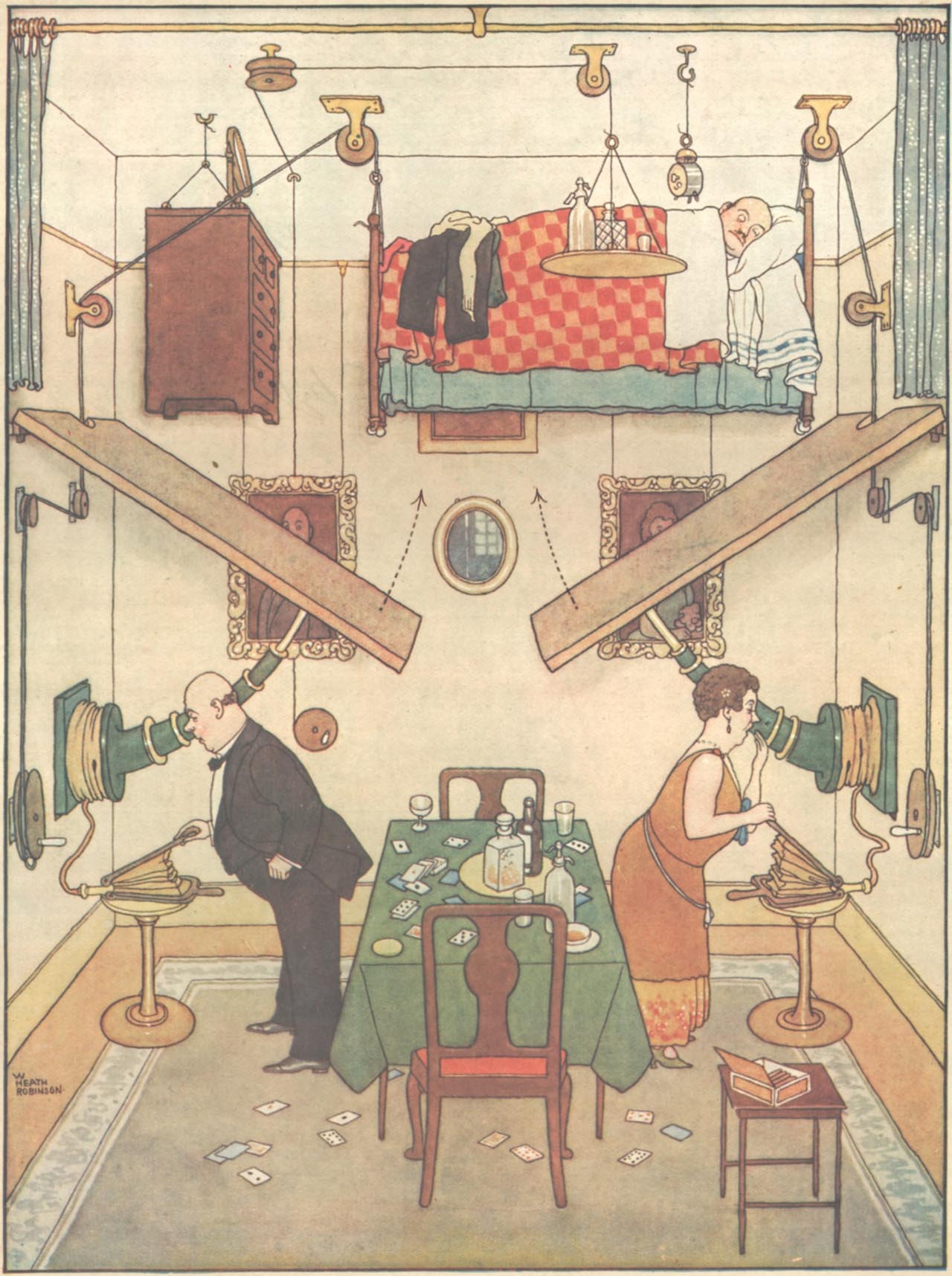
In a Heath Robinson device, everything has a clear purpose, no matter how strange it appears. For example, there is a clearly discernable logic to the profusion of cables, pulleys and bellows in his “Spare Room,” above, from this year’s HR calendar. It may not be realistic — I wouldn’t want to sleep in that bed — but everything makes sense. (The same is true of the inventions of Heath Robinson’s American counterpart, Rube Goldberg.) Comparing Neil Ferguson’s incomprehensible mathematical model to a Heath Robinson device slanders Robinson.

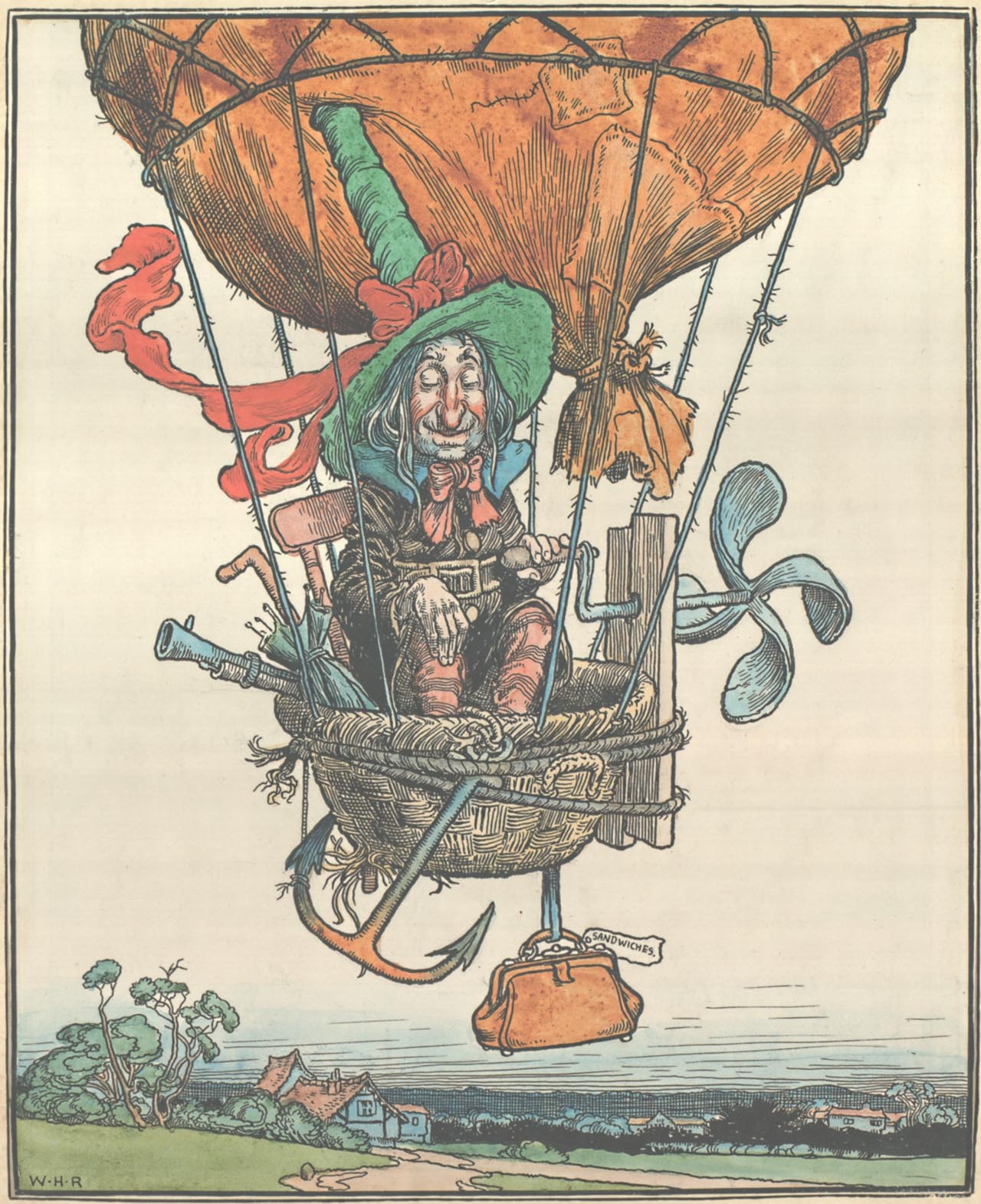
Bonus calendar picture: Uncle Lubin in color.

Uncle Lubin

Memo to the blogosphere

If you write quotably, please proofread your prose before you click “publish.” Case in point, from John C. Wright:

Thirty years ago, I was in the newspaper business, and I saw then that the news was utterly corrupt and utterly dishonest, and was willing to loose money rather than cover stories that told the truth and gave both sides of any debate. It was like living in the Matrix. The news was fake, and I knew it, and could prove it, and could recite chapter and verse of the lies, propaganda and distortion — and no one believed me, no one cared, no one could be bothered to listen.

If I were to quote that for its content, I would either insert a “(sic)” after “loose,” or put “lose” in its place in brackets, indicating a substitution. Either course is ugly and clunky and weakens the impact of the statement.

Empty playground

Like pretty much everything else in Kansas, playgrounds3 in Wichita are off-limits. Nobody was watching me yesterday morning, so I grabbed a few panoramas. These look best in full-screen mode.

The spaceship off to the west was part of a slide that was later closed up and partially dismantled because of liability issues.

Lenin’s birthday miscellany

Robbo:

I see today that Our Betters are starting to beat the drum that we should be treating glowbull enwarmening and coronapalooza at the same time and in the same way.

By a staggering coincidence, I already happen to be doing just that thing.

Maybe not the way they’d like….

*****

The Z Man:

If you’re willing to send cops after people walking on the beach, just to make a point about who decides who can go outside, you’re probably going to have no qualms about ending the voting charade.

*****

What we definitely know:

Here are the official Coronavirus guidelines:
1. Basically, you can’t leave the house for any reason, but if you have to, then you can.
2. Masks are useless, but maybe you have to wear one, it can save you, it is useless, but maybe it is mandatory as well.
3. Stores are closed, except those that are open.
4. You should not go to hospitals unless you have to go there. Same applies to doctors, you should only go there in case of emergency, provided you are not too sick.
5. This virus is deadly but still not too scary, except that sometimes it actually leads to a global disaster.
6. Gloves won’t help, but they can still help.
7. Everyone needs to stay HOME, but it’s important to GO OUT.
8. There is no shortage of groceries in the supermarket, but there are many things missing when you go there in the evening, but not in the morning. Sometimes.
9. The virus has no effect on children except those it affects….

*****

Via Glenn Reynolds:

Just think how many lives have been saved by two things leftists hate most: suburbs and the car culture. And just think how many lives have been lost by things the left love most: mass transit and high-density urban living.

*****

Meanwhile, in New York it is now mandatory to break the law.

(Via Pixy.)

See also George Carlin on the state of the planet.

*****

Update: possibly relevant:

Joan alone

I rode downtown around noon today. While it wasn’t quite the ghost town that it was on my last trip in, I still pretty much had the place to myself, as you can see by the dense crowds on Main Street, above. The statue in front of the library is of Joan of Arc — Wichita is a “sister city” of old Orleans.

View this in greater detail as an interactive panorama here.

Continue reading “Joan alone”