The worst time-sink on the internet is TV Tropes, followed by Wikipedia. And then there’s YouTube, where I got trapped this weekend. I wondered if I could find some of the barely-remembered songs I heard back in ancient times. Many hours later, I had located quite a few. Here are some I unearthed. You can judge for yourselves whether these were buried treasures or something else.
Category: Music
The truth about Lincoln …
… and Theodore Roosevelt, Woodrow Wilson, Warren G. Harding and Richard M. Nixon. Fred Himebaugh, a.k.a. The Fredösphere, who has neglected his weblog for too long, shares the results of his historical research. Content advisory: robots, alien gods, banjos.
Fred earlier wrote a chamber opera “They’re Made Out of Meat,” using the Terry Bisson short story as the libretto, as well as a touching ballad of interplanetary romance, “Earth Girl.”
Cold temperatures and warm hearts, true chemical romance, and how to avoid bad theology
Here are a few videos that recently caught my fancy.
There are no “gangnam” parodies because I’m sick of them.
No silver eagle of the steppe

US copyright law is stupid. Case in point: Girls und Panzer‘s eighth episode is missing about a minute in its Crunchyroll version. Unless you download a fansub, you are going to miss this 1938 song, the highlight of the episode.
Update: here’s the video, via Ivlin, who notes that “Copyright is demonstrably making art worse“.
(hic)
The Twenty-First Amendment was ratified on this day in 1933, making this tasteful song possible. Here is an atmospheric, evocative performance by a chamber ensemble conducted by Lindley A. Jones.
Saint-Saens, improved
This video satisfies your minimum daily requirement for high culture.
(Via Eve Tushnet.)
8,979 shows too many
I recently discovered that the Internet Archive contains over 100,000 live concerts that you can download, free and legally. Most of the performers I haven’t heard of, but there are quite a few of note. Acts represented include Bela Fleck and the Flecktones, Brave Combo, Hot Club of Cowtown, as well as my recent enthusiasms Estradasphere and Secret Chiefs 3. There are also 8,980 Grateful Dead concerts. The archive also gives me a chance to sample bands who were previously just names to me, such as bluegrass eccentrics Split Lip Rayfield and Bad Livers, and just plain eccentrics like Hypnotic Clambake. The recording quality varies; most concerts I’ve listened to sound like good bootlegs.
Let’s all do the “Bulgarian Boogie.”
Now let’s do the “Hokey Pokey.”
Bach for lunch
The complete Goldberg Variations, performed by Kimiko Ishizaka, are available here in various formats, for free, thanks to Kickstarter. ((The .mp3 zip file is missing the twenty-eighth variation, but you can download that separately from the player on the page.))
The last Winfield post …
… maybe.
This is a slide show of the pictures I took at the Walnut Valley Festival. You might notice a lot of photos of Roger and Tricia. That’s partly because you were likely to hear good music when they were around. They are whom you hear in the video.
Fish music
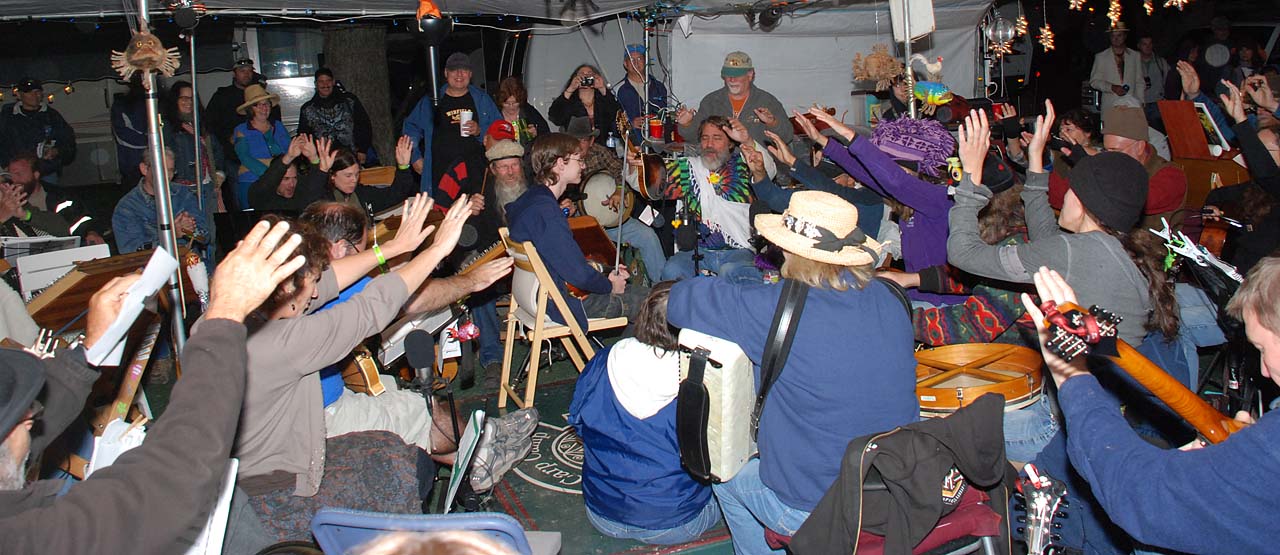
Roger Netherton, a young friend of mine, placed second this year in the old-time fiddle contest at Winfield Friday. He celebrated by heading over to Carp Camp, where he led the assembled eccentrics in a couple of tunes. Here’s the first. It starts off with Roger alone.
There are more pictures of carp people below the fold.
Mystery revealed

The gizmo in yesterday’s post is a Stroh violin. This is what it sounds like:
The fiddler is Jill Woodhouse, of the Beautiful Music Violin Shop in Lawrence, Kansas.
Winfield 2012
Oranges, lemons and bananas
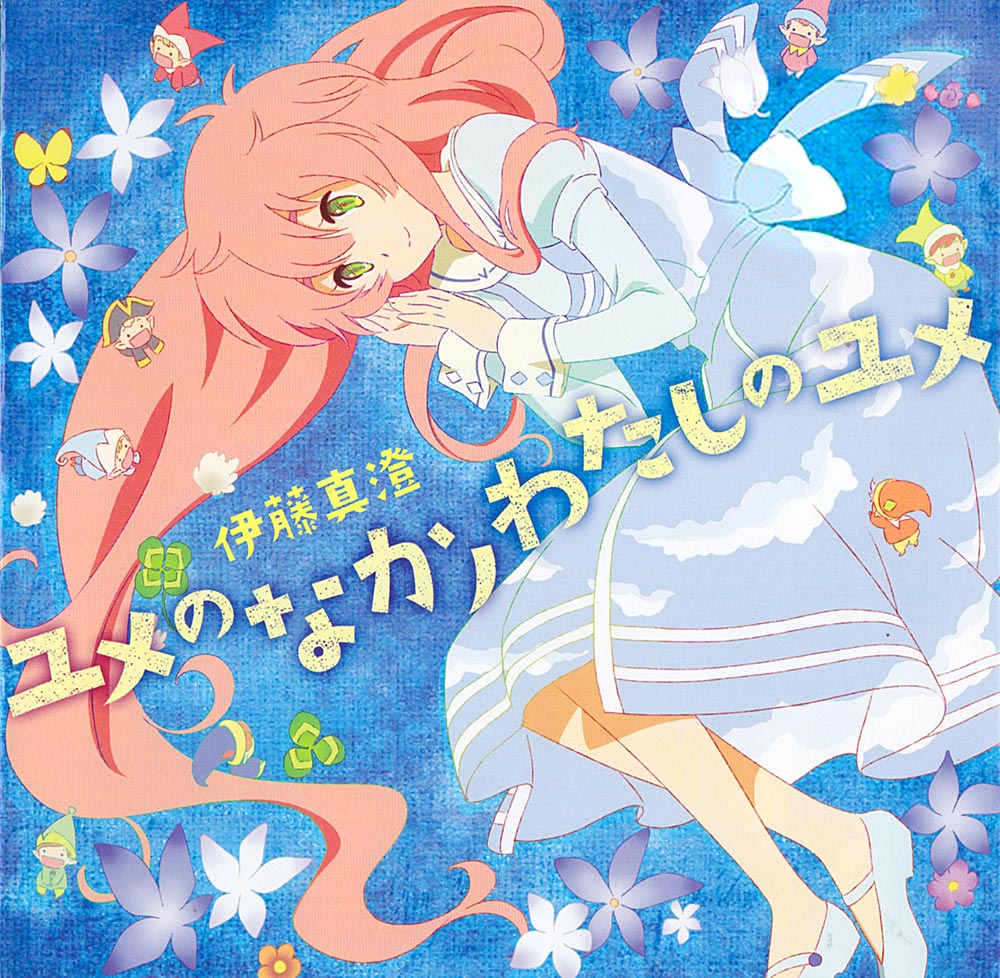
I’m following four current shows. Three of them — Moyashimon Returns, Dog Days II and Joshiraku — are pleasant entertainments and little more, and I haven’t much to say about them. ((Steven has lots to say about Dog Days.)) The fourth, Jinrui wa Suitai Shimashita, or Humanity Has Declined, is a series unlike other series. Exactly what it is, I’m still not sure. It initially was surrealistic and satirical, but in recent episodes the emphasis has shifted from ridicule to something nearer science fiction as we know it. It remains plenty strange, though. I wonder if there will ever be an explanation for the fairies: are they actually cutesy morlocks, or sucrose-based alien life forms, or what? In any case, beware of fairies bearing bananas.
The ending theme of Jintai, “Yume no Naka no Watashi no Yume,” reminds me strongly of the opening and ending of Azumanga Daioh. There’s a good reason for that. It was written and sung by Masumi Itou, who was half of the Oranges and Lemons duo. She was also part of Heart of Air, of “Blue Flow” fame. (Say “‘Blue Flow’ fame” ten times fast.) There is a transcription of “Yume no etc.” and a link to sheet music here if you’d like to follow the key changes.
Incidentally, the ending theme of Joshiraku, “Nippon Egao Hyakukei,” suits Momoiro Clover Z’s talents and limitations much better than the opening of Mouretsu Pirates, and I would link to a video of it if I could find one on YouTube. It’s the most energetic closing song I’ve heard since Pumpkin Scissors‘ “Mercury Go.”
Hmm
An interesting observation from Jane in Anchorage:
Our Latin Mass choir here has, counting myself and my husband, three men and eight women. The oldest person in the choir is about 40, or not much older, four of us are in our 20s, and four are teenagers.
In contrast, there is currently no one in the parish choir, that sings at the main English-language Mass of the day, who is under 50.
What’s Don listening to these days?
Nothing special — just plain, ordinary gypsy metal and the like.
Piano mysteries and more
Here’s about two week’s worth of accumulated trivia.
I lost patience with radio years ago. The only time I listen nowadays is during storm warnings. Consequently, I never knew the Piano Puzzler existed until Angela at Mommy Bytes recently mentioned its tenth anniversary. Each week, pianist Bruce Adolphe arranges a “familiar” tune in the style of another composer, and the contestant’s task is to identify both the composer and the melody. I can usually identify the composer right off, but naming the tune is often difficult. What makes the segments memorable is Adolphe’s fantastic ingenuity in devising his arrangments, which must be heard to be believed. He does things like combine Schubert with Gershwin, Gershwin with Copland, The Fantasticks with Berg, spirituals with Handel, “Old MacDonald Had a Farm” with Brahms, etc., and makes each combination, no matter how unlikely, work. You can stream the programs or download them here. My favorite so far is the April 6, 2011 program.
Fireworks
My father was a clarinetist in his college marching band. He frequently played recordings of band music at home while I was young, with the result that I grew up allergic to John Philip Sousa. Over the years I’ve acquired some tolerance to the genre — though I’ll never be a fan — enough so that I can enjoy stunts like these.
(Several hotshot young pianists play Horowitz’s transcription on Youtube, if you want to hear it with better sound. To my ears, Volodos is the least unsatisfactory. If you want to understand why it is so difficult to take Lang Lang seriously, this will make it painfully clear.)
*****
I’m sure it’s purely coincidental, but it amuses me that the best-known of all mahou shoujo is clad in red, white and blue.

Katy, waltz and woodchuck
A young friend had a good day yesterday, placing third in the open division at the Missouri Fiddlers and Country Music Association fiddle contest.
Just incredible math
Miscellaneous musical notes:
My financial situation has improved from desperate to merely uncomfortable, and I’ve been able to finally make a few purchases that I’ve had in mind for years. For instance, I now have a grand piano. More precisely, I have a mathematical model of a grand piano in my laptop, Modartt’s Pianoteq. It’s no substitute for the real thing, of course, but I don’t have the space for a full-size grand, let alone the cash. Pianoteq sounds pretty good, and it’s much more “alive” than any sample-based instrument I’ve played. Add a pinch of reverb, and it would take a very sensitive ear to tell that it’s not an actual physical piano in a recording. If you have a velocity-sensitive MIDI keyboard handy, download the demo and try it yourself.
Because it’s not based on samples, the software requires surprisingly little disc space. Pianoteq is only 20 megabytes large. In comparison, Synthology’s Ivory II Italian Grand takes 28 gigabytes, and EastWest’s Bösendorfer gobbles 87. (They also need 7200 RPM disc drives, which means they won’t run on my humble laptop, where I need them. ((On top of that, they both require you to by an “iLok” key, a goddam miserable expletive-deleted dongle, and that is a deal-killer. (Q. What is the purpose of digital rights management? A. To punish the legitimate user.) I daresay that these are wonderful instruments, but I ain’t touching them.))) Physical-modeling synths such as Pianoteq do make heavy demands on the processor, but my laptop handles the load easily.
*****
I’ve been considering finally buying one of the major notation packages, either Finale or Sibelius. I don’t need the full, all-the-bells-and-whistles versions, which is fortunate, because I don’t have the funds. However, the affordable intermediate version of each can be installed on only one computer, which is inconvenient. I think I’ll see how well MuseScore works.
*****
I see that Bakumatsu Kikansetsu Irohanihoheto (did I spell that correctly? Yes) has been licensed. I’m a little surprised. Although I enjoyed the first several episodes, I never did finish watching it, and I don’t recall that it was exceptionally good or particularly popular.
However, it does feature a good Yuki Kajiura opening song.
*****
Josh, who prefers J.K. Rowling to Margaret Atwood, finds echoes of Kierkegaard in Talking Heads.
Politics, grammar and velcro
A few recently-spotted items worth quoting:
Being politically correct does not trump being grammatically correct…please fix.
— Dr. J’s Gothic Literature teacher
But these days the wages of sin is boredom.
Well, I could argue that a proper understanding of punk and its inherent rebellion would have everyone becoming a libertarian or principled conservative …
— Mollie Hemingway (in the comments)
The last is from a thread about the “Weirdest Band You Love.” It’s hard to pick the strangest of my many musical enthusiasms, but the Sons of Rayon might be the most obscure. The inventors of velco tap dancing (fiddler/guitarist Kelly Werts glued velcro hooks on the soles and heels of his shoes and danced on a patch of tightly-woven carpet, which was miced, creating sound when his feet left the platform), the Bill Monroe-meets-Robert Fripp trio was active in Wichita for several years around 1980. They released one cassette, No Velcro, which was one of the first items I digitized when I hooked up my computer to the stereo. Here is perhaps their loveliest song, written and sung by banjoist Paul Elwood and featuring Intergalactic Yodeling Champion Randy Erwin, “UFOs Over New Zealand.”