Some bamboos are hardy in Kansas. I’d guess that this one is a species of Fargesia.
Trivia that matter

Some bamboos are hardy in Kansas. I’d guess that this one is a species of Fargesia.

Willow.

In the summer of 1842, anything that’s fun is illegal in Edo. This includes all forms of entertainment, technological innovations and, in particular, fireworks. The policeman Akai assiduously enforces the law with a particular emphasis on the Furai terrace house, whose inhabitants include the fireworks artisan Seikichi and his mathematician brother Shunpei. One day, after an unpleasant encounter with Akai, Seikichi returns to his room to find a strange, pretty young woman with stars in her eyes (literally) and blue hair who tells him to call her “Sora.” She has a modest request for him: can he make a rocket that will go to the moon?
Oh! Edo Rocket is a collection of disparate elements, starting with the character art. There are at least three distinct styles represented. Seikichi, Shunpei and Sora have classic anime big eyes and small (but definite) noses. (Their mouths are larger than is standard nowadays, though. Seikichi’s is downright big.) Akai, the locksmith Ginjiro and other older characters have normal-sized eyes and relatively realistic faces, and they are considerably taller than Seikichi. Finally, there’s a collection of cartoony grotesques who could have stepped out of a Jay Ward production. These all are as short as Boris Badenov, barely reaching Ginjiro’s knee, with oversized heads. (I posted a portrait gallery earlier.)
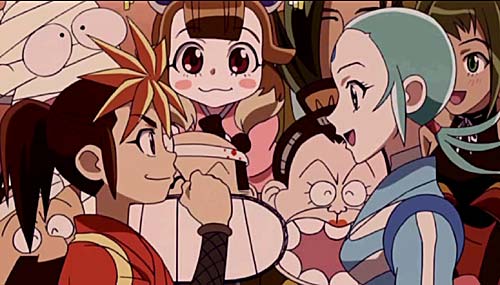
In addition to these, there are strange creatures lurking about. One of these is a pale “sky beast,” apparently intelligent, and capable of zapping its enemies with electrical discharges. The magistrate Torii and his secret police pursue the creature, but as of episode two they have yet to capture it.
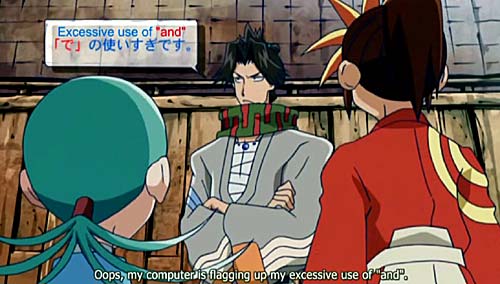
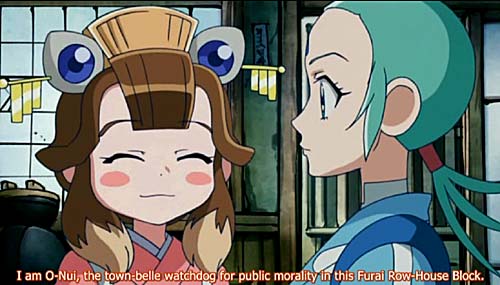
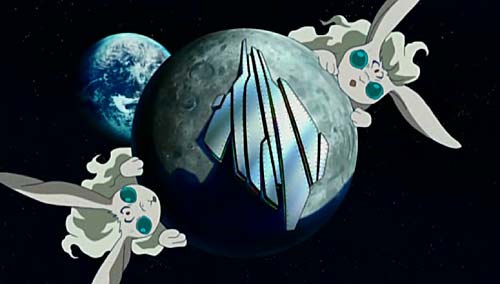
Other elements include a jazz soundtrack, frequent anachronisms and breaks in the fourth wall. There’s a self-pitying effeminate bishounen whom nobody notices. There aren’t any meganekko or nekomimi so far, but there is Onui, the “watchdog for public morality,” who is distinctly puppyish. There are giant rabbits on the moon.
Oh! Edo Rocket is mostly farce, but there’s menace under the comedy. The inventor Shinsa is hauled off to jail at the end of the first episode. He returns in the second, covered from head to toe with bandages because he refused to inform on Seikichi. The heavily armored secret police are absurd — one travels by turning cartwheels so quickly that he is a blur — but they are also scary. The regular police seem as competent as the Keystone Cops, but Akai is observant enough to be dangerous.
Whether the show’s creators can pull all these heterogenous elements into a unified whole remains to be seen. A stage play, a novel and an earlier television series preceeded the anime, so presumably the writers have some idea of where they’re going with the story. There’s nothing else much like it, so I’ll probably continue to follow it.
And all computers have cooling fans anyway, so why put the A/C for the building in that room?
(Via Chizumatic.)
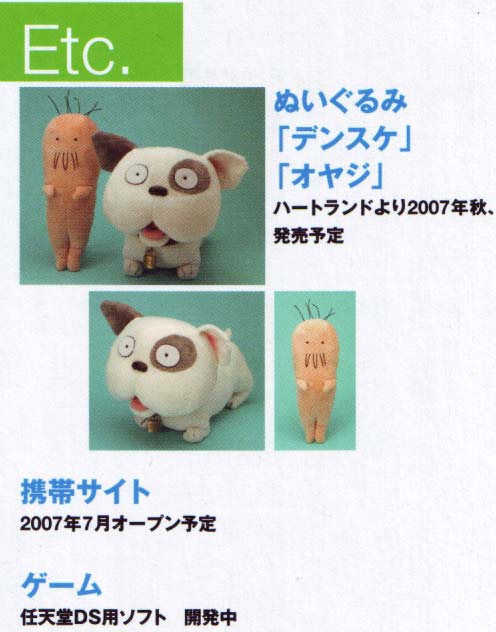
Inevitably, plushies of Denno Coil creatures will soon be available in Japan. Owners of the Densuke doll will be one-up on Yasako, who doesn’t know what her cyberpet feels like. (But where are the mojos?)
*****
After some experimentation with ffmpegX, I managed to encode a watchable flash file of the opening to Animal Yokocho, which I’ve posted on the video weblog. Apparently, the quality of the playback is more a function of the computer it’s viewed on than of the size of the file. On my aging Mac at home with its antique video card, playback is annoyingly jumpy, but here at the office (it’s lunchtime) on my newer, faster machine, it’s acceptable. Though it’s hardly a classic, the AniYoko opening does its job quite well, with cheerful, energetic music and imagery that advertises that anything can happen. Animal Yokocho deserves more attention that it gets; it’s a kid’s show that adults can enjoy as much as their children. It’s a pity that it will probably never be licensed. (For more on the joys of working with Flash, see Astro’s account of his experiments.)
*****
The thirteenth episode of Seirei no Moribito was the first that disappointed me. It’s a good story, and the fight scenes were every bit as spectacular as those in the third episode, but the script was clumsy. The symbolism, not exactly subtle to begin with, was highlighted, then underlined, then explicitly explained as if the viewer were in a ninth-grade English class. The rampaging Balsa deserved better. Perhaps not coincidentally, this was the first episode with an unequivocally evil character.

As near as I can tell, this is a yellow-crowned night heron.

On the way home from work, twenty minutes before the rain. (This is getting old.)
A bunch of stuff was recently licensed. The most interesting news is the title that wasn’t there. Ouran High School Host Club, in my opinion the outstanding show of the non-banner year 2006, has still not been licensed. I presume that it’s a matter of money; otherwise, it is incomprehensible that dreck like OtoBoku gets a region 1 release and Ouran doesn’t.
Random notes on some of the other shows:
The original Genshiken was okay, but just okay, and the three episodes of Kujibiki Unbalance were all that was necessary. The additional episodes will likely demonstrate that “more is less.”
Darker Than Black is a possible buy, but I want to read some reactions to the complete series before I invest time and money in it. Is there substance under the glossy finish?
I watched half of the first episode of Victorian Romance Emma and, well, I was bored. I daresay I would find it fascinating if I could get into the rhythm. It can wait.
Gurren-Lagann is another possible buy. Again, I’ll wait for reports on the entire series before making a decision.
The first three episodes of Nanoha seemed to me to be an inferior version of Cardcaptor Sakura. Things start getting interesting in the fourth episode with the appearance of another mahou shoujo, but by that point I was thoroughly repulsed by the transformation sequence, which was storyboarded with dirty old men in mind. I never thought I’d say this, but I am not interested in watching any more of Nanoha unless it’s censored.
*****
Today’s Words of Wisdom: Too much Freud is bad for you.
*****
The first episode of Sola has two things going for it: a photographer, albeit a flaky one; and, the three inches between the hem of the girl’s very short skirt and the top of her stockings. ((This motif turns up a lot in anime, e.g., Yomi in Azumanga Daioh, but I don’t think I’ve ever seen a real-life example.)) Astro gave the series a “B,” so I may watch the rest sometime, but it’s not high priority.
*****
None of the summer’s series look particularly promising. I may watch the first episode or two of Tetsuko no Tabi, which seems to be the least stereotypical offering. If the characters are interesting, it could be fun.
*****
I see that Gedo Senki has been fansubbed. I will not be downloading it. I like the books too much.

Central Steel, Inc., II
… Evil!Snape.
(Via Galley Slaves and Ross Douthat.)
*****
Jonathan Last on Transformers:
Now that I have some distance, it occurs to me that Transformers is actually important in that it does something that’s never been done before–it is not just critic-proof, it is judgment proof. Michael Bay has created a work which simply cannot be held to any sort of standard: artistic, logical, moral, critical. He has made a movie which simply is. This is the Holy Grail of modern moviemaking, I think. It’s Hollywood’s version of a perpetual motion machine.
I’m in the mood for loud music, so here’s some Steve Morse.
“Gina Lola Breakdown” (turn the sound way up for this one)

A portion of a fairy ring, truncated by a parking lot and the street.

An escapee from the butterfly house.
How long will it take to grow plants with silicon leaves?
Whatever Carl Woese writes, even in a speculative vein, needs to be taken seriously. In his “New Biology” article, he is postulating a golden age of pre-Darwinian life, when horizontal gene transfer was universal and separate species did not yet exist. Life was then a community of cells of various kinds, sharing their genetic information so that clever chemical tricks and catalytic processes invented by one creature could be inherited by all of them. Evolution was a communal affair, the whole community advancing in metabolic and reproductive efficiency as the genes of the most efficient cells were shared. Evolution could be rapid, as new chemical devices could be evolved simultaneously by cells of different kinds working in parallel and then reassembled in a single cell by horizontal gene transfer.
But then, one evil day, a cell resembling a primitive bacterium happened to find itself one jump ahead of its neighbors in efficiency. That cell, anticipating Bill Gates by three billion years, separated itself from the community and refused to share. Its offspring became the first species of bacteria—and the first species of any kind—reserving their intellectual property for their own private use. With their superior efficiency, the bacteria continued to prosper and to evolve separately, while the rest of the community continued its communal life. Some millions of years later, another cell separated itself from the community and became the ancestor of the archea. Some time after that, a third cell separated itself and became the ancestor of the eukaryotes. And so it went on, until nothing was left of the community and all life was divided into species. The Darwinian interlude had begun.
The Darwinian interlude has lasted for two or three billion years. It probably slowed down the pace of evolution considerably. The basic biochemical machinery of life had evolved rapidly during the few hundreds of millions of years of the pre-Darwinian era, and changed very little in the next two billion years of microbia evolution. Darwinian evolution is slow because individual species, once established evolve very little. With rare exceptions, Darwinian evolution requires established species to become extinct so that new species can replace them
Now, after three billion years, the Darwinian interlude is over. It was an interlude between two periods of horizontal gene transfer. The epoch of Darwinian evolution based on competition between species ended about ten thousand years ago, when a single species, Homo sapiens, began to dominate and reorganize the biosphere. Since that time, cultural evolution has replaced biological evolution as the main driving force of change. Cultural evolution is not Darwinian. Cultures spread by horizontal transfer of ideas more than by genetic inheritance. Cultural evolution is running a thousand times faster than Darwinian evolution, taking us into a new era of cultural interdependence which we call globalization. And now, as Homo sapiens domesticates the new biotechnology, we are reviving the ancient pre-Darwinian practice of horizontal gene transfer, moving genes easily from microbes to plants and animals, blurring the boundaries between species. We are moving rapidly into the post-Darwinian era, when species other than our own will no longer exist, and the rules of Open Source sharing will be extended from the exchange of software to the exchange of genes. Then the evolution of life will once again be communal, as it was in the good old days before separate species and intellectual property were invented.
(Via Ross Douthat.)