This is possibly the most frightening video I’ve ever seen. If there had been fresh hot lava erupted, the ash cloud would have instantly incinerated the videographer and everyone with him.
Sinabung, a volcano in Sumatra disconcertingly close to Lake Toba, has been erupting spasmodically since September. Above is a time-lapse video of pyroclastic flows there, the same phenomena that destroyed Pompeii and St. Pierre.
You can watch the eruption here during daylight hours in Sumatra. When visibility is good, you probably won’t have to wait long for a pyroclastic flow. See Eruptions and Volcano Café for updates and more information on Sinabung.
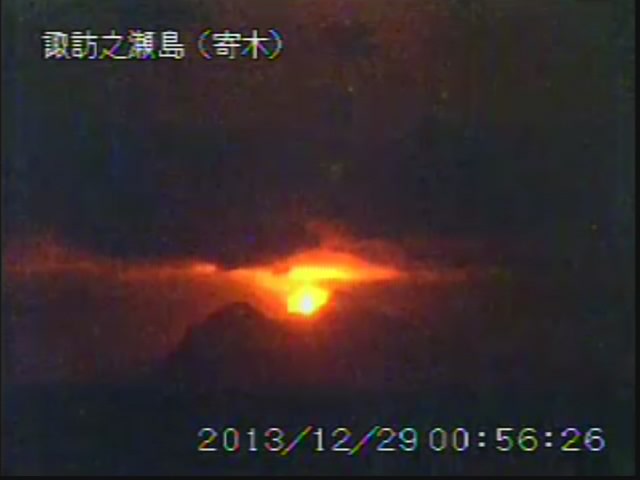
Suwanosejima, a volcano south of Kyuushu, is as brilliantly incandescent as I have ever seen it on the webcams right now (the last two cameras on the list in the box).
During the last year or so I have had reason to study Sweden’s largest environmental disaster, the Nautanen Mining field. The Nautanen mines where active from 1902 until 1909 and in comparison to other Swedish mines the Nautanen field is puny. Still it releases more heavy metals into the surrounding waters than all other Swedish mines, historic and present, put together. It is estimated that if Nautanen is left without any measures taken somewhere in the range of 50 to 100 tons of heavy metals (mainly copper) will be released into the surrounding waters….
Let us go through what was released during [Pinatubo’s] VEI-6 eruption. While reading the numbers keep in mind the Nautanen maximum figure of 100 tons of heavy metals. Pinatubo produced 800 000 tons of zinc, 600 000 tons of copper, 550 000 tons of chromium, 300 000 tons of nickel, 100 000 tons of lead, 10 000 tons of arsenic, 1 000 tons of cadmium and 800 tons of mercury. All of it in the form of ash that was spread not only locally in layers tens of meters thick, it was also dispersed across the globe.
The concentration of heavy metals is so high that it causes birth defects, cancer, neurological disorders, liver and renal failure, heart and lung deceases and the list just goes on and on. It has been estimated that Pinatubo has shortened the lifespan on the island of Luzon by as much as a decade. That equates to 7 000 000 people in mortality if we recount the lost life years into average human life expectancy in the Philippines.
New Zealand’s Tongariro, where parts of The Lord of the Rings movies were filmed, erupted briefly yesterday. ((Some accounts state that this is its first eruption in over a century. That’s not strictly accurate. The particular crater might not have been active since the 19th century, but other vents in the Tongariro complex, which includes the photogenic Ngauruhoe, have erupted as recently as 1977.)) About two inches of ash are said to have fallen three miles from the volcano. There are no reports of damage or injuries. Things are currently quiet, but that can change rapidly.
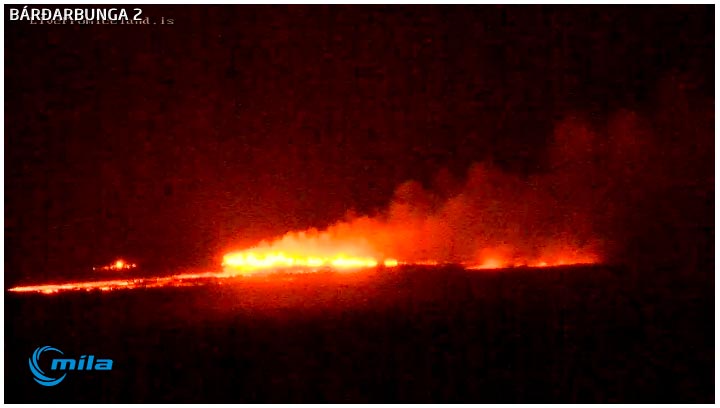
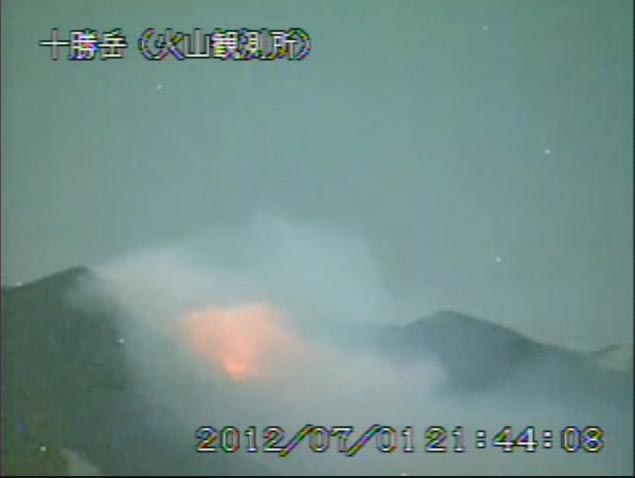
Tokachi has roused itself from its nap. Its eruptions are usually “mild-to-moderate,” and I’d be more concerned with what ElHierro is going to do next, but any erupting volcano presents dangers. There are pictures and videos here, ((Update: as far as I can tell from the Giggle translation, the pictures are from five years ago.)) and a webcam here (the fourth on the list).
At the southwest end of Japan on Kyushu, Sakurajima remains its usual explosive self. If your local authorities forbid fireworks Wednesday because of fire danger, you can always watch the show here and here (fifth from the bottom).
Update: Since I grabbed the screencap of Tokachi, I haven’t seen any incandescence in the webcam, and there might not be anything of significance going on, after all. It’s not mentioned in the Japan Meteorological Agency’s list of warnings. You might want to keep an eye on Popocatéptl, instead.
In case there is anyone reading who has just logged online after spending the past ten years in suspended animation: Venus will be passing in front of the sun, starting any minute now. There’s plenty of information about the transit here, including links to numerous live streams. You can also follow the event on the Astronomy Picture of the Day.
Tomorrow is the 100th anniversary of the Katmai/Novarupta eruption, probably the most violent event on earth in the 20th century. I don’t have time to write about it, but I expect there will be commemorative posts at volcano blogs such as Eruptions. Update: ~5,300 Nimitz-class aircraft carriers per hour.
Update: Open the APOD image in another window to see it at full size, 4096 pixels square.
32 years ago today, Mt. St. Helens exploded. Stupendous though it was, it was scarecely more than a hiccup compared to the Katmai/Novarupta eruption of 1912 in Alaska, which has fascinated me ever since I came across an article on the Valley of Ten Thousand Smokes in a 1918 National Geographic. In anticipation of its centennial next month, the U.S. Geological Survey has published a paper about the eruption and the history of research on it, which can be downloaded here.
A friend forwarded this picture to me. This is the note that accompanied it:
The 120° panoramic image (and its crop) you see above is titled “Daguerreotype View of Cincinnati” and was captured in 1848 by Porter and Fontayne from Newport, Kentucky. It was created with eight full-plate daguerreotypes and shows a two mile stretch of the Cincinatti waterfront. Codex 99 writes,
The panorama is not only the first photograph of the Cincinnati waterfront but the earliest surviving photo of any American city. It is also the earliest image of inland steamboats, of a railroad terminal and of freed slaves. It may very well be one of the most important American photographs ever taken.
Well, I could argue that a proper understanding of punk and its inherent rebellion would have everyone becoming a libertarian or principled conservative …
The last is from a thread about the “Weirdest Band You Love.” It’s hard to pick the strangest of my many musical enthusiasms, but the Sons of Rayon might be the most obscure. The inventors of velco tap dancing (fiddler/guitarist Kelly Werts glued velcro hooks on the soles and heels of his shoes and danced on a patch of tightly-woven carpet, which was miced, creating sound when his feet left the platform), the Bill Monroe-meets-Robert Fripp trio was active in Wichita for several years around 1980. They released one cassette, No Velcro, which was one of the first items I digitized when I hooked up my computer to the stereo. Here is perhaps their loveliest song, written and sung by banjoist Paul Elwood and featuring Intergalactic Yodeling Champion Randy Erwin, “UFOs Over New Zealand.”
[audio:http://tancos.net/audio/UFOs Over New Zealand.mp3]
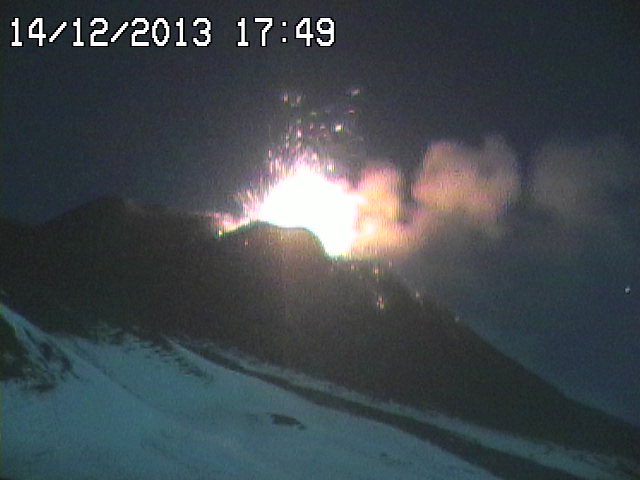
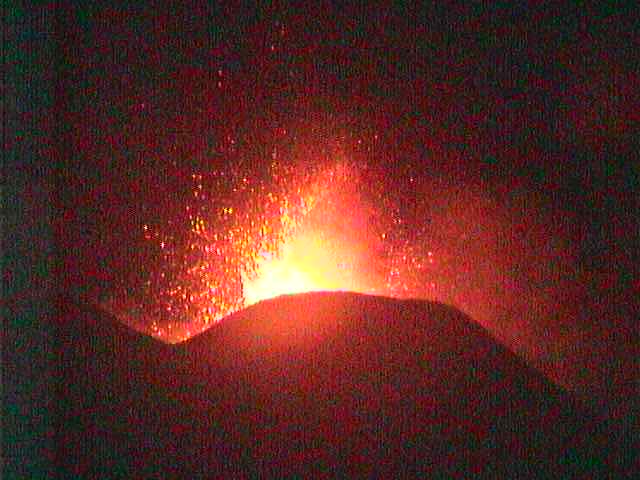
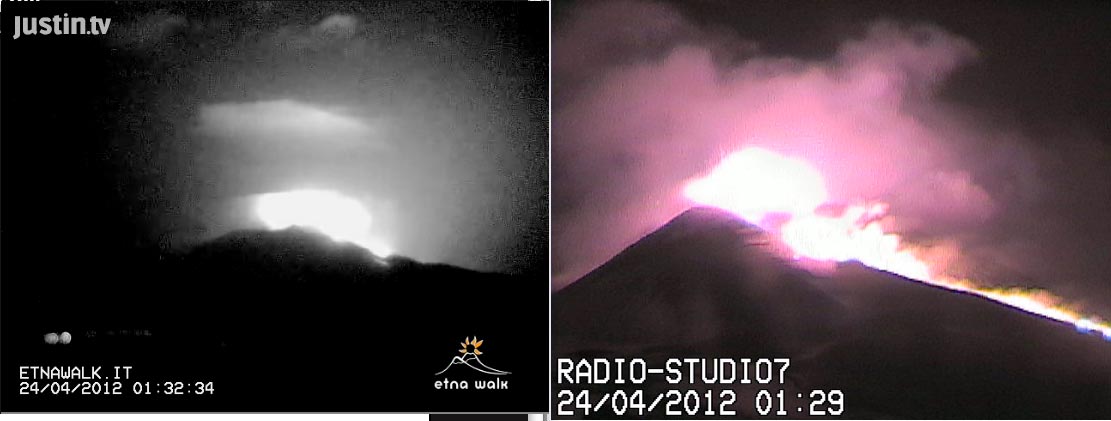
Etna is in the middle of another paroxysm. This one seems to be different from other recent displays: more sustained, but no tall lava fountains yet. There are good views of the show here and here.
My friend Richard has been following anime since the mid-1980s, when he was stationed in Okinawa. This past weekend he brought by a box of a magazines, many 20 years old or older. Most of them are Japanese-only, and I can’t read a word. However, I can look at the pictures, and there are lots of pictures.
82 years ago today, Elm Farm Ollie, also known as Nellie Jay and Sky Queen, became the first cow to fly in an airplane, and also the first cow to be milked in mid-air.
Etna is doing her thing again. You can watch the show though numerous webcams, such as this or those here. You can listen to the explosions here as well as see them when the camera is working and the server isn’t overburdened.
Update: the show is over. You can see pictures here and some videos of the eruption here. If you’re lucky, you’ll also see a cheesy Italian commercial.
Suppose the translators responsible for The New American Bibletook on Shakespeare:
Existence or its opposite? That’s what I am asking myself.
Whether it be more or less dignified to put up with
The barbs and darts of brash Luck, or to use weapons
Against distress’s oceans, to stop them from happening.
There supposedly is a genre of iyashikei, or “healing,” anime, such as Aria or Ikoku Meiro no Croisee. I find most such productions irritatingly bland, rather than soothing or refreshing. ((The only example of the genre I find rewatchable is Someday’s Dreamers, which has a serious story underlying all the niceness.)) If you seek therapeutic anime, the works of Tatsuo Sato are much more effective:
A rewatch of Nadesico helped me get through the first few days of living with a broken arm, and Shingu was good for a flu and high fever.
Update: I just watched the second episode of Mouretsu Pirates. It looks like it’s going to be at least as good as Nadesico. Whether it approaches the level of Shingu remains to be seen.
“You don’t have to rely on a healthy body image or self-respect any more”:
I don’t know if you can “cook a tasty chicken on lava”, but I know you can cook a steak of meat on an Hawaiian lava flow! I did it! You just lay a sheet of aluminium on the lava; you spread some some oil on the steak, possibly with some herbs. Then, you put the steak on the aluminium sheet and let it broil a few tens of seconds on each side. I can assure you it is delicious, all the more with a glass of Californian wine! I’m French; I know what good cooking means!!
Robert Stacy McCain is angling for theambassadorship to Vanuatu. Charles G. Hill mentions a few facts about the islands, but omits why I hope someday to visit them: there are numerous active volcanoes, including Yasur and Ambrym. The former has exhibited constant strombolian and vulcanian activity for hundreds of years, and is considered to be perhaps the most approachable of erupting volcanoes. The latter is one of the very few places on earth where you can find active lava lakes. ((The others are Kilauea in Hawaii, Villarica in Chile, Erta Ale in Ethiopia, Nyiragongo in the Congo and Erebus in Antarctica. To my knowledge, there are no lava lakes in Indonesia, Japan or Kamchatka, despite the intense vulcanism of those regions, or in North America.)) There are many videos on YouTube of the violently churning lake in Marum crater in the Ambrym caldera; they put me in mind of Mt. Doom immediately after Gollum returned the ring to its source.