Fiddling around

Tomorrow is World Fiddle Day, or something like that. Here’s Roger Netherton with some fiddle music.

More of Roger and his friends here and here.

Update: Roger’s in Japan now. Here’s a video of the old-time session last night at the Armadillo Music Bar in Nagoya. After a bit of talking, Roger starts off with three solo pieces such as he would play in a fiddle contest. Then he is joined by several other musicians for the rest of the set.

Mysteries on the Amazon

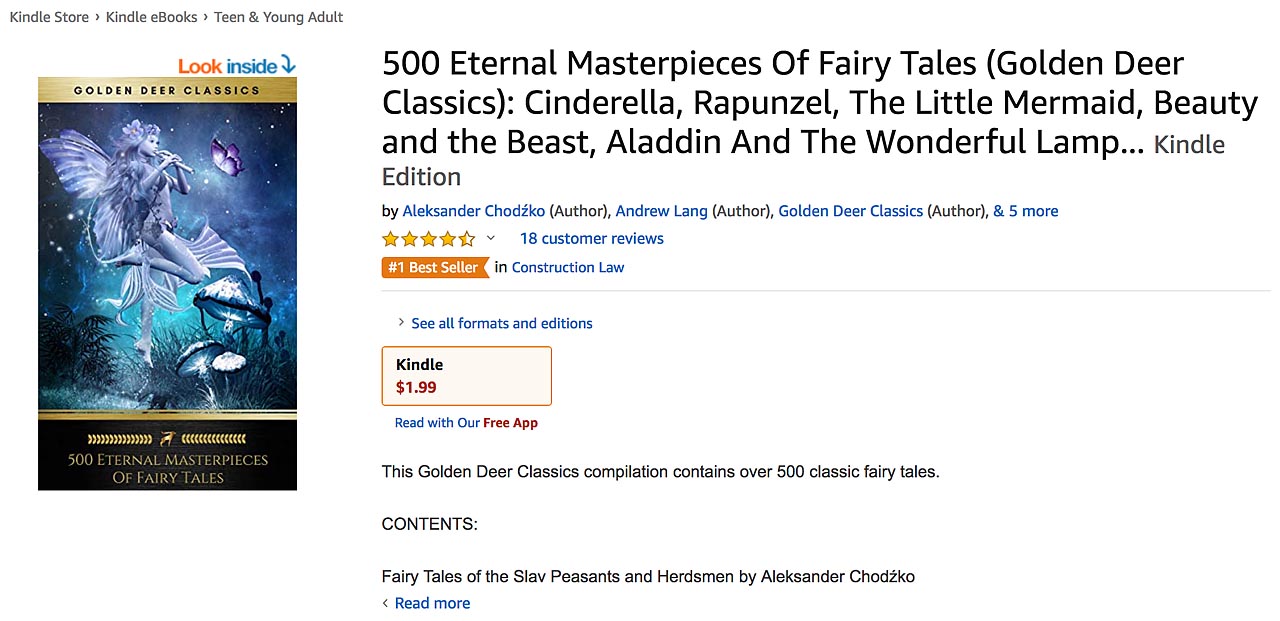
I recently got a Kindle, and I spent part of yesteday evening stocking it with cheap public-domain books. Some of the collections I considered were category “best sellers,” but not the categories I would have expected.

The quality of the electronic editions varies greatly. In general, the large collections are worth the dollar or two they cost, but not always. Some are highly readable and easily navigable, but others are little more than unedited OCR text. Also, omnibus collections often dispense with the original illustrations. The Pre-Raphaelitish plates and drawings that are part of the charm of Andrew Lang’s colorful books are missing from the construction law best seller.

Further details about the Amazon, from a 1929 study1:

Plastic and rust, and Japanese vanilla

Botanica, the botanical garden in Wichita, has installed a number of sculptures in the gardens. Most range from “meh” to kitschy. I rarely bother to include them in my photographs. Currently the people who run the institution are installing a bunch of figures made of Legos in awkward spots through the grounds, such as the pansy above. I hope they’re temporary. They have novelty value and might attract a few additional visitors to the gardens, but there are much more interesting things you can do with Legos.

Unfortunately not temporary are the panels at the south entrance of the not-particularly-Shakespearean garden. They’ve been there as long as I’ve visited Botanica, and they look a little worse every year. (Right-click and open in a new window to see at maximum ugliness.)

Continue reading “Plastic and rust, and Japanese vanilla”

The mechanical engineer of fantastic fiction

… I recall that when Damon Knight asked me back in the ’60s whom I was reading I wrote back and said “J.R. Tolkien, G.K. Chesterton and Mark’s Engineer’s Handbook.”

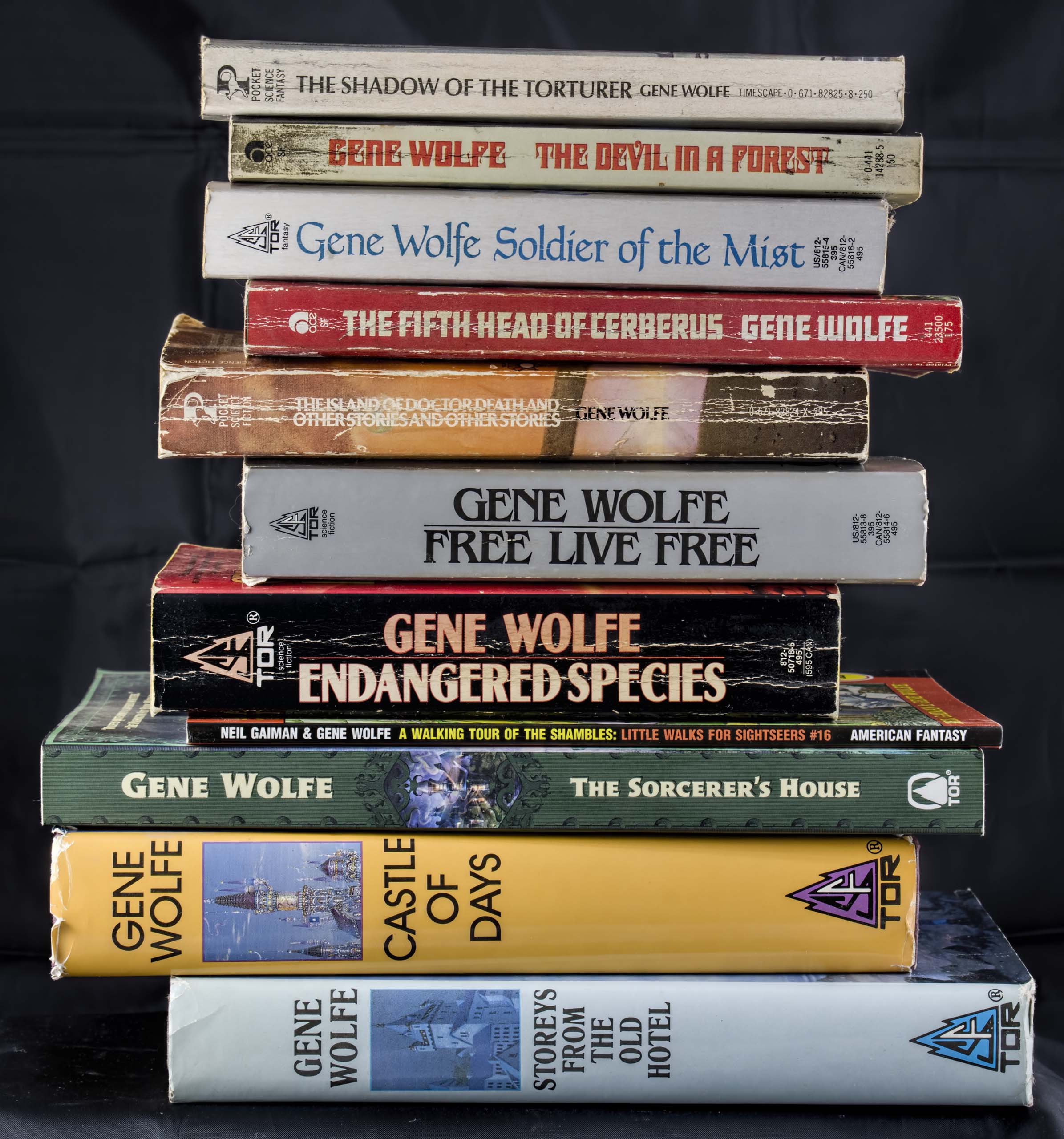
I’ve been meaning to write a short essay on Gene Wolfe, the last great American writer, who died last month. I don’t know when I’ll get it done, though, so here are a some notes and quotes instead.

***

I don’t remember which was the first Wolfe story I read. It might have been “Trip, Trap” in an early Orbit anthology. But the novella “The Fifth Head of Cerberus” made it clear to me that he operated on a level far beyond Asimov or Clarke in skill, imagination and depth. His stories improved with re-reading. His name in the table of contents was sufficient reason to purchase any anthology, and I bought every book of his as soon as it appeared in paperback.

***

From a 1988 interview:

… I’d argue that SF represents literature’s real mainstream. What we now normally consider the mainstream—so called realistic fiction—is a small literary genre, fairly recent in origin, which is likely to be relatively short lived. When I look back at the foundations of literature, I see literary figures who, if they were alive today, would probably be members of the Science Fiction Writers of America. Homer? He would certain belong to the SFWA. So would Dante, Milton, and Shakespeare. That tradition is literature’s mainstream, and it has been what has grown out of that tradition which has been labeled SF or whatever label you want to use.

Continue reading “The mechanical engineer of fantastic fiction”

A few words from Lucy

Miku may finally have competition.

The Yamaha Vocaloids, particularly Hatsune Miku and her colleagues at Crypton, have been the gold standard in synthesized vocals for over a decade. None of the alternatives I’ve looked at combine musicality and intelligibility as well. 2

That may change soon. I just stumbled across the Emvoice One beta and gave it a try. Its capabilities are limited — it doesn’t receive MIDI data yet, all note entry and editing must be done by clicking on a piano-roll, and the one available voice, “Lucy,” is not particularly melodious — but it already sounds more musical and enunciates more clearly than Plogue’s Alter/Ego. Here’s a quick five bars of Lucy with a bit of compression and reverb.

This might be worth keeping track of.

By the way, if you use Alter/Ego, the “NATA” voicebank is now free for the downloading.

Caledonian strangeness

Today is Tartan Day in North America. (In Australia, it’s July 1.) Here’s a medley of melodies that were once Scottish: “The Piper’s Weird,” “Bonnie Thackit Hoosie,” “Marnock’s Strathspey” and “Mackenzie Highlanders.” I don’t have a good set of bagpipes on my computer, so I had to make do with other virtual instruments. That may or may not disappoint you. The first two tunes are from James Scott Skinner’s collection The Harp and Claymore. Skinner uses “weird” here in the sense of “destiny” or “fate,” though the more common meaning may also apply.

Literary linkdump

The worst dictators were often bibliophiles. The young Lenin read Virgil and other Roman authors in the original Latin. He was also a fan of Jack London. Mussolini at one point was the honorary president of the International Mark Twain Society. Hitler “… had a special fondness for the literature of a land he could not subjugate: England. Hitler preferred Shakespeare to Goethe and he was also fond of tales of far-off lands, such as Robinson Crusoe and Gulliver’s Travels.”

Mao Zedong’s bedroom was full of books even as his minions in the Cultural Revolution wrought havoc outside. The Albanian dictator Enver Hoxha enjoyed vampire novels. Fidel Castro loved Ernest Hemingway and reviewed Gabriel García Márquez’s novels before publication. In 2015, the Ayatollah Khameini took to Twitter to praise the works of Mikhail Sholokhov and Alexei Tolstoy, Leo’s less talented, pro-Bolshevik cousin….

What does this mean for our understanding of literature itself? At the very least, the fact that some of history’s worst mass murderers were avid bibliophiles should kill any lingering notion that there is something innately ennobling about the book. Literature is far too ambiguous for that. We take what we want from it and dictators are no different. When Lenin wrote his essay on the religious-vegetarian-pacifist Tolstoy, he focused on the prophet’s “pent-up hatred”. When Mussolini read Dante, he enjoyed the poet’s invective best of all.

It is also striking that all these well-read men preferred mediocrity to masterpieces. Just as their political theories reduced the ambiguities of history to simplistic narratives of good and evil, they were most inspired by crude tales with a moral or political message.

***

Neville Longbottom > Harry Potter.

In related news, Rowling states that Black Clover takes place in the Potterverse.3 (Don’t read the comments; you’ll despair for humanity.)

***

Poe’s poetry was allegedly improved by translation into French. Something similar happens with H.P. Lovecraft. His prose

… is indigestible: so very mannered that sometimes it comes off as a parody. The saving grace comes when Lovecraft’s work is translated into a Romance language. I’ve read Lovecraft in Italian and in Castilian, as with this particular book [El horror de Dunwich], and his prose becomes more elegant and less heavy simply because Romance languages are more parenthetical and better support long-winded periods.

***

Could a great—or even a readable—Latin poet have possibly emerged in eighteenth-century Guatemala?

If your Latin is in good working order, you might want to take a look into the works of the 18th-century Jesuit Father Rafael Landívar. Vulcanologists might find something of interest there.

***

An appreciation of Camille Paglia. Yeah, she’s crazy, but she’s interesting crazy.

***

Josh writes about James Joyce, Thomas Aquinas and Marshall McLuhan.

***

Holy foolishness: Once upon a time, one found Myles Connolly’s Mr. Blue on nearly every reading Catholic’s bookshelf. He wrote the story in 1928, just in time for the Depression. 20 years later he wrote a couple more novels. I might have to track them down, though I expect that some of the writing will make me cringe.4

(Via Amy Welborn.)

Seeing pink, and an administrative note

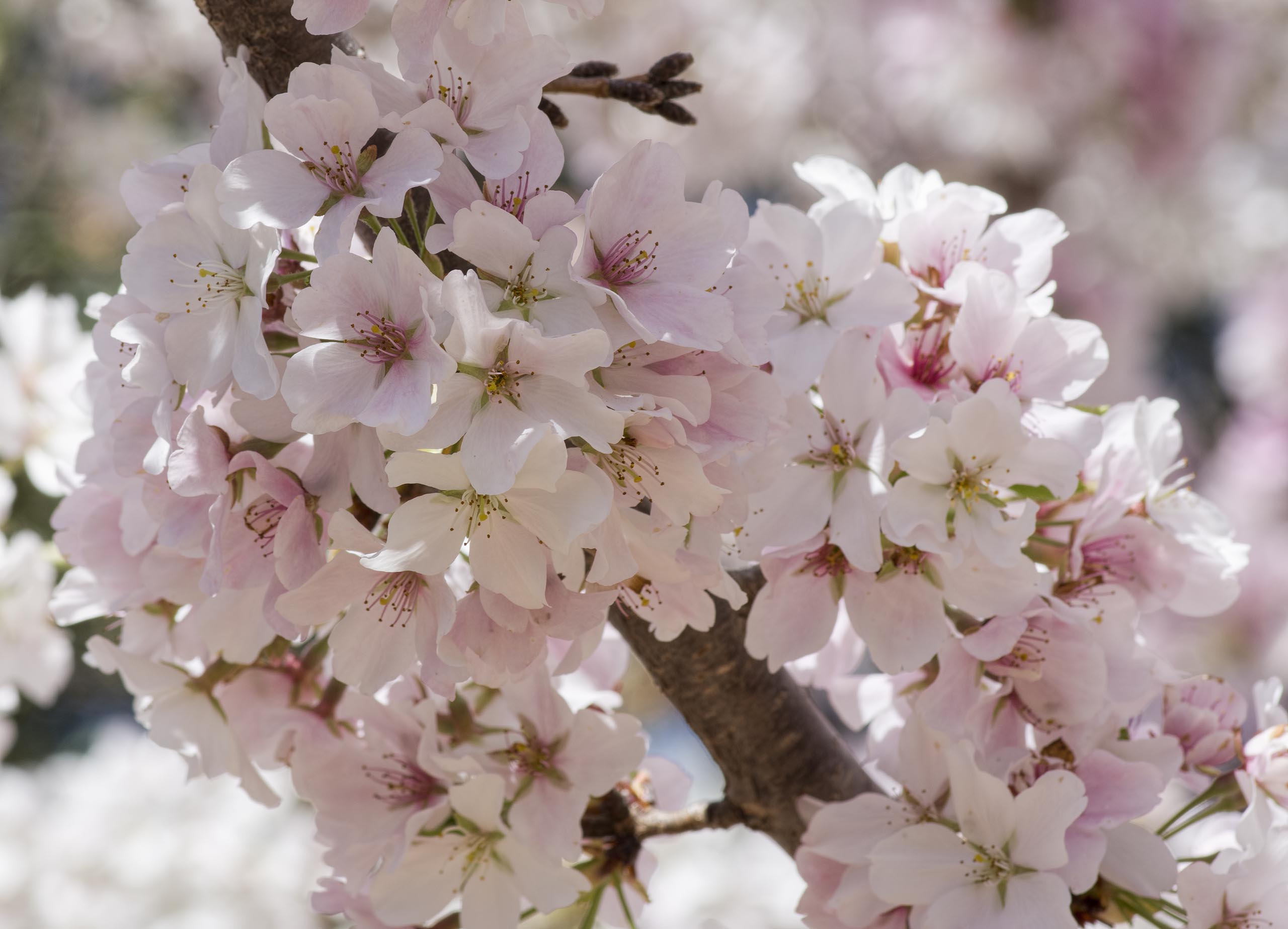
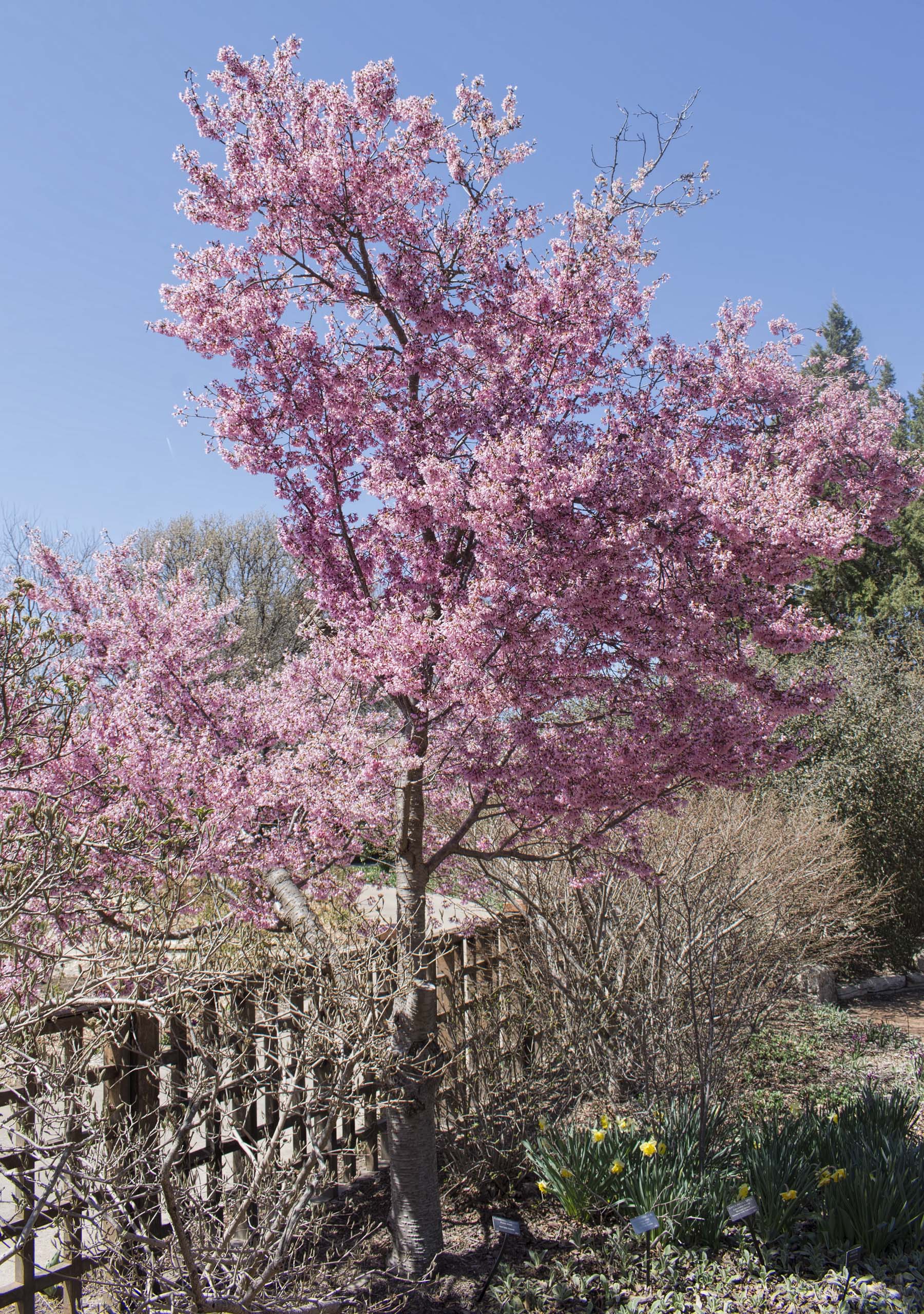
The semi-Japanese Okamé cherry5 was by far the most colorful item at the botanical garden yesterday, along with the usual daffodils. The deciduous magnolias were getting started but were not fully open.

There was a bit more color here and there, but the garden is off to a slow start this year due to the lingering winter.

***

A few years ago, it looked like I would be soon locked out of Flickr, which was where I posted most of my photographs. I was unable to log into my account except on one particular computer, and only with Safari. To log in anywhere else, I would have needed to respond to emails sent to a couple of long-defunct addresses. It made no sense to me, but logic is irrelevant to the yahoos at Yahoo. I therefore started a second weblog just for pictures.

Flicker is now owned by a different, smaller company, and has fixed the login snafu. I can now log in anywhere with any browser. Consequently, I am resuming posting the bulk of my photos at Flickr. I’ll leave the photo weblog up in case things at Flickr get screwy again, but to see more from yesterday’s trip, go here.

Continue reading “Seeing pink, and an administrative note”

Heroic links

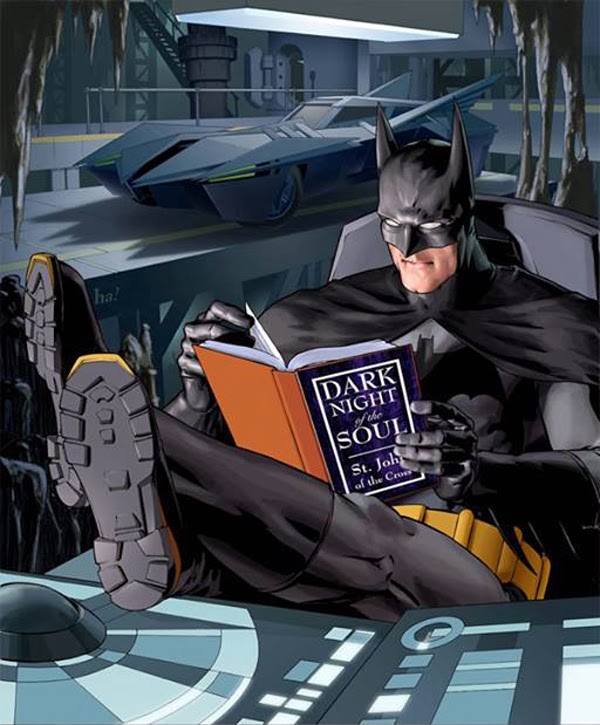
The Greeks have Achilles and Odysseus; the Romans have Aeneas; the French have Roland; the Spanish have the Cid; the British have King Arthur. And, Americans have Batman.

(Illustration from here.)

And the Japanese have Utena Tenjou. Josh lists some possible interpretations of Revolutionary Girl Utena. (Caution: spoilers.)

e)Financial interpretation

Male uniforms have a tendency to suggestively come undone for no reason at all, a tendency which increases as the show progresses. This indicates that Ohtori Academy has contracted the production of these uniforms to a low quality manufacturer. Furthermore, the academy seems to be perpetually understaffed, as we rarely see any faculty, and indeed almost never see them actually teaching. All this suggests severe budget cuts. Meanwhile, the Chairman’s quarters has a projector which can physically manifest objects, while the Student Council is given an entire tower with a picturesque view. All this is obviously an indictment of how many educational institutions allocate funding in an inefficient manner, resulting in greater financial burdens on students and a lower quality of education.

Sprung

Winter hung on like the respiratory crud that was going around earlier this year, but it looks like it’s finally gone. It won’t officially be spring until the first tornado watch, but I did find a little color on my visit to the botanical garden this past weekend. There are more pictures here, plus orchids here.

There’s a springtime jigsaw puzzle below the fold.

Continue reading “Sprung”