A bit of high culture, courtesy of the Muppets.
Author: Don
Porkypalooza II
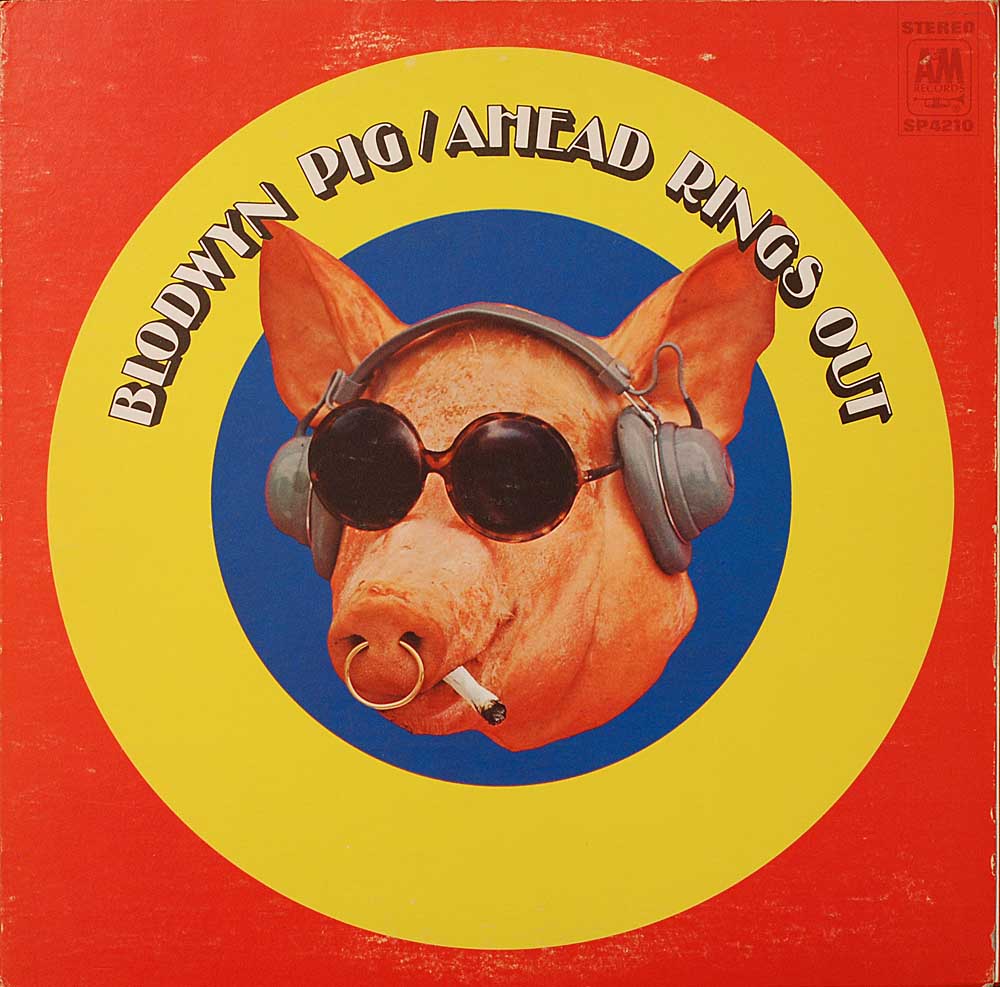
A couple of old favorites by Blodwyn Pig, the band guitarist Mick Abrahams formed after his departure from Jethro Tull. Jack Lancaster plays saxes, plural and often simultaneously. The bass and drums are by Andy Pyle and Ron Berg.
Katachi, Makoto, Kotowari

Crunchyroll is now streaming Kenji Nakamura‘s Mononoke, one of the very best shows ever broadcast, and in higher quality than either the old fansub or the recent DVD release. If you are interested at all in animation as art, I can’t recommend it highly enough.
Now when do we see Dennou Coil?
A Dissertation upon Roast Pig
By Charles Lamb
Editor’s note: An old essay, but timely once again.
MANKIND, says a Chinese manuscript, which my friend M. was obliging enough to read and explain to me, for the first seventy thousand ages ate their meat raw, clawing or biting it from the living animal, just as they do in Abyssinia to this day. This period is not obscurely hinted at by their great Confucius in the second chapter of his Mundane Mutations, where he designates a kind of golden age by the term Cho-fang, literally the Cooks’ holiday. The manuscript goes on to say, that the art of roasting, or rather broiling (which I take to be the elder brother) was accidentally discovered in the manner following. The swine-herd, Ho-ti, having gone out into the woods one morning, as his manner was, to collect mast for his hogs, left his cottage in the care of his eldest son Bo-bo, a great lubberly boy, who being fond of playing with fire, as younkers of his age commonly are, let some sparks escape into a bundle of straw, which kindling quickly, spread the conflagration over every part of their poor mansion, till it was reduced to ashes. Together with the cottage (a sorry antediluvian make-shift of a building, you may think it), what was of much more importance, a fine litter of new-farrowed pigs, no less than nine in number, perished. China pigs have been esteemed a luxury all over the east from the remotest periods that we read of. Bo-bo was in the utmost consternation, as you may think, not so much for the sake of the tenement, which his father and he could easily build up again with a few dry branches, and the labour of an hour or two, at any time, as for the loss of the pigs. While he was thinking what he should say to his father, and wringing his hands over the smoking remnants of one of those untimely sufferers, an odour assailed his nostrils, unlike any scent which he had before experienced. What could it proceed from ? — not from the burnt cottage — he had smelt that smell before — indeed this was by no means the first accident of the kind which had occurred through the negligence of this unlucky young fire-brand. Much less did it resemble that of any known herb, weed, or flower. A premonitory moistening at the same time overflowed his nether lip. He knew not what to think. He next stooped down to feel the pig, if there were any signs of life in it. He burnt his fingers, and to cool them he applied them in his booby fashion to his mouth. Some of the crums of the scorched skin had come away with his fingers, and for the first time in his life (in the world’s life indeed, for before him no man had known it) he tasted — crackling! Again he felt and fumbled at the pig. It did not burn him so much now, still he licked his fingers from a sort of habit. The truth at length broke into his slow understanding, that it was the pig that smelt so, and the pig that tasted so delicious; and, surrendering himself up to the new-born pleasure, he fell to tearing up whole handfuls of the scorched skin with the flesh next it, and was cramming it down his throat in his beastly fashion, when his sire entered amid the smoking rafters, armed with retributory cudgel, and finding how affairs stood, began to rain blows upon the young rogue’s shoulders, as thick as hail-stones, which Bo-bo heeded not any more than if they had been flies. The tickling pleasure, which he experienced in his lower regions, had rendered him quite callous to any inconveniences he might feel in those remote quarters. His father might lay on but he could not beat him from his pig, till he had fairly made an end of it, when, becoming a little more sensible of his situation, something like the following dialogue ensued.
“You graceless whelp, what have you got there devouring? Is it not enough that you have burnt me down three houses with your dog’s tricks, and be hanged to you, but you must be eating fire, and I know not what — what have you got there, I say ?”
“O father, the pig, the pig, do come and taste how nice the burnt pig eats.”
The ears of Ho-ti tingled with horror. He cursed his son, and he cursed himself that ever he should beget a son that should eat burnt pig.
Bo-bo, whose scent was wonderfully sharpened since morning, soon raked out another pig, and fairly rending it asunder, thrust the lesser half by main force into the fists of Ho-ti, still shouting out “Eat, eat, eat the burnt pig, father, only taste — O Lord,” — with such-like barbarous ejaculations, cramming all the while as if he would choke.
Ho-ti trembled every joint while he grasped the abominable thing, wavering whether he should not put his son to death for an unnatural young monster, when the crackling scorching his fingers, as it had done his son’s, and applying the same remedy to them, he in his turn tasted some of its flavour, which, make what sour mouths he would for a pretence, proved not altogether displeasing to him. In conclusion (for the manuscript here is a little tedious) both father and son fairly sat down to the mess, and never left off till they had despatched all that remained of the litter.
Grrr

Gee, thank you so much. Is the anime industry deliberately trying to force me to torrent everything again?
Another fun little quiz
Wednesday morning quotes
A couple of notes from the February First Things:
Mark Bauerlein, “Grammar Rules”
When we consider the vast transformations of politics, culture, science, technology, and daily life since 1600, it is astonishing that we can read Shakespeare’s sonnets and the King James Bible so easily. Relatively little vocabulary has changed, and grammar and syntax not much at all — a sign that language bears elements that resist historical and cultural variations.
John O’Callaghan, via R.R. Reno: The nine bourbons every professor should have, and where to hide them.
9) Early Times. Because, as Walker Percy once wrote, “the noxious particles and the sadness of the old dying Western world and him thinking: ‘Jesus, is this it? Lisening to Cronkite and the grass growing?'” Stash behind Love in the Ruins.
8) Evan Williams. Because it’ll do. Payday isn’t until Friday. Stash behind Lost Weekend.
7) Wild Turkey (101, not 81). Because essential reading requires essential drinking. Stash behind Elmore Leonard’s Three Ten to Yuma and Other Stories.
6) Maker’s Mark. Because sometimes it seems the world isn’t quite as awful as it appears to be. Stash behind Augustine’s Confessions.
5) John B. Stetson. Because sometimes the world is as awful as it seems to be. John B. will help you make it through the night. Stash behind Paradise Lost.
4) Woodford Reserve. Because sometimes class went well. Stash behind Deus Caritas Est.
3) Bulleit. Because if you’re good, it may give up the ghost for you. It did for me. Stash behind Hamlet.
2) Basil Hayden. Because it’s the Catholic Bourbon. Stash behind Wise Blood.
1) Blanton’s. Because Pappy Van Winkle is for rich people and other criminals. Blanton’s is 1/4 the price and is what Christ serves to the saints while they smoke their cigars on the veranda of His Father’s mansion. Stash behind Summa Theologiae.
And from Ricochet:
[Paul Dirac’s] father was as strict a disciplinarian at home as in the schoolroom, and spoke only French to his children, requiring them to answer in that language and abruptly correcting them if they committed any faute de français. Flo spoke to the children only in English, and since the Diracs rarely received visitors at home, before going to school Paul got the idea that men and women spoke different languages.
100,000 drawings

I recently got a blu-ray drive for my computer. For the first movie to watch at 1080p, I picked Redline. It was a good choice. Although there are plenty of digital effects employed in the 2009 movie, all the characters, all the cars — everything — are hand-drawn, and it shows. The last half-hour is the most spectacular anime I’ve seen since the end of Akira, and the whole movie is gorgeous. The screencaps here are all from the first twelve minutes.
Redline opens and closes with wild road races. In between, there is a romance, interference from the mafia, and a repressive government up to No Good, but the story doesn’t get in the way. The movie is pure eye candy.
Pop quiz



One, and only one, of the characters above from the Heroic Botch of Arslan is a girl. Can you tell which one?
[poll id=”3″]
Update: The answer is below the fold.
Wring that dishrag
Here’s a song for Steven, sung by John McCutcheon.
Coming soon to a sky near you

Fireworks for the new year
Courtesy of Sakurajima.
Look back in boredom
I can’t make a top ten list of anime for 2014 because I didn’t watch ten series all the way through. Here’s a quick look at what I finished.
The best
Pupipo. It’s unlikely ever to be licensed, so you’ll have to track it down through irregular channels. It’s worth an hour of your life.
Pretty good
Hozuki no Reitetsu. Life in Japanese hell. The most successful comedy of the year. To fully appreciate the eighth episode, watch a Kyary Pamyu Pamyu video first. (You don’t have to watch the video all the way through. One minute will be plenty.)
Kill la Kill, part two. Over the top and beyond. ((I’d like to see a sequel to this — not more bizarre action with the fate of the world at stake, but rather an account of how Satsuki adapts to ordinary life and ordinary clothes. It will be a much greater challenge for her than anything she faced in the show.))
The rest
Amagi Brilliant Park. It’s the first Kyoto Animation series I’ve watched beginning to end since the first season of Suzumiya Haruhi, which is something. Still, I was too irritated with the principals to enjoy the humor.
Madan no Ou to Vanadis. The greatest disappointment of the year. Tatsuo Sato is more comfortable with spaceships than with swords and magic. Tigre is too much a straight arrow, and the war maidens are often too silly to take seriously. The show felt rushed. It needs at least 26 more episodes, but I’d rather Sato start a new project that suits his vision better than waste more time in Brune.
Ore Twintails ni Narimasu. The fourth episode is great. After that, it goes downhill fast. There are way too many double-entendres throughout, and the premise is just a bit squicky.
Sabagebu. Sometimes funny, sometimes tasteless. Still, it’s a good antidote for the Stella C3 catastrophe.
Sekai Seifuku —Bouryaku no Zvezda—. Sometimes funny, sometimes merely weird.
Witch Craft Works. I know I watched this, but I can barely remember it.
And a couple of other things
Girls und Panzer: Kore ga Hontou no Anzio-sen Desu! OVA. A particularly enjoyable affair with Miho’s girls and their tanks.
Mouretsu Pirates: Abyss of Hyperspace. Excellent, as far as I can judge from the raw, but I’ll have to withhold final judgement until it’s subtitled.
Zooming along
Back in the 1980s, it took immense amounts of computer time to generate fractal images. If you wanted to see pretty pictures of recursively-generated figures, you borrowed books such as The Beauty of Fractals, or watched Nothing But Zooms if you knew someone with the video. Computers and software have come a long way since then, and nowadays you can easily create your own fractal images on your laptop. I experimented with a couple of applications for Macs this weekend, Xaos and UltraFractal.
Xaos is freeware, and it comes in Windows and Linux versions as well. It’s fairly easy to use, though you might want to bookmark the online documentation. It’s what I used to make the video above. It doesn’t actually make movies. Instead, it outputs a series of .png files, which you can import into Final Cut or something similar. (Be aware that at 30 frames per second, there are 1800 images per minute. You’re going to be working with a lot of files.)
Ultra Fractal has some Photoshop-style image manipulation features. It’s more complicated than Xaos but not really difficult to figure out. However, it’s a bit pricey; if you want to do animations, it will cost you $130. I think I’ll make do with Xaos for now.

The pirates return

I got impatient and downloaded a raw of Mouretsu Pirates: Abyss of Hyperspace. It looks beautiful, and the story moves briskly along. What that story is, though, I only vaguely understand. Will someone please license this for North America, or, failing that, fansub it?
There are a few screencaps below the fold. Steven has a bunch more here, though my favorite image from the movie is here.
A little Maiden in the morning
There’s a lot of bluegrass metal around these days. Perhaps that’s not so strange; bluegrass has been called “acoustic shred,” and sometimes that definition fits. Here are a couple of examples, the one above from Finland and the other possibly from somewhere ‘way down south.
Grand Pas de Don’t
And now for a bit of culture. You’ve heard of The Red Shoes? Here’s the red pocketbook. There’s a cow, too.
Louder than Lang Lang
Before there were sequencers, there were player pianos. The American Fotoplayer also incorporated a forerunner of the drum machine.
There are many more examples here.
(Via the Borderline Boy.)
Ayn Rand at the movies
“101 Dalmatians”
A wealthy woman attempts to do her impoverished school friend Anita a favor by purchasing some of her many dogs and putting them to sensible use. Her generosity is repulsed at every turn, and Anita foolishly and irresponsibly begins acquiring even more animals, none of which are used to make a practical winter coat. Altruism is pointless. So are dogs. A cat is a far more sensible pet. A cat is objectively valuable. —No stars.
“Mary Poppins”
A woman takes a job with a wealthy family without asking for money in exchange for her services. An absurd premise. Later, her employer leaves a lucrative career in banking in order to play a children’s game. —No stars.
There’s more here.