
Insulting the right people signals compassion, and modern people buy it because hating the nasty backward traditional oppressor is what unites modern people. Despising the right people means love.
The microwave of doom

The dangers of dihydrogen monoxide are well-known, but there are other hazards that you might have been unknowingly exposed to. For instance, studies have demonstrated that over 93% of all cancer patients have at some time inhaled O2, a powerful oxidizer. More than 87% of people with bipolar personality have looked at a full moon without adequate eye protection. Anecdotal evidence suggests that individuals exhibiting egregious political activism ingested acetylsalicylic acid during childhood. It has been hypothesized that the majority of people who during early adulthood order a steak rather than a salad will not live to see their 100th year.
Now, if you’ll excuse me, I have important culinary matters to attend to.
Ballet, electronica, cats and the Swedish chef
Dance and animation.
The Nyan Cat Variations. (Via Fillyjonk.)
Continue reading “Ballet, electronica, cats and the Swedish chef”
Hmphmhmphwmhphm
Let no screencap go to waste: miscellaneous illustrations for posts I didn’t write.
What comes next …
… once polkas become passé?
Barbershop, of course.
Murder and meh-hem
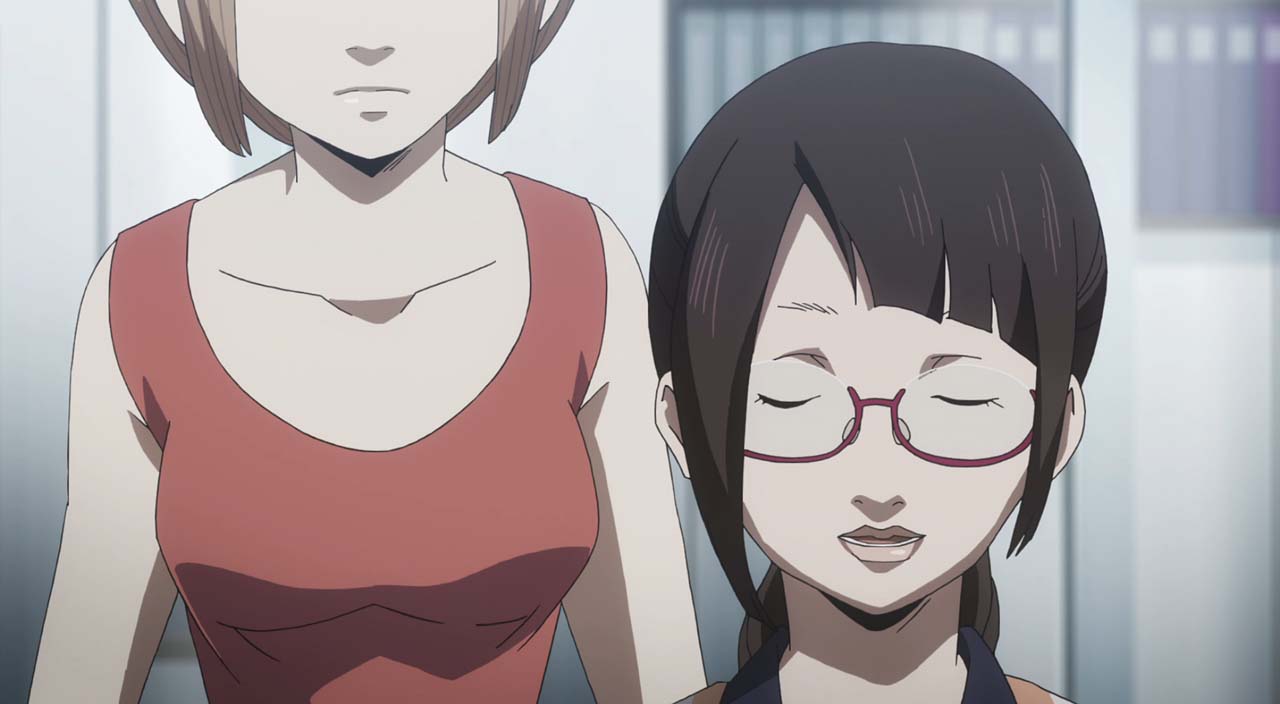
The Perfect Insider has very good opening and closing animations. The stuff in between, which falls somewhere between a locked-room mystery and And Then There Were None and concerns people tediously self-conscious of their high IQs, is less enthralling. I did spot a pair of red half-rim spectacles, though. If there were any rubber ducks, I missed them.
Speaking of ATTWN, here’s Eve Tushnet on Agatha Christie: “Never trust the cute ones.”
Wilder than Wilma

Notes from the Psychiatric Center for Research on Regressive Tendencies
Various odds and ends:
Fillyjonk linked to an old but not outdated story by Ray Bradbury, “The Murderer.” I found a couple of other favorites, “The Veldt” and “The Pedestrian.”
*****
Perhaps not entirely unrelated to the Bradbury stories:
Having time each day merely to amuse oneself, or just to sit and think, greatly improves one’s life. Yet we’re practically taught to avoid such periods – to stay as busy as possible virtually all the time. The emphasis on work, on “multitasking” (which, as a former expert in the architecture of multitasking operating systems for embedded devices, I can assure you is always an illusion) and on achieving ever more per unit time is using us up in ways we don’t always perceive and even less often appreciate. You’d almost suspect that time spent in introspection had been deemed an offense against the social norms.
(Via Dustbury.)
*****
While Sakurajima is ominously quiet, in the South Indian Ocean Piton de la Fournaise is putting on a modest, colorful show.
Continue reading “Notes from the Psychiatric Center for Research on Regressive Tendencies”
Annual task

It’s time to look for next year’s calendars. I found a number at YesAsia that might be of interest to visitors here:
Studio Chizu (i.e., Mamoru Hosoda)
Japanese dream
Roger, who is spending the current semester in Japan, recorded a theme from Someday’s Dreamers, playing both the piano and fiddle parts. Unfortunately, I don’t know how to embed Facebook videos on my site, but you can listen here.
Update: It’s on YouTube now.
Update II: Roger with some of his Japanese friends playing a different sort of music:
Animation you can eat
Some stop-motion dessert for you.
Susan and friends
Occasionally an obscure tune that caught my ear back in ancient times pops into my mind. Last night it was “Susan,” by The Mauroks from 1969. I guessed right on the spelling of their name and found it quickly on YouTube. It’s no classic, but it has a nice garage/psychedelic sound and a good groove.
Other curiosities I’ve unearthed include The Damnation of Adam Blessing and very early Nils Lofgren. There are more here.
Afternoon glory

It was well after noon by my watch (though still morning according to the sun) when I spotted these today. Four o’clocks are also staying open into the afternoon hours. They still don’t open at 4:00, though.

Decline and fall, with peaches
On October 10, 1969, forty-six years ago today, three noteworthy albums were released simultaneously: Frank Zappa’s Hot Rats, King Crimson’s In the Court of the Crimson King, and the Kinks’ Arthur. To celebrate, here’s a tune from each, though not necessarily the version on the record.
This is the tune that persuaded me that Zappa was more than just a clever novelty act with a dirty mind.
Court indulged in science-fiction and fantasy, with lyrics so profoundly meaningful they’re silly. The music was pretty good, though.
While King Crimson did F&SF, the Kinks took their inspiration from recent British history and culture in lyrics blending nostalgia and cynicism. Musically, the Kinks were the least interesting of the three acts, but Ray Davies at his best was a formidable satirist.
Beyond healing
There’s “iyashikei,” or “healing” anime, “… created with the specific purpose of having a healing or soothing effect on the audience. Works of this kind often involve alternative realities with little to no conflict, emphasizing nature and the little delights in life.” In general I find these shows annoyingly bland. The few such that I like, I enjoy in spite of, not because of, their soothing nature.
On the other hand, there is what I think of as “convalescent” anime, shows to marathon when you’re starting to recover from an illness. Something invigorating with a good story and likable characters is what I want then, and the better efforts of Tatsuo Sato are perfect. Mouretsu Pirates has served me well in the past. A few days ago I watched Shingu yet again. It works every time.
I grabbed a few more screencaps along the way.
Oops

While watching Princess Tutu (recommended) last night, I noticed something didn’t look quite right.
Yep

(Via the Bayou Renaissance Man.)
I wonder …
For the past week, ever since Campi Flegrei was awarded third place in the New Decade Volcano Program, I’ve wondered which volcanoes could possibly present a greater threat. Nothing that comes to mind meets the criteria. The Auckland volcanic field lies directly under the New Zealand city and could erupt at any time, but the magma involved is basaltic and not explosive; other north island volcanoes probably present a greater danger to the inhabitants than the one directly below them. There are plenty of dangerous mountains in Iceland, but the the total population is less than that of Wichita. Kamchatka is also sparsely populated. Islands in the South Pacific are generally too small to support millions of residents. And so on.
While reading the most recent post at Volcano Café, on how vulcanism affected the waters of Lake Tanganyika, it occurred to me that maybe I’m thinking too literally. Perhaps I should look for placid lakes, not fiery mountains. Lake Kivu, for instance.
In 1984, Lake Monoun in Cameroon experienced a “limnic eruption,” releasing an asphyxiating cloud of carbon dioxide that killed 37 people. Two years later at Lake Nyos, also in Cameroon, a similar event suffocated 1,700 more. Both lakes are “meromictic,” in which the water remains stratified throughout the year.
Lake Kivu is another meromictic lake, and its depths are saturated with carbon dioxide. It’s also 2,000 times larger than Lake Nyos, and there are over two million people along its shores. Nearby is Mount Nyiragongo, noted for its lava lake and its very fluid lava that could readily travel to the lake and trigger a limnic eruption. There is evidence that these eruptions occur there regularly. From Wikipedia:
Sample sediments from the lake were taken by professor Robert Hecky from the University of Michigan, which showed that an event caused living creatures in the lake to go extinct approximately every thousand years, and caused nearby vegetation to be swept back into the lake.
So, I am going to guess that the Lake Kivu/Nyiragongo complex is one of the two remaining NDVP volcanoes. We’ll find out if I’m right in one or three weeks if the café maintains its schedule.
Dr. Huey’s last hurrah

I’ve been experimenting with the trial version of Zerene Stacker. The picture above of Dr. Huey, the most common rose in cultivation, ((Dr. Huey is frequently used as a rootstock for garden roses. Often suckers from the vigorous rootstock overwhelm the grafted variety and take over, producing a tremendous display of red in late spring. Dr. Huey rarely reblooms, though. This is the only year I’ve seen it in flower during later months.)) was assembled from 63 slices, each at f/5.6. Z Stacker works pretty well, but the final image tends to be grainy, and there are often some thread-like artifacts. I cleaned most of them up, but you can find a couple near the right edge of the picture in the full-sized version. (Click to embiggen.)
First class, second class
About a hundred thousand years ago, I saw several episodes of the International Festival of Animation on teevee, with Jean Marsh as host. Some of the short films were wonderful; others were tedious. As the show progressed, the proportion of the latter increased, and I eventually lost patience. My favorite was a piece called “Second Class Passenger,” an account of an uneventful train ride in Europe. Once I discovered YouTube, I’d search periodically to see if someone had uploaded it. I finally found it this afternoon.
“Traveller Second Class” was released in 1973 by Borivoj Dovnikovic, or “Bordo,” of the Zagreb school of animation. There’s quite a bit of Zagreb animation at YouTube, including more of Dovnikovic. It’s sometimes good — the character designs and slapstick often remind me of Jay Ward productions — but too often the fun is compromised by an excess of message. The train ride is the only example I can unreservedly recommend.