If you can’t make it to Japan for this year’s cherry blossom viewing, you can stop by the botanical garden in Wichita, where the Okame cherry1 is just coming into bloom.
There are more pictures here.
Trivia that matter

It gets worse:

Orchids may get most of the attention here nowadays, but I sill grow plenty of cacti and other succulents.

The hooked central spines of Mammillaria pennispinosa are as sharp as they look.

Pleiospilos nelii, above, and Hoodia gordonii are coming along nicely.


Token orchid: the little octopus, Prosthechea cochleata, is blooming again.
There are more pictures here.
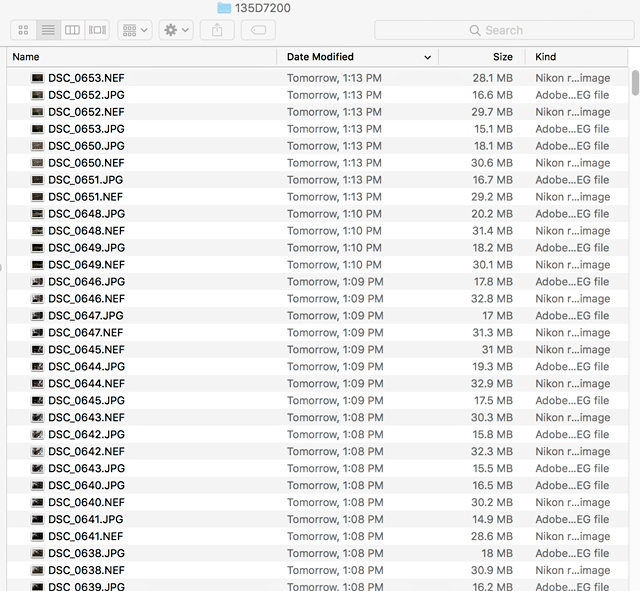
Above is a list of some of the files in my camera this afternoon. Evidently it is unstuck in time. Some of the pictures that I took tomorrow at the botanical garden are below the fold.

This is the first game I ever played with Professor Anderssen, the greatest German player, and at that time in the zenith of his fame. For a novice to offer so brilliant an expert the Muzio was like Ivanhoe challenging Bois-Gilbert in the lists at Ashby, but we were nothing if not daring in those days, and the cautious modern safety-loving youth of today had not yet been evolved.
Don’t use the past tense of “to do” online, or Google will delete you.
(Via Pixy.)
***
Expert is not the English word of the same spelling and pronunciation, and which means “one who has skill, experience, or extensive knowledge in his calling or in any special branch of learning.” This old word still exists and is in use in areas in which deplorables are to be found.
But this old useful word is just not the same as the modern expert. This modern word, which can only be distinguished in context from the old, means “a flack who repeats the consensus, and who causes the consensus.”
***
“Reactionary” may be an unsatisfactory term, but…
… I suppose bearing with things that you’re stuck with because they’ve been codified by long use is more or less a principle of being a reactionary. So it all works out!
Via Francis W. Porretto:
MINAS TIRITH (AP): The League Against Cultural Appropriation has filed suit against both the Texas Rangers of Major League Baseball and the New York Rangers of the National Hockey League for appropriating the cognomen of the Dunedain of northeastern Eriador, which is often called Arnor by the irredentist movement. The AP’s representative in the palace press pool sought the opinion of King Elessar Telcontar, who wore that moniker as “Strider the Ranger” before his ascension to the throne, but so far his press secretary has declined to comment. (Queen Arwen Evenstar’s publicist told our stringer to “Come back when you can ask in proper Sindarin Elvish.”) More on this story as it develops.
Via Glenn Reynolds:
Before this decade is out, some smart Democrat is going to realize that if they would have treated Trump like an ordinary President, he would have behaved like an ordinary President, that they have only themselves to blame for making him extraordinary. And if we’re very lucky, the rest of the Democrats will ignore and ostracize this insightful Democrat, and remain stuck on stupid for another 30 years.
It’s February 2 today, when the students at the University of Dallas traditionally drink beer in the chilly drizzle at Forker Field (do they still do that?), and when bloggers post favorite poems if they remember to. So, here’s “Macavity, the Mystery Cat,” which I recited to my bored and fidgety classmates at grade school #4.
Macavity’s a Mystery Cat: he’s called the Hidden Paw—
For he’s the master criminal who can defy the Law.
He’s the bafflement of Scotland Yard, the Flying Squad’s despair:
For when they reach the scene of crime—Macavity’s not there!Macavity, Macavity, there’s no one like Macavity,
He’s broken every human law, he breaks the law of gravity.
His powers of levitation would make a fakir stare,
And when you reach the scene of crime—Macavity’s not there!
You may seek him in the basement, you may look up in the air—
But I tell you once and once again, Macavity’s not there!Macavity’s a ginger cat, he’s very tall and thin;
You would know him if you saw him, for his eyes are sunken in.
His brow is deeply lined with thought, his head is highly domed;
His coat is dusty from neglect, his whiskers are uncombed.
He sways his head from side to side, with movements like a snake;
And when you think he’s half asleep, he’s always wide awake.Macavity, Macavity, there’s no one like Macavity,
For he’s a fiend in feline shape, a monster of depravity.
You may meet him in a by-street, you may see him in the square—
But when a crime’s discovered, then Macavity’s not there!He’s outwardly respectable. (They say he cheats at cards.)
And his footprints are not found in any file of Scotland Yard’s.
And when the larder’s looted, or the jewel-case is rifled,
Or when the milk is missing, or another Peke’s been stifled,
Or the greenhouse glass is broken, and the trellis past repair—
Ay, there’s the wonder of the thing! Macavity’s not there!And when the Foreign Office find a Treaty’s gone astray,
Or the Admiralty lose some plans and drawings by the way,
There may be a scrap of paper in the hall or on the stair—
But it’s useless to investigate—Macavity’s not there!
And when the loss has been disclosed, the Secret Service say:
‘It must have been Macavity!’—but he’s a mile away.
You’ll be sure to find him resting, or a-licking of his thumbs,
Or engaged in doing complicated long division sums.Macavity, Macavity, there’s no one like Macavity,
There never was a Cat of such deceitfulness and suavity.
He always has an alibi, and one or two to spare:
At whatever time the deed took place—MACAVITY WASN’T THERE!
And they say that all the Cats whose wicked deeds are widely known
(I might mention Mungojerrie, I might mention Griddlebone)
Are nothing more than agents for the Cat who all the time
Just controls their operations: the Napoleon of Crime!
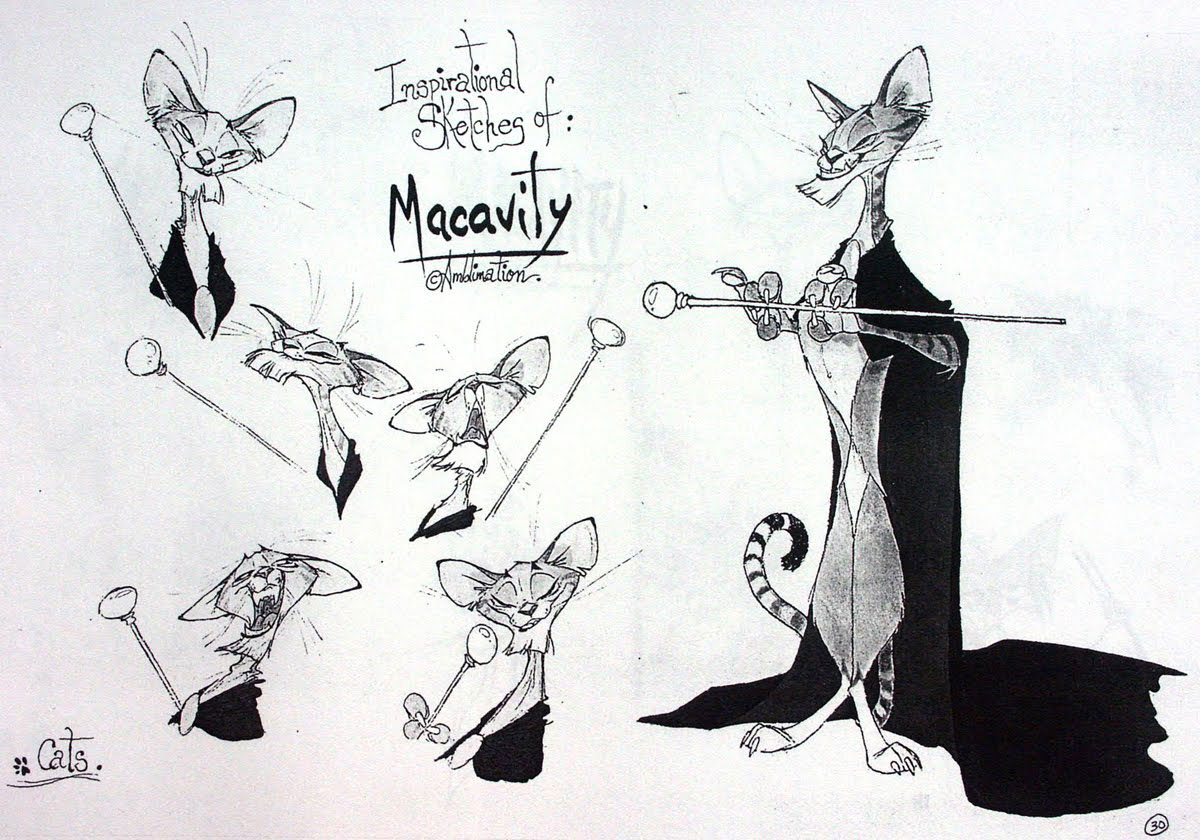
In a comment on a recent post, Fillyjonk mentioned that there were plans to give Cats a traditionally-animated movie version, with Steven Spielberg at the helm. While I would have preferred that Lloyd Webber et al had left Eliot’s poems alone, this probably would have been preferable to the recent movie. If nothing else, the sketches of Macavity more closely approximate my mental image of the feline Moriarty than the thug of the stage version.

Another orchid opened its first blooms this weekend. This one is Cattleya Aloha Apricot. It is more frequently listed as a Sophrolaeliocattleya [SLC], but Sophronitis and most of Laelia recently have been lumped into the Cattleya genus, so it’s just a Cattleya now. It’s a compact plant, eight inches high including the pot, and the flowers are two-and-a-half inches in diameter.
Here’s a little poem I wrote a few months ago that possibly is still timely. It’s bit obscure and doesn’t rhyme, but if you take it line by line, letter by letter, you might see the point.
I, a lilac creamer,
Clear air malice.
I, calmer ace liar,
Race icier Llama.I recall camera. I
Acclaim earlier
A miracle eclair:
A Camel Air relic.Re: racial malice,
Real racial mice.
Racial ace miler —
Mecca, all airier.A cleric, a mailer
Ail ceramic Earl.
Caramel ice. Liar!
I recall America.
Are the members of Gryphon closet Sailor Moon fans?
My Crunchyroll subscription lapsed a month ago. I’m pretty much done with anime, though I’ll probably always retain some interest. Possibly someone might like to read about my experiences and thoughts, so I’ll write a few summary posts, starting with some pre-history.
I quit watching television when I realized that I could accurately predict the events of an action/adventure/spy show from the first five minutes. This was ‘way back in prehistoric times, when there were only three channels.2 The rest of the family remained addicts, and there was usually a television on in the house at all waking hours and halfway through the night.3 I typically spent my evenings alone in my room, reading, while my parents sat in front of the television.
Movies were a novelty in the small city where I spent the largest portion of my childhood. There was one theater, with just one screen, and one drive-in. You had little choice in what to watch. Consequently, I saw few movies when I was young, and those were mostly thrillers at the drive-in, when my parents tossed me in the back of the car expecting me to sleep while they watched. I had insomnia even then, but I usually found the films more annoying than interesting. (I had nightmares about crop-dusting airplanes after they saw North by Northwest.) Later on in other places we lived, there were multiple theaters available, often with several screens. Unfortunately, movie-going was a family activity, and by then I had had enough of family. With a few exceptions (the Marx Brothers, Ealing Studios comedies, Ray Harryhausen), I never learned to like movies much.
There were a couple of items that presaged my interest in Japanese animation.
First were Saturday morning cartoons. Back in ancient times when I still watched television, my friends and I woke up at dawn on Saturdays and turned the television on, even though at that hour stations just broadcast test patterns, so that we would not miss anything once the programs started. Eventually our parents would wake up and throw us out of the house, but not before we had watched several hours of animation.
Cartoons fell into three classes. The least interesting were the innumerable Hanna-Barbera productions and similar. Yogi Bear, Quick-Draw McGraw, Top Cat, etc., they were all just mere entertainment: formulaic, cheap-looking and bland. They were better than a test pattern, but not by much.
Vastly better were the old Warner Brothers cartoons. These were superior in every respect to HB productions: voice acting, character design, art, animation, music, and particularly the writing. Bugs Bunny was far more vivid and alive than Yogi Bear could ever be. Bugs made me a Raymond Scott fan, too, though I didn’t know that at the time.
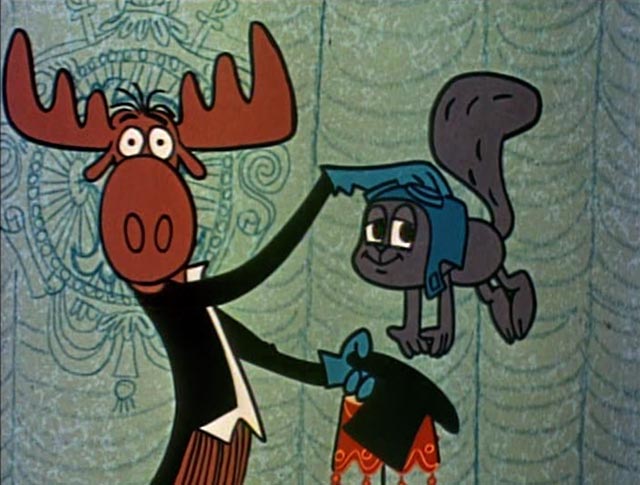
The best were the Jay Ward productions. Rocky and Bullwinkle looked even cheaper than Yogi Bear, but it didn’t matter. When the scripts were good, they were brilliant, and they were good more often than not.4 George of the Jungle was consistently good; Hoppity Hooper was downright trippy, as I recall (it’s hard to find; the episodes I’ve unearthed are decidedly eccentric, but I need to see more.) Although the shows were presented as kids’ entertainment, they were written for adults rather than dumbed down for dull children. Bullwinkle is one of the three great comic characters of the 20th century, along with Groucho Marx and Ignatius Reilly.

The other harbinger was Shounen Sarutobi Sasuke. This was the first animated Japanese movie to get a proper release in America, under the title Magic Boy. It turned up one Saturday afternoon at the kids’ matinee, and it blew away all the Disney movies I had ever seen. I thought it was the greatest movie ever made. I later saw Forbidden Planet, and that was the greatest movie ever made, and I eventually forgot Magic Boy.
Some years back, I tracked down a fansub of the movie. By every objective criterion it’s inferior to Disney products. But it had wildness and strangeness absent from its carefully-polished occidental counterparts, and it excited my imagination as no Disney movie ever had.
Books and music took the place of movies and television for me.
Half a lifetime later, I read a news article about a new children’s show being imported from Japan. It had something to do with girls who identified with the planets of the solar system and wore sailor suits. It sounded silly, but I was curious.
Several years after that, I read a review of an animated movie called Perfect Blue. It seemed worth seeing. Too bad it would never come to Wichita. Princess Mononoke looked interesting, too, but it also was unlikely ever to be shown here.
Not quite 20 years ago, a bodhran-playing friend turned out to have a DVD of Princess Mononoke. I asked to borrow it.
Update: I was annoyed to find that recent reissues of Rocky and Bullwinkle on DVD substituted different music for most of the openings and endings. Fortunately, you can find the correct music here. Pianists looking to enlarge their repertoire might consider assembling the incidental music to Dudley Do-Right into “silent movie” suite.
***
Don’t hold your breath waiting for the next installment.
… I have often thought of starting a society for the prevention of cruelty to vegetables. I do not mean by this the terrible way the British used to cook vegetables, boiling them for hours to an unseasoned, indistinguishable, tasteless mush without discernible consistency; I mean the prevention of the suffering to which modern research suggests that plants are capable of experiencing. Pity the poor potato, from its soil untimely ripp’d! The tortured tomato, the assaulted asparagus, the beaten bean, the raped radish! I would start a movement to picket greengrocers and florists, throwing manure over them, haranguing them for their complicity with cruelty to the plant kingdom. Do they know nothing of the mandragora, have they never read Romeo and Juliet, never heard “shrieks like mandrakes torn out of the earth”? Shakespeare knew that plants suffer. Is it not time we caught up with him?
I think the rise of ADD, ADHD, LD, dyslexia, and all of the other alphabet soup syndromes are just a rise in the number of square pegs being jammed into round holes. Some kids have exceptional mathematical ability and are weak with language. Others are good at language but fumble with numbers. Most are balanced between the two. School seems to be designed around the idea that everyone learns at the same speed using the same techniques at the same age, and everyone who fails to fit this model must therefore have some sort of “problem”.
To me, the number of kids with learning disabilities is a measure of the rigidity of the education system, not the students.
I use mathematicians as an example, because mathematics as a discipline has long been associated with Truth and Reality. Toss these out and you toss out the meaning of math: whence proof without Truth? And indeed, the Heterodox study found mathematicians had the lowest left to right ratio, which was still 5.5 to 1 in favor of Democrats. In contrast, Anthropology, which used to have the same ideals as mathematics, the ratio is 42.2 to 1.
TS:
He says people laugh at him for this, but he thinks Bing Crosby’s movies ruined the Church by setting up ridiculous expectations of priests in Going My Way and Bells of St. Mary.
“They anesthetized people’s common sense. Anybody who couldn’t see that was phony couldn’t see anything. And yet they became cultural icons of the Catholic clergy, that you could do no wrong. I don’t think any sane priest thinks they can do no wrong; I know there are priests who do think they can do no wrong but they’re not sane. I think that this idea somehow that there was this kind of ethereal clergy did violence to us. I think it’s part of the cultural baggage that we came out of the horrific World War II with, trying to find some peace and security, and in fact not doing that at all.”

… another orchid society meeting. This time the show-and-tell included a tiny Dendrobium and several nice Cattleyas. There are more pictures here.

zplane claims that its deCoda is “… the tool for music practicing, transcription and instrument practice. deCoda can decode any song so the user can learn to play it in minutes.” I thought I’d check it out.
It had little trouble with simple stuff harmonized with triads, e.g., plain arrangements of Celtic tunes. It seemed to recognize only four types of chords, though: major, minor, augmented and diminished. Sevenths were absent.
I gave it Masumi Itou’s “Soramimi Cake,” the opening of Azumanga Daioh5 and a memorable, quirky tune.
As deCoda sees it:
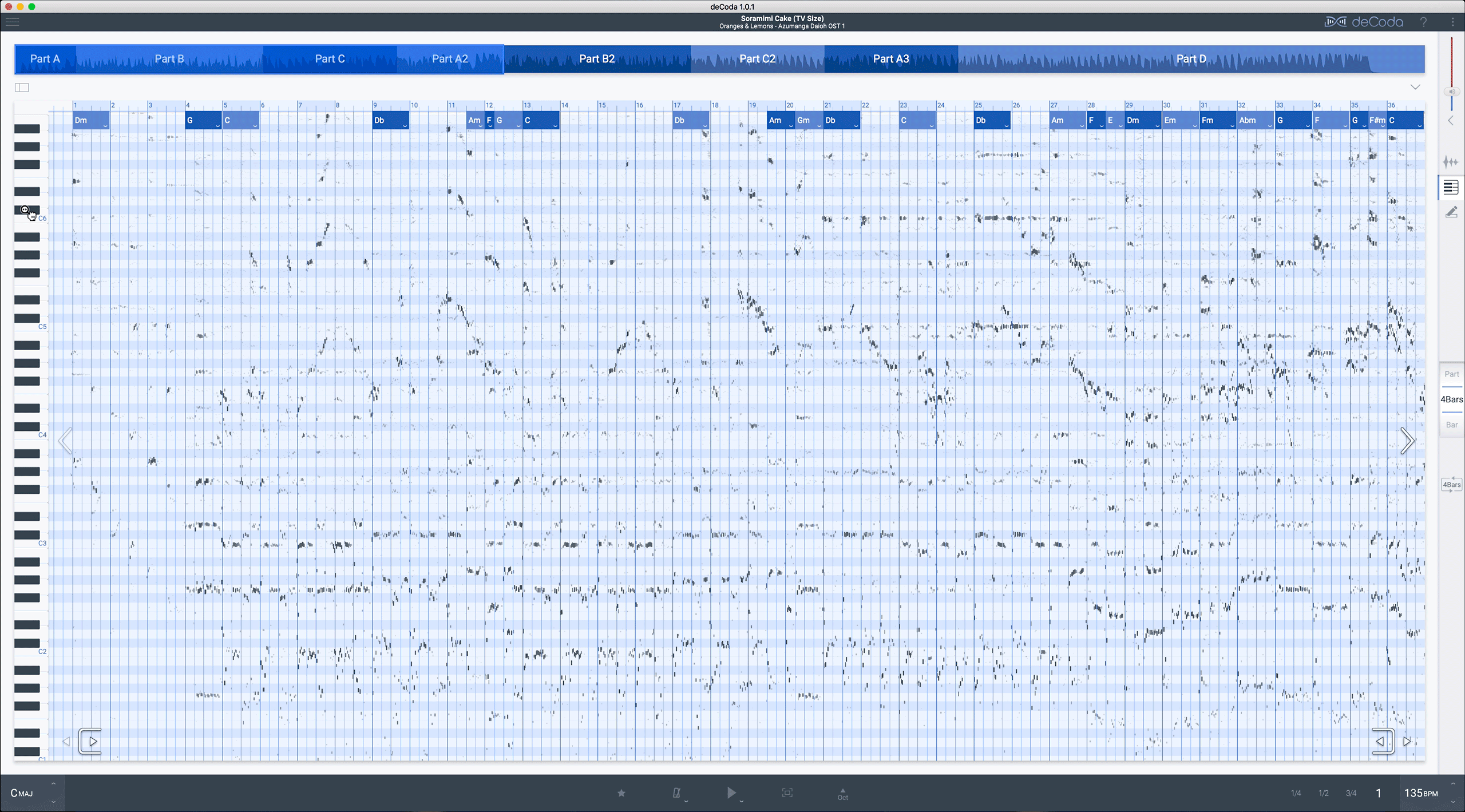
It looks reasonably close, catching the C / D♭ seesaw. However, there are still just four types of chords. I wonder just how sophisticated the “advanced chord and tempo detection algorithms” are. (Here’s a piano transcription of the tune for comparison, and a video with a cutesy animated score.)
Here’s a brief collection various types of chords.
In order, there is a basic G7 to C cadence; Scriabin’s “mystic chord,” first arpeggiated and then up an octave; C6/9, first with the notes spaced out and then condensed in a high octave; the “Tristan” chord, the second time as it appeared in a Beethoven piano sonata; the “Petroushka” chord[s], followed immediately by the “Symphony of Psalms” chord; the “Elektra” chord; the “μ” chord popularized by Steely Dan; and the four sus4 chords Ron Jarzombek based “Suspended on All Fours” on.
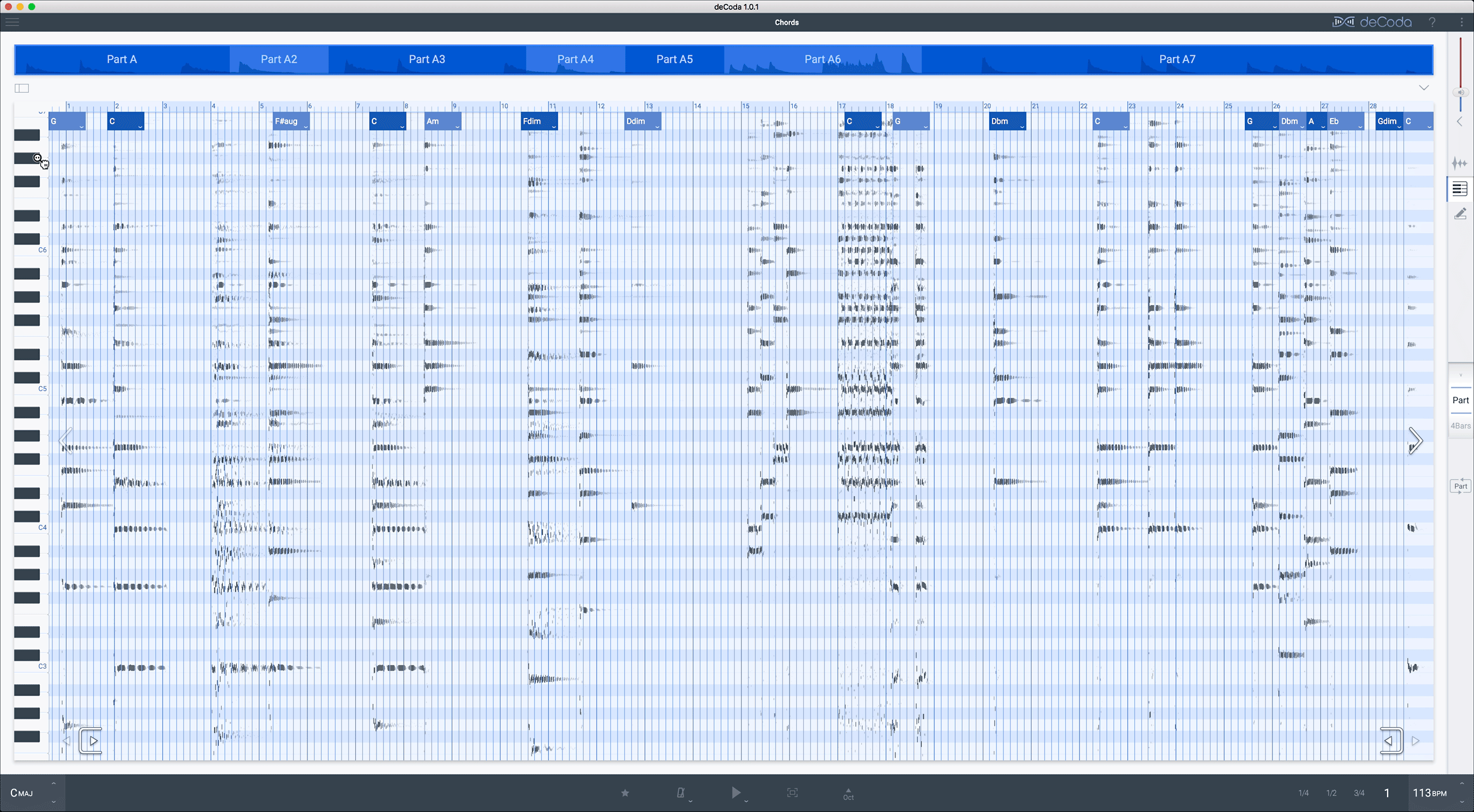
And deCoda flunks the test. Once again, all it sees are the four basic triads. It misses the seventh of G7. It calls the mystic chord (C, F♯, B♭, E, A, D) a “C” when it’s arpeggiated and an “F#” when it’s not. It gets partial credit for calling the C6/9 “C” or “Am,” since it contains both triads. Calling the Tristan chord (F, B, D♯, G♯) “Fdim” is close but not quite right. It’s at best a quarter-right on the Petroushka chord, first labeling it as “D#dim, then catching the C triad but ignoring the F# one. I was surprised that it got the Psalms chord wrong; it’s just an Em triad with the G’s emphasized, but Stravinsky’s eccentric voicing fooled the algorithm. It’s at best half-right on the Elektra chord (E, B, D♭, F, A♭), which does include the notes of D♭m, but there’s more to it than that. deCoda missed the added ninths of the Steely Dan6 chords and the suspensions of Jarzombek’s.
I was interested to learn that silence, as in the penultimate measure of the test, is a G diminished chord.
So, is deCoda worthwhile? If you have a well-trained ear, no. Otherwise, it might be a useful tool if sheet music for the tunes you are interested in is hard to find, and the music is not too complex.

I gather that the movie Cats is not doing well, and one of the reasons is that the design of the feline people is creepy. Perhaps the film makers should have considered the Japanese approach.
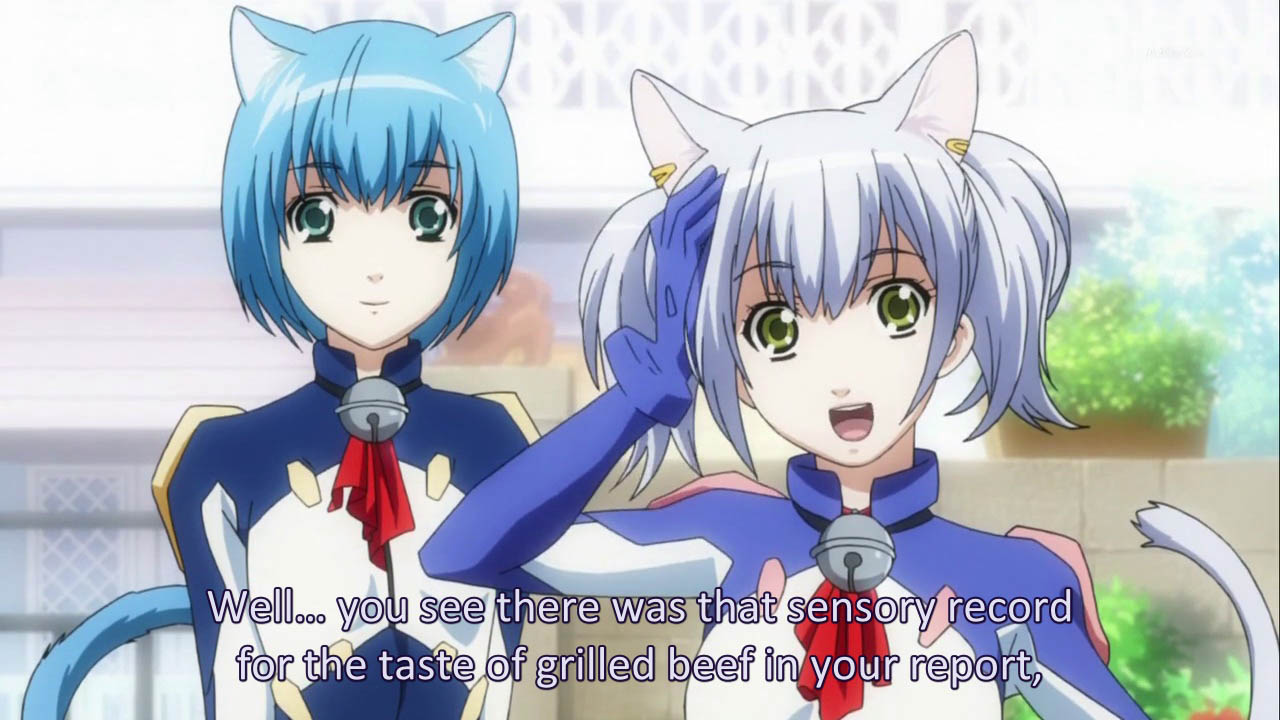
(The screen caps are from Asobi Ni Iku Yo, a fun show but too off-color to recommend.)
2020 is a leap year starting on a Wednesday. If you save old calendars to display when the dates line up correctly again, you’re out of luck unless your collection extends back to 1992. However, calendars for 2014, 2003 and 1997 will be correct in 2020 for January and February7, and those for 2015, 2009 and 1998 will work for the rest of the year.

What did I read, listen to or watch during the past year? Let’s see….
Published, released or broadcast in 2019
• Books
Hellbender, by Frank J. Fleming — A very silly post-apocalyptic fantasy revolving around a mysterious cube on which are drawn bunnies. The characters are mostly flakes, and the story about “warfs” (war orphans) in the haphazardly totalitarian Confederacy of Astara after the Third Digital Rights War is too complicated to easily summarize. However, the author, friendly Frank Fleming 8, is clever and funny, and the book is always entertaining even at its most confusing. A representative paragraph:
“Donuts!” Lulu jumped up from the couch. “I always said one of these days you’d do something useful … or accidentally kill us all. And it was the former!”
• Movies
None.
• Music
There was Winfield in September, and a few concerts during my visit to St. Louis. If you’re ever in that area, see if Dave Black, Roger Netherton or Joey Koenig are playing anywhere.
• Television
American? Ha.
Japanese: The only show I watched all the way through was Endro. It’s featherweight fluff, but it was fun. I also managed to watch about half of the first season of the similarly light Iruma-kun, which is something like Hayate goes to Hells. I sampled most everything on Crunchyroll that wasn’t obviously drivel, but I didn’t get beyond the second episode of anything else.
Too often, watching anime felt like doing homework. My CR membership recently expired, and I doubt that I’ll renew it. This is the first time in several years that I didn’t order a Japanese calendar. I may write a few summary posts about Japanese animation (don’t hold your breath), but I’m pretty much done with the form.
So much for 2019.
So, what else did I read this year? Mostly old favorites: J.R.R. Tolkien, R.A. Lafferty, Gene Wolfe, Tim Powers, G.K. Chesterton, Tom Holt, Cordwainer Smith, etc.
New to me this year
The Elementary Particles, Michel Houellebecq — The token important book for the year. I was prompted to read it by the perspicacious, flaky Rod Dreher. Here’s Houellebecq on Lovecraft:
Lovecraft, for his part, knew he had nothing to do with this world. And at each turn he played a losing hand. In theory and in practice. He lost his childhood; he also lost his faith. The world sickened him and he saw no reason to believe that by looking at things better they might appear differently. He saw religions as so many sugar-coated illusions made obsolete by the progress of science. At times, when in an exceptionally good mood, he would speak of the enchanted circle of religious belief, but it was a circle from which he felt banished, anyway.
Few beings have ever been so impregnated, pierced to the core, by the conviction of the absolute futility of human aspiration. The universe is nothing but a furtive arrangement of elementary particles. A figure in transition toward chaos. That is what will finally prevail. The human race will disappear. Other races in turn will appear and disappear. The skies will be glacial and empty, traversed by the feeble light of half-dead stars. These too will disappear. Everything will disappear. And human actions are as free and as stripped of meaning as the unfettered movement of the elementary particles. Good, evil, morality, sentiments? Pure “Victorian fictions”. All that exists is egotism. Cold, intact and radiant.
Lovecraft wrote about unimaginable horrors; Houellebecq writes about human behavior. There is overlap. I might read Submission sometime, and that will be enough of Houellebecq.
Less important, but more enjoyable:
The Conan stories of Robert E. Howard — If all you know of Conan is Arnold Schwartzenegger and Frank Frazetta, you don’t know Conan. Dr. Mauser discovered Howard at about the same time I did and reacted similarly. See John C. Wright for extensive commentary.
The Moon Pool and The Metal Monster, A. Merritt — Science fiction from almost exactly a century ago, still quite readable, albeit a bit purplish in its prose. Blame Joseph Moore for piquing my curiousity.
A Princess of Mars, Edgar Rice Burroughs. I figured I ought to read something by Burroughs to see just how bad a writer he was, since people still read his books despite the contempt of the literati. Surprisingly, he’s not bad. He’s not Howard’s caliber, but he can tell a story.
Honor at Stake: A Catholic Action Horror Novel, Declan Finn — Blame Moore for this one also.
Please Don’t Tell My Parents I’m a Supervillain, Richard Roberts — Blame J Greely for drawing my attention to this. The daughter of superheroes discovers that her own wild talent makes her best-suited to be a mad scientist. It’s fluff, clever and entertaining. There are hints that the sequels could be darker.
… and that’s enough for 2019.
Another of the greats has passed. Neil Innes, Urban Spaceman,
Seventh Python,
Fifth Beatle,
Update: Here’s a nice 2004 article on Innes.