
After several weeks of dithering and dallying, winter finally fully arrived yesterday. It’s time for the annual frost pictures, taken at the front door.
Trivia that matter
After several weeks of dithering and dallying, winter finally fully arrived yesterday. It’s time for the annual frost pictures, taken at the front door.
Noise comes in colors. There are white noise, pink noise, red noise, brown noise, blue noise, grey noise, etc. The various shades are most easily perceived by acousticians and sound engineers.
While wandering around an airport earlier this summer, I realized that there music playing throughout the building. It was light, watery jazzish stuff, difficult to pay attention to. There was a trumpet in the mix, but the sound was bland, not bold. The melodies were trivial and the chords hackneyed. It may very well have been AI slop. What I was hearing could be called “beige noise”: music intended to be ignored.
*****
Joseph Epstein on a biography he never wrote:
In my early thirties I signed on to write a biography of John Dos Passos, who was still alive. I wrote to Dos Passos to ask if I might have his cooperation in writing his biography. He replied instantly, saying that he would help me in any way he could, on the condition that I “put my liberal ideology in mothballs” and pledge never again to use the word “explicate.”
*****
Atomic Fungus shows how to talk to machines:
Mrs. Fungus was trying to get a tech on the phone, and was stuck at the recalcitrant AI prompt. After hearing her say, “I want to talk to an agent!” fifty-odd times, I took the phone from her.
Machine: “Do you want to try to restart your cable box now?”
Me: “NO! BIB GOBBLE WAGLE BAG GAG HANGLE!”
Whenever the clanker would ask me a yes/no question, I’d answer it, but then add random gobbledygook. And I kept making the tone angrier and angrier.
It gave up and shunted us to a human.
Mrs. Fungus: “How did you do that?”
The algorithm that translates what the user is saying into something the computer can understand has a limited capacity for literal nonsense. In theory, after a sufficient number of errors, it should crap out and send the caller to a human.
That was my theory. I’m glad it worked!
*****
A thousand years ago I discovered three records in the University of Dallas library that would determine much of my musical activity over the years to come: Augustin Anievas’ Chopin waltzes, the first disc of Isolde Ahlgrimm’s “Well-Tempered Clavier,” and Songs by Tom Lehrer1. Lehrer died recently. A few years ago he released his music into the public domain. You can find all the songs here.
*****

One of the places I passed through in Alaska, southeast of Fairbanks. There is culture in the wilderness.

Here’s a selection of snapshots from my visit to my sister’s place near Fairbanks in Alaska. It’s a very different world than Kansas. As usual, click on the pictures to see them larger and with better color.


I spent the last week of June in Alaska visiting family. Circumstances precluded any long trips outside of Fairbanks, but I still found plenty of subjects for my camera. Disappointingly, the Alaska Range was generally concealed by haze and clouds. The above was as good a photograph as I was able to get, though I did spot Denali/Mt. McKinley once when I didn’t have the camera in my hands. It will probably take a week or two to go through all the hundreds of pictures I took. For now, here are some of the peonies and roses at the Georgeson Botanical Garden at the University of Alaska at Fairbanks, the most northerly botanical garden in the world. In Kansas, peony season season is long over, but in central Alaska it’s just starting. The roses are mostly hybrids of the very hardy Rosa rugosa.


It’s getting warmer — the temperature is all the way up to -6℉ now — but it was ten below, colder than central Alaska, when I snapped these pictures at the front door this morning.

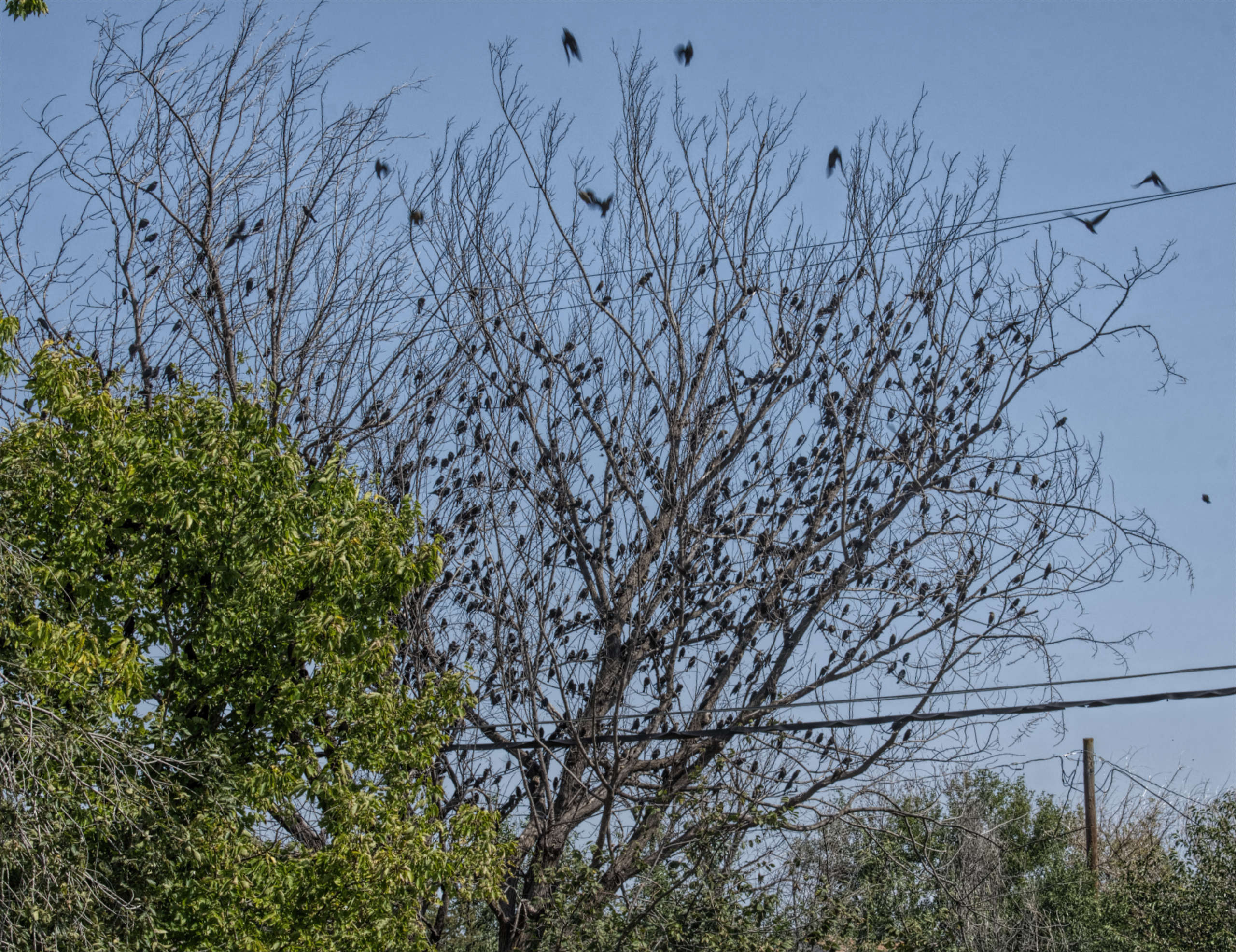
… when I think of Alfred Hitchcock and Daphne du Maurier.
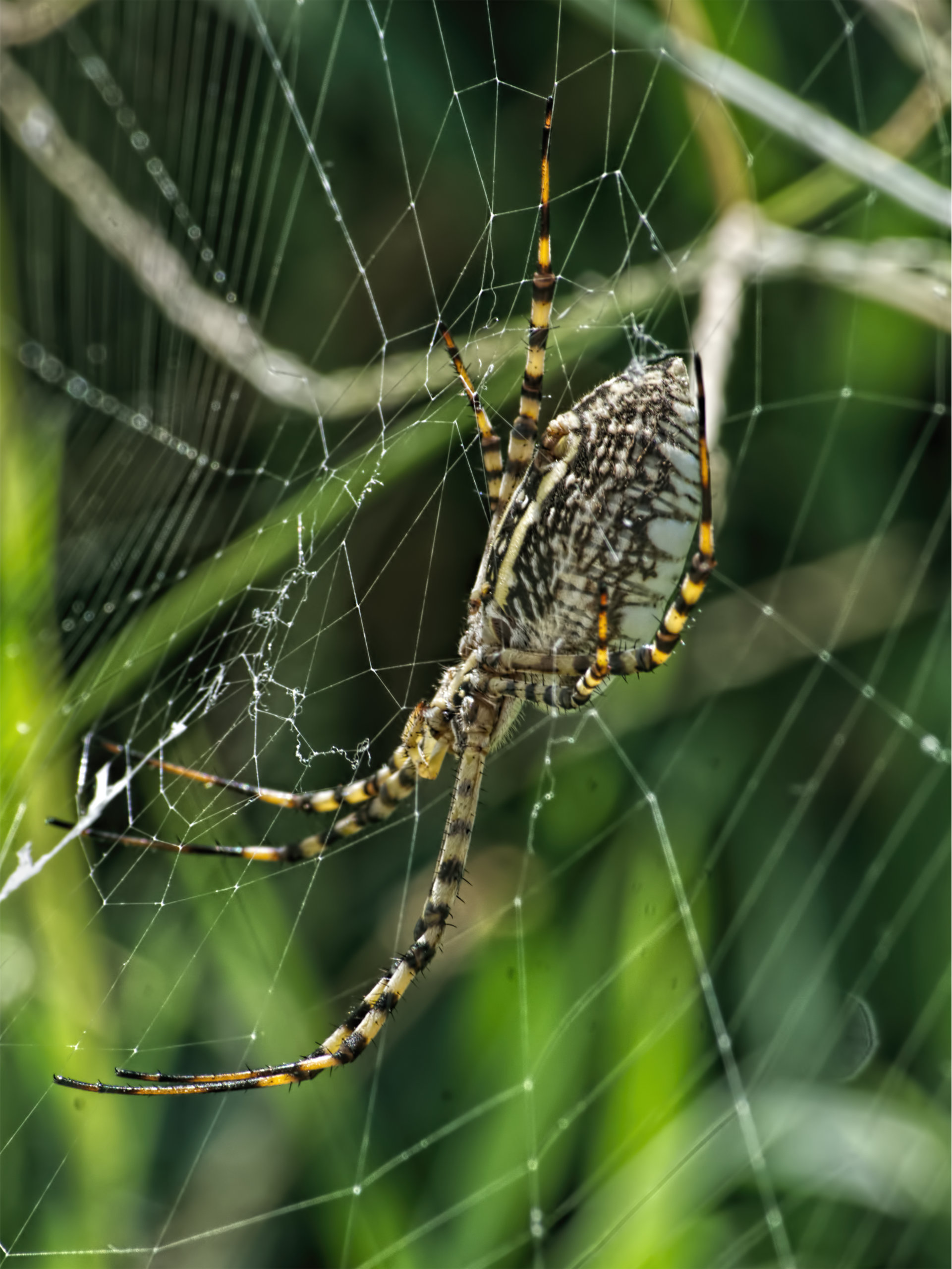
Grasshoppers have been a plague, as usual. The only control I have found that works at all is the orb weaver spider. I observed one in my garden wrap up two grasshoppers almost as large as itself in five minutes.
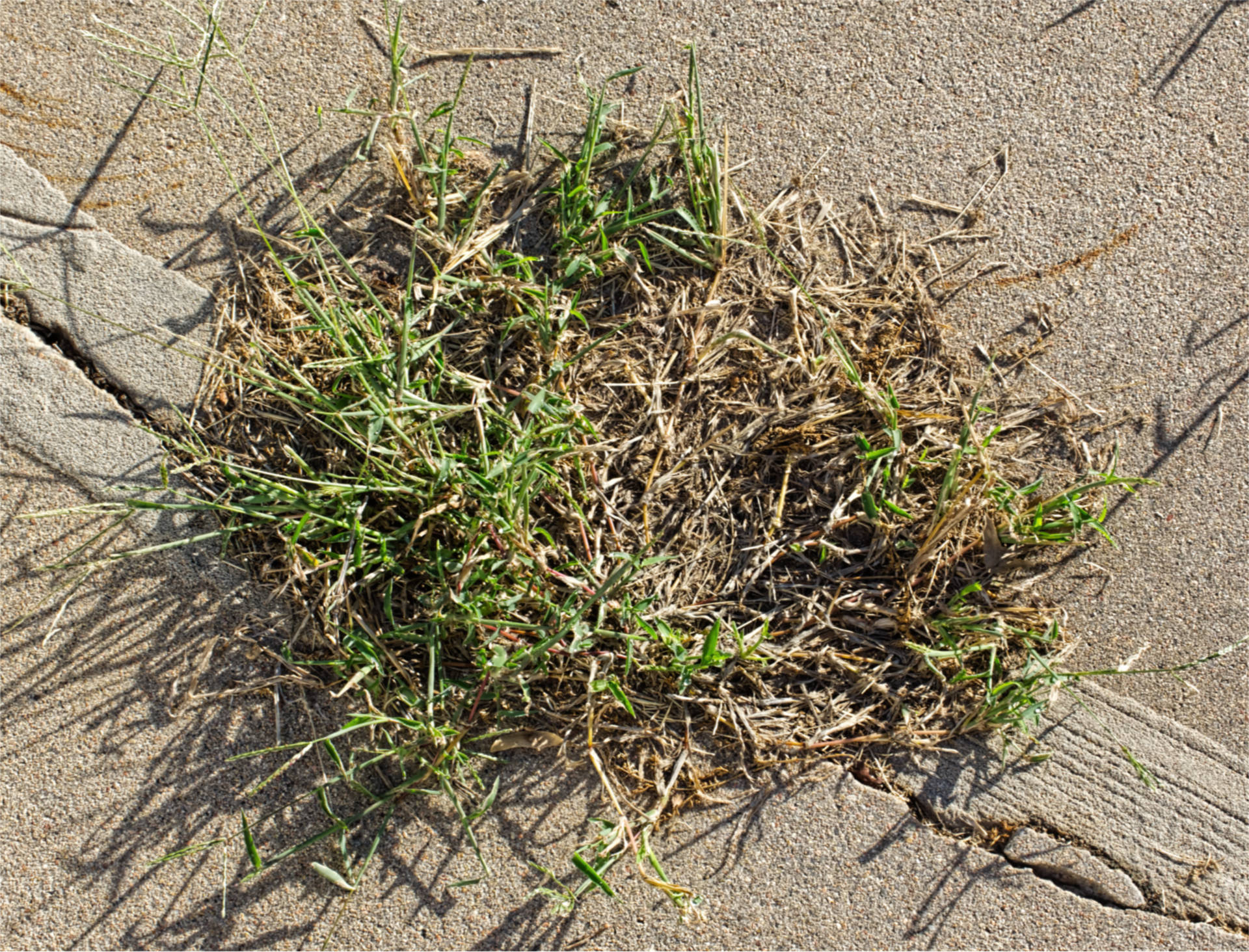
Roundup is no longer Roundup. It used to contain glyphosate, and it was the best chemical solution for most weeds, particularly invasive, difficult-to-dig-out grasses like bermuda.2 However, it’s been reformulated without glyphosate, and it no longer reliably kills weeds. I sprayed the above plant above three weeks before I took the picture. With the old Roundup it would have been completely dead and ready to scrape off the pavement. With the new, disimproved formula, it looks uglier than it did before but is still vigorously growing. I checked every herbicide at Home Despot; not one of them contains glyphosate any more.
Sleep, creep, leap: the conventional wisdom is that growing perennials from seed to bloom takes three years. The first year they produce just a few leaves and concentrate on developing their roots; the second year there is more top growth but most of the action still takes place underground; the third year they’re ready to put on a show. I find that this may be true of some, but most are quicker. I’m still waiting for the Baptisias, Asclepias and the rest of the Silphiums that I started last year, but all the Penstemons bloomed this year. Quite a few bloomed well their first year, e.g. Helianthus, Aster Symphyotrichum, Dianthus, Rudbeckia, Echinacea.
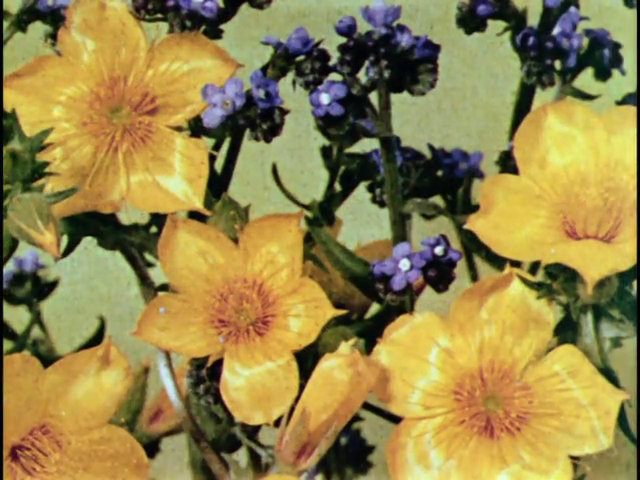
I spotted the above while reviewing Monty Python recently. The yellow flowers look like Mentzelia, possibly M. lindleyi — a plant of the American west, and not something I would have expected from a bunch of silly Brits (and an expatriate American).
I have yet to hear a sermon that was too short.
If you need an accurate forecast and your choice is between a site like weather.com and the Magic 8 Ball, pick the latter.

Sunday afternoon the weatherman declared that there was a 100% chance of rain that evening. As the afternoon became evening, that chance steadily diminished, and I figured we’d be lucky to get a trace of moisture. When the probability dipped down to 38% and it looked like everything was indeed going to miss us, I heard thunder. Then rain came, arriving horizonally at 86 mph.3 The wind uprooted trees all over town and snapped telephone poles. I was lucky and my place got almost no damage, but where the ash tree was that I used to see out the window while I sat at my desk is now just blue sky. The neighborhood did lose electricity for a day and a half — not surprising when the poles supporting power lines are broken into two or more pieces — but it’s back now. I was impressed with how quickly the worst of the mess on the street was cleared up. Yesterday morning, a fleet of pickup trucks from a nearby town brought a crew of about two dozen young men, who cleared the street and took chainsaws to the fallen trees and branches, leaving the debris neatly piled to be hauled away.
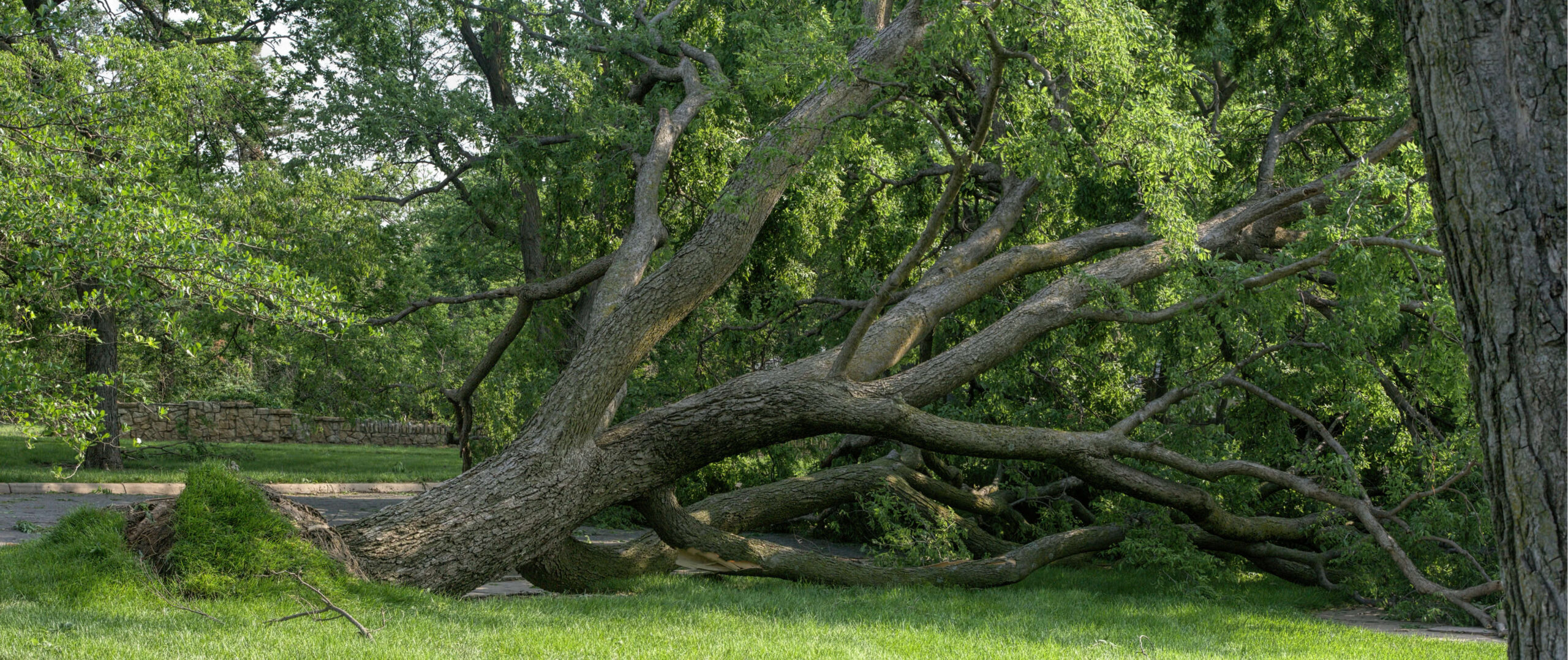
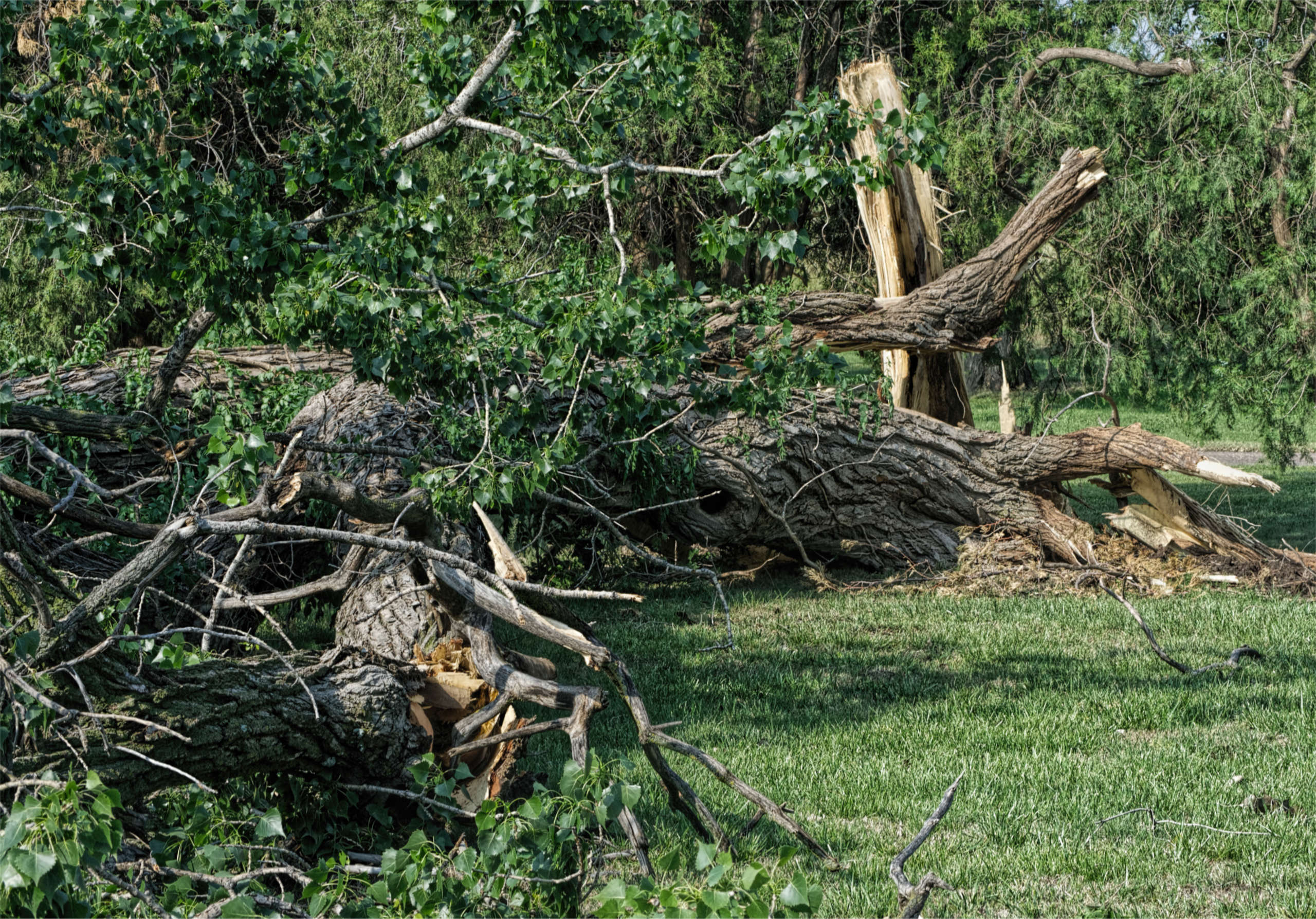
Stay far away from old cottonwood trees during stormy weather.
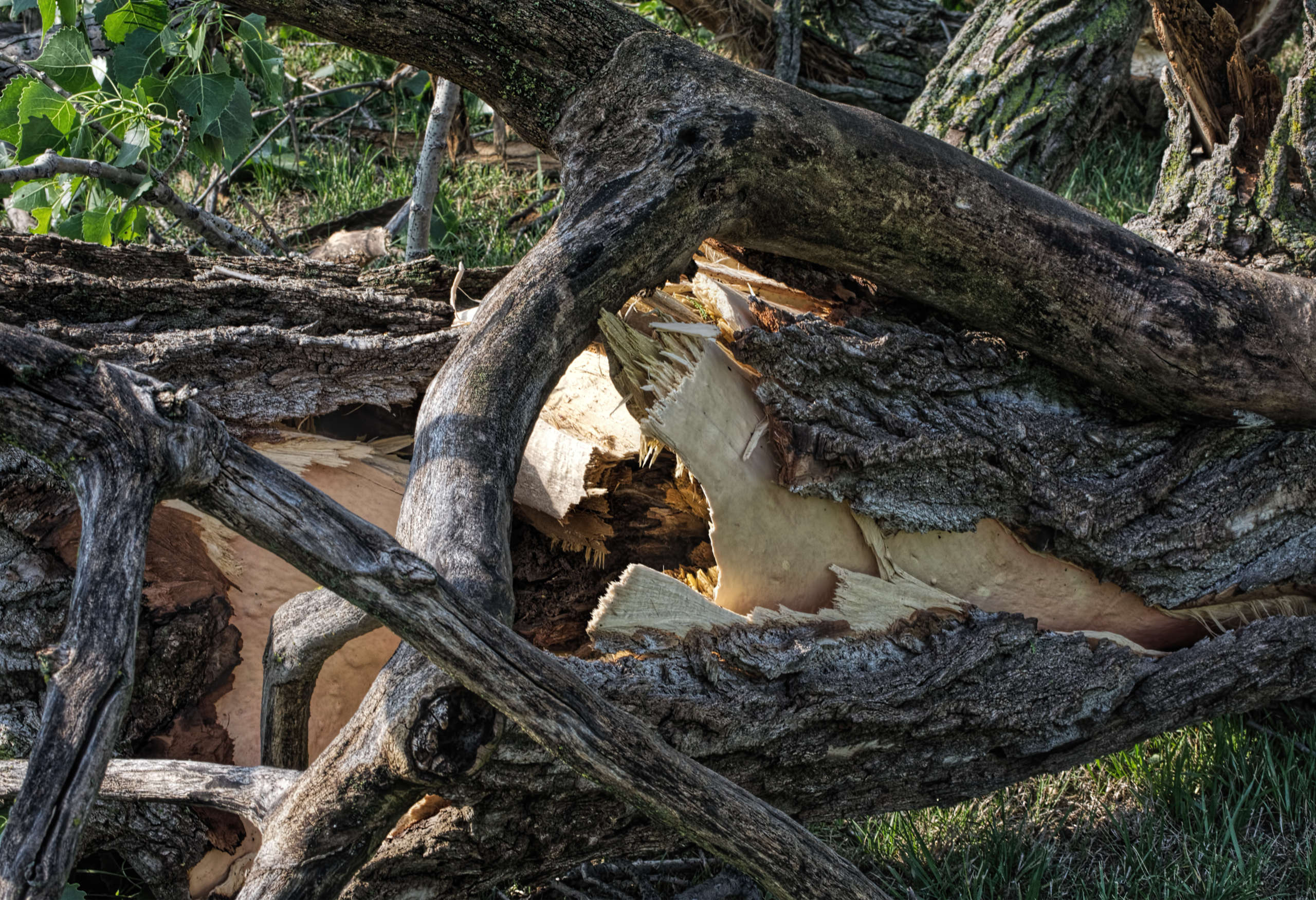
(The pictures were taken at a park at the other side of town but are representative of the storm damage.)
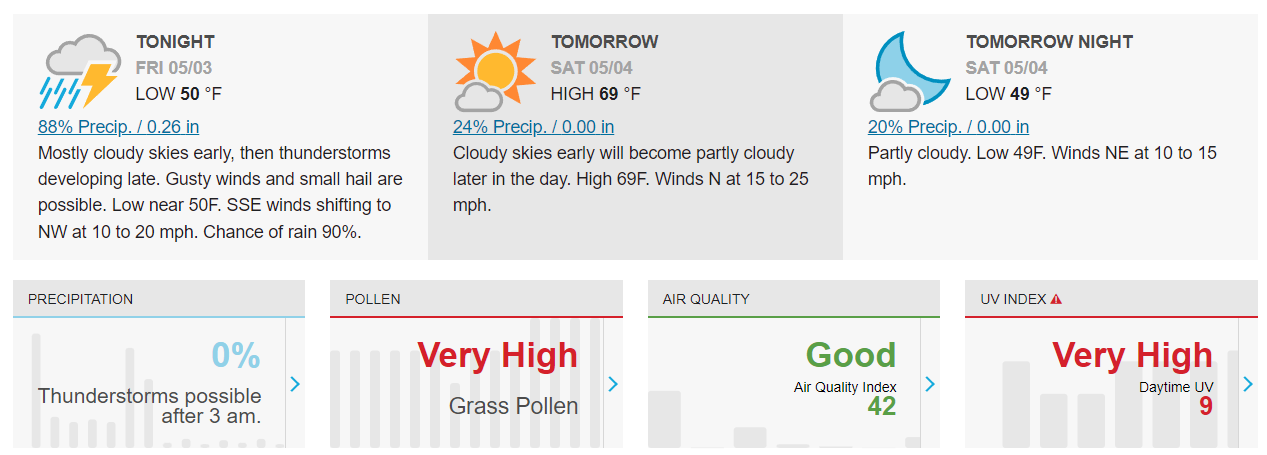
… will it rain? While much of the prairie has been getting an overabundance of weather, out here in the middle of nowhere there has been virtually nothing. April showers this year amounted to .16 of an inch. It’s dry, and we need some real rain, not just a bit of drizzle. Yesterday the weatherman predicted a 100% chance of rain tonight, and I thought, yeah, right. He’s predicted heavy rain many times this year, but as the moment approaches the probability diminishes, the “thunderstorms possible after” time gets later and later, and ultimately that inch of rain becomes just a trace, or nothing.
Tonight, however, it looks like rain might actually fall. The chance of rain is at 90%, not the 60% or 40% that it would typically have been reduced to by this time. The arrival time has been postponed to after 3 a.m. and the amount expected is down to a quarter inch, which are not good signs, but nevertheless it looks like we might get enough moisture to make a difference.
Update, the morning after: We got about an inch of rain, starting shortly after midnight.
Despite the dryness the garden is doing well. Snapshots are below the fold.
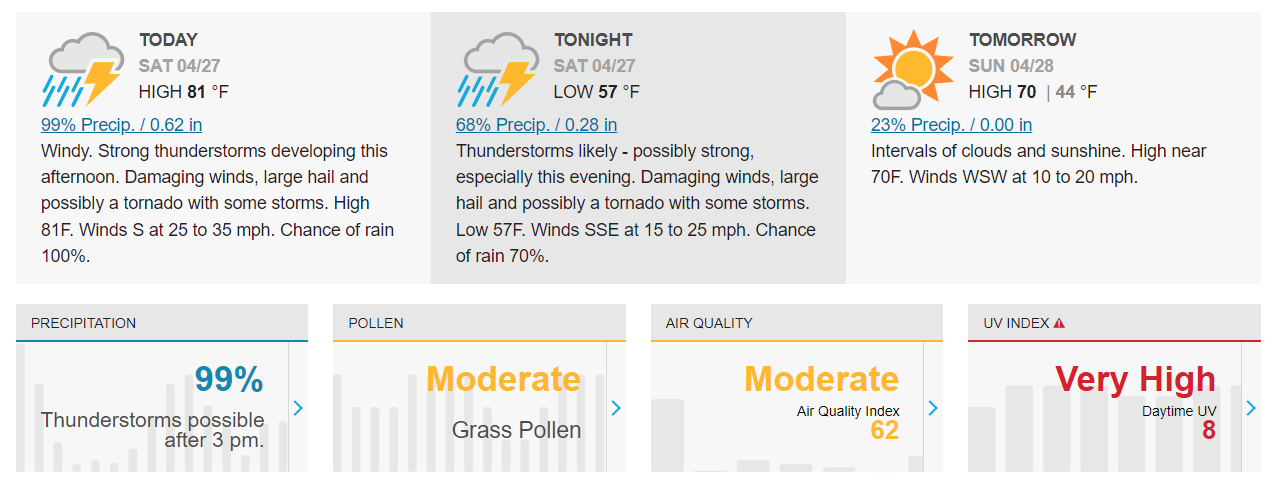
This is the forecast for the afternoon. It looks promising, and there’s even a tornado watch, but I don’t know if there will actually be any measurable precipitation. Several times earlier this week the weatherman has promised 50%, 60%, 70%, 80% chances of rain. Here’s what we got:
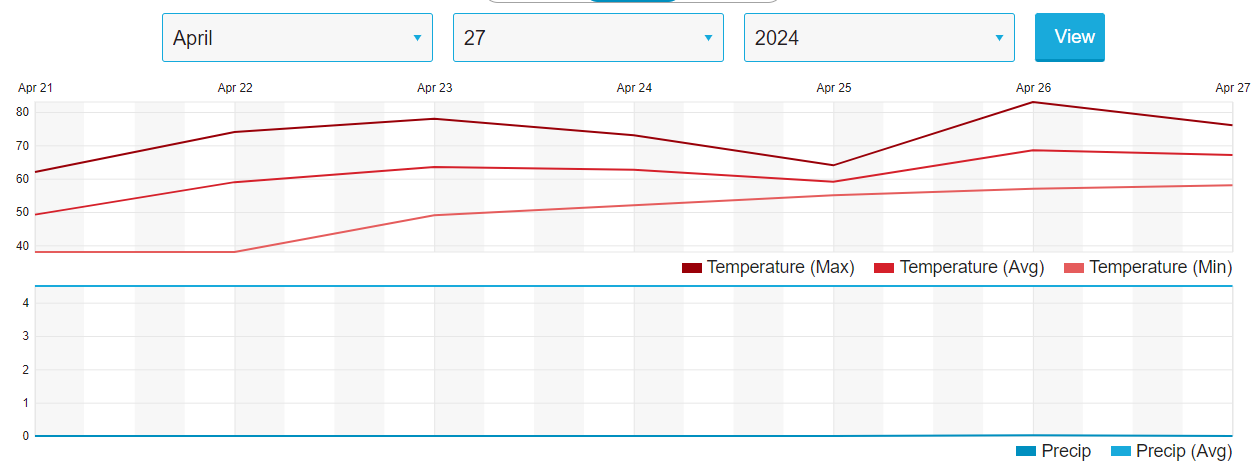
The garden needs water, but I don’t want to get out the sprinklers if we’re going to get an inch of rain. I’ll just cross my fingers for now.
Update: All the interesting weather missed us, which is fortunate. However, we only got half of a tenth of an inch of rain overnight, which is not enough. I’ll need to water everything.
It was 93℉ a week ago. Now it’s snowing.

It was ten below when I got up this morning. This was the view at the front door.
Let’s take a look back at 2023….
Nah, let’s not.
… Just a few highights, then.
Excitement
Most of the thrilling action around here this past year happened in the garden. I summarize it here.
Music
This year’s musical discovery was guitarist Takeshi Terauchi, who formed his first group 60 years ago. If Dick Dale had been Japanese, he might have sounded like Terauchi.
Dick Hyman’s 1975 recordings of Scott Joplin’s music were finally re-released in their entirety this year. Jed Distler says that they’re the best, and he may be right. Previously my preferred Joplin recordings were William Albright’s — which are good (and Albright’s own ragtime music is worth investigating) — but Hyman’s are more alive and colorful, and swing better. Hyman is a jazz pianist, and it shows, particularly in his improvisations on Joplin’s rags.
Entertainment
This fall there were two first-rate anime series broadcast simultaneously. Most years there are none. If Frieren and The Apothecary Diaries maintain quality in their continuations, they are both potential classics.
Books
Most of what I read was disappointing, and what wasn’t I haven’t finished yet. The most curious was Roger Scruton’s Fools, Frauds & Firebrands, in which Scruton summarizes, as far as it can be done, the philosophical underpinnings of radical leftism. I have a hard time with philosophy; it’s often difficult to believe that most of it isn’t ultimately just complicated word games. Scruton’s book doesn’t help. Although he writes clearly and engagingly, the people whose ideas he analyzes come across as a bunch of pompous loonies proclaiming nonsense. It’s possible that Scruton is unfair to his subjects, but other things I have read by him indicate that he is generally a reasonable, temperate man. Scruton on Slavoj Žižek:
We should not be surprised, therefore, when Žižek writes that ‘the thin difference between the Stalinist gulag and the Nazi annihilation camp was also, at that moment, the difference between civilization and barbarism.’ His only interest is in the state of mind of the perpetrators: were they moved, in however oblique a manner, by utopian enthusiasms, or were they moved, on the contrary, by some discredited attachment? If you step back from Žižek’s words, and ask yourself just where the line between civilization and barbarism lay, at the time when the rival sets of death camps were competing over their body-counts, you would surely put communist Russia and Nazi Germany on one side of the line, and a few other places, Britain and America for instance, on the other. To Žižek that would be an outrage, a betrayal, a pathetic refusal to see what is really at stake. For what matters is what people say, not what they do, and what they say is redeemed by their theories, however stupidly or carelessly pursued, and with whatever disregard for real people. We rescue the virtual from the actual through our words, and the deeds have nothing to do with it.

We got nine inches of snow here yesterday. I took a walk around the neighborhood this morning while the snow was at its most photogenic.
I’ve had my new laptop for two weeks now. Articles on switching from Apple to Windows recommend that you quit using your old Mac cold turkey, and that has been easy. Windows 11 feels very Mac-like, and I’ve had little trouble finding my way around. The new computer is also much, much faster than the aging iMac, thanks to solid-state drives. I can check my mail thirty seconds after turning the laptop on; with the old Mac, I had time to shave and fix breakfast before I could delete the morning spam. Whenever I do use the old Mac, everything happens in slow motion. (I expect that the current generation of Apple computers with SSD drives are as fast as my new Windows machine, but the prices range from Too High to Absolutely Ridiculous, and they generally aren’t upgradable.)
With one major exception, most of the software I used on the Mac has Windows versions which I could — usually — install on the new computer without buying again. (The exception is Logic, the digital audio workstation that I’ve been using for over twenty years. It is Apple-only, and it is the only remaining good reason for using a Mac.) Sometimes the installations went smoothly. Applied Acoustics Systems conveniently assembled all the instruments I’ve bought over the years into a single file to download, which installed everything in the right places and authorized them, all at once. They get an A+. Native Instruments’ installer also got it right the first time, which is important when the total download is nearly 600 gigabytes and needs to be split across two drives (the applications on the main drive, the samples and soundware, which constitute the bulk of the downloads, on the capacious external drive). NI also gets an A.
IK Multimedia, however, gets a D. The installer for their “product manager” would not launch the first few times I tried. Re-downloading it didn’t make any difference. Just before I sent IK an angry note, I tried once more, and this time it worked and installed the installer. The total IK download was about 450 gigabytes, and as with NI, it was also to be spread across two drives. However, the product manager screwed things up. Although I told it that the sounds were to go on the external drive, it ignored me and put most of them on the main drive. Fortunately, it was easy, albeit tedious, to fix: copy all the misplaced files to the correct folders, launch each application one by one and tell it where to find the sounds, and delete the superfluous files.
Embertone gets a C-. Here again you need to download an installer. Unfortunately, the link to that installer goes to “This site can’t be reached.” I finally heard back from the company yesterday and all is now well, but they need to update their website.
Graphics software was more of a problem. If I am going to continue to use Photoshop Elements, I will have to purchase it again (like hell I’m going to “subscribe” to anything Adobe). I think I’ll see if Affinity Photo (cheap) or GIMP (free) will do what I need. Topaz Labs does make their “legacy” filters available for download on their site, but the installers put them in random places. You have to track them down and manually move them to the right plugins folder for Photoshop to find them. I may be looking for alternatives for Topaz. Filter Forge doesn’t offer legacy downloads, and you need to purchase the most recent version to install it on a new computer. Adobe, Topaz and FF all get C’s or worse. Other specialized software vendors are more responsible, fortunately; Helicon Focus, PanoramaStudio and Photomatix were all easily installed and get A’s.
Not everything about Windows is delightful. The task bar is stuck at the bottom of the screen where it constantly gets in my way, and, as far as I can tell, it is not possible to move it to the side in Windows 11, as I could the dock on my Mac. Special symbols like a degree sign or an em-dash are simple three-key combinations on a Mac keyboard, but require either an easily-forgotten alt-plus-(number pad) digits sequence or scrolling down a menu to insert. I use a lot of dashes when I write, and this is a damned nuisance.
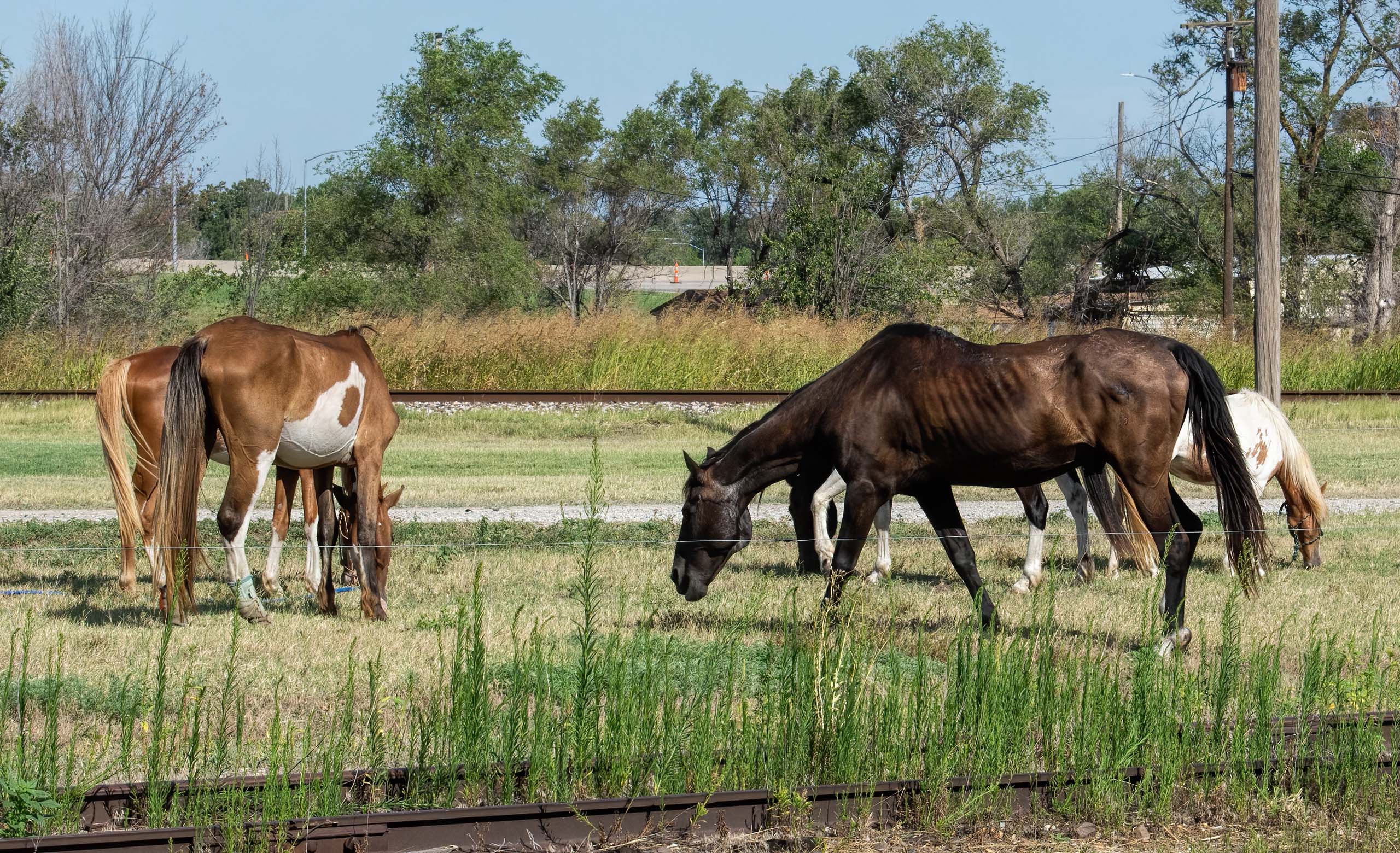
Some new neighbors have moved in the next street over.
***
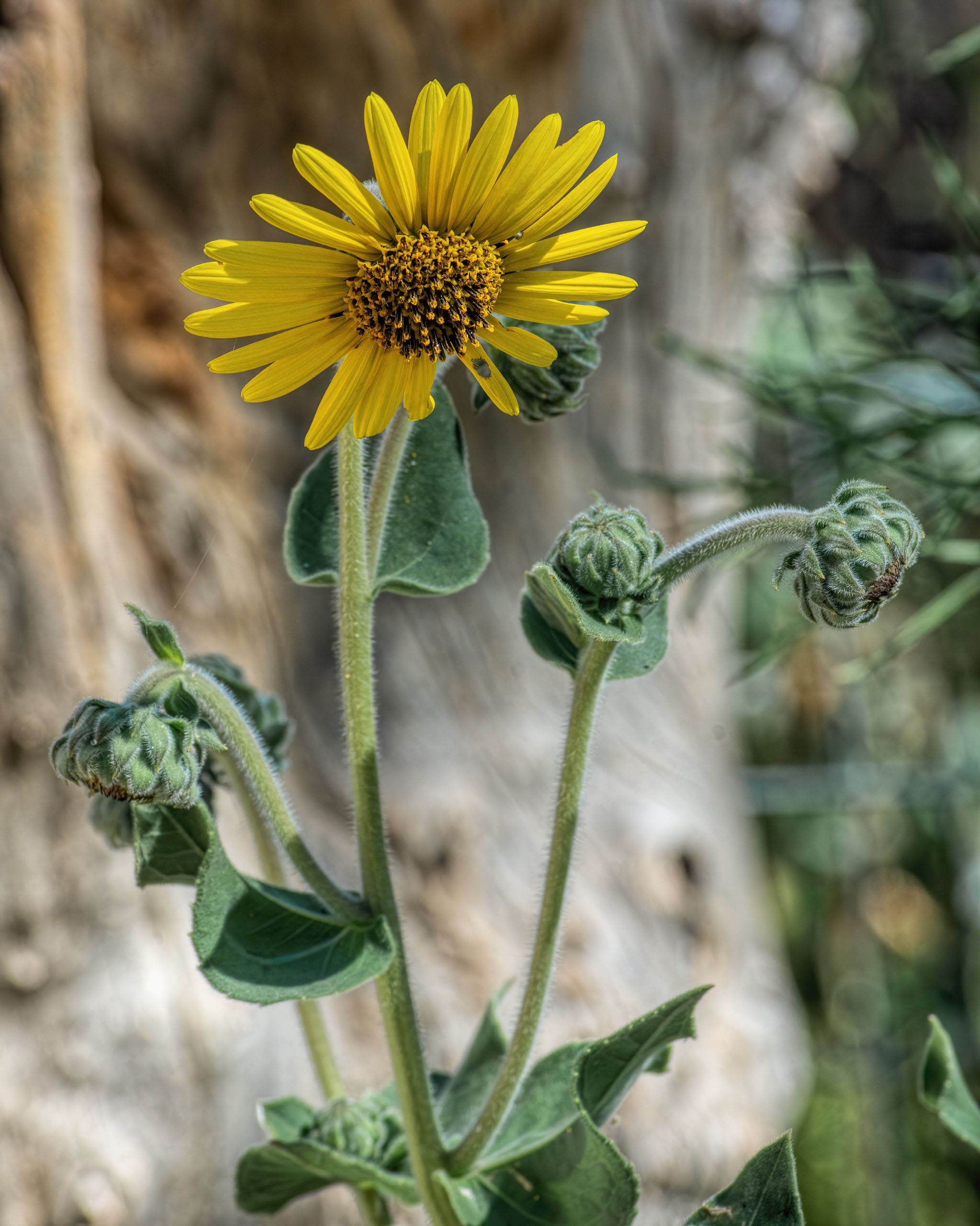
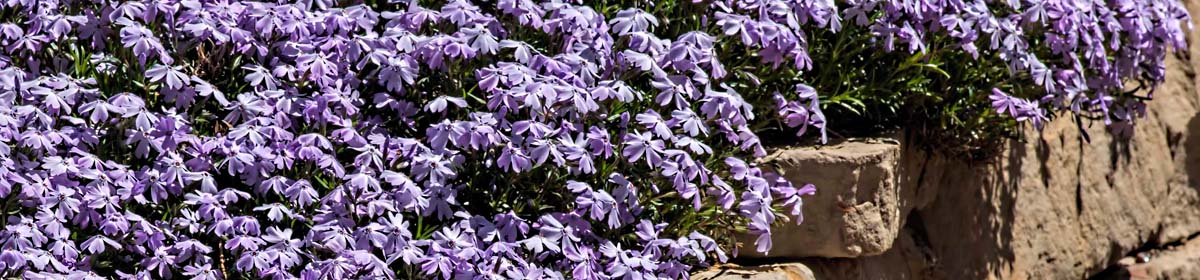
Most of the plants I started this year are perennials which will take a year or two to reach blooming size. However, a number have flowered already. Currently, Helianthus mollis, the “ashy sunflower,” is putting on a good show. The plant has a more refined appearance than most sunflowers. According to what I’ve read it’s inclined to be rambunctious, so I’ve got it in the dry far corner of the yard where its aggressiveness will be a virtue.
Twenty years ago today I launched my first weblog, Mixolydian Mode.4 I intended to write mainly about books and music. My gimmick was that I would post a simple MIDI arrangement of a traditional, public domain melody every day. I never wrote all that much about what I read or listened to, but I did post a tune a day for over a year. Finding and arranging the tunes became tedious; I eventually reduced the frequency I with which I posted them, and finally quit altogether. There are over 600 of these MIDI files gathered here. Some of them are transcriptions of old music, but the vast majority are my own arrangements.
The first tune I posted, on April 14, 2003, was the thirteenth-century round, “Sumer is icumen in.” Here is the file. Back then, if your browser wouldn’t play a MIDI file, QuickTime would. This is no longer true. Here is the tune as an mp3, which should work in all browsers.
Here are the lyrics, if you’d like to sing along:
Sumer is ycumen in,
Loude sing cuckou!
Groweth seed and bloweth meed,
And springth the wode now.
Sing cuckou!
Ewe bleteth after lamb,
Loweth after calve cow,
Bullock sterteth, bucke verteth
Merye sing cuckou!
Cuckou, cuckou,
Wel singest thou cuckou:
Ne swik thou never now!
The first several years of the twenty-first century were the golden age of blogging. Even though I never had much to say, my site got a lot of traffic and a lot of links. At one point I was receiving over 400 hits a day, and it’s possible that most of them were actual visitors, not just bots. Sure, Glenn Reynolds got that many hits in a minute, but out here in the backwaters of the internet, that wasn’t bad. That golden age is long over, and I get less and less traffic every year. I expect that when I observe the twenty-fifth anniversary of my weblog, I may get a hit every other day from an actual human visitor (and a hundred from the multitudinous bots every hour).
Soon after starting Mixolydian Mode I discovered that some Japanese animation is worth watching (most isn’t, of course; Sturgeon’s law applies here as it does everywhere else). This led to contact with Steven Den Beste and the eccentrics who hung out at his place. Steven quickly became my most prolific commenter. Soon I began a second weblog for my anime explorations, so that readers of my main weblog who weren’t fascinated by all things Japanese would not be subjected to my obsessions.
Back when I started posting online, Blogger and Safari didn’t get along, and WordPress didn’t exist. Instead, I used the now-forgotten pMachine. It worked well for a while, but eventually it became impossible to efficiently clean up the spam comments that increasingly infested the blogosphere. When the pMachine people abandoned the free version of their software, it was my cue to move to WordPress. In April 2007 I re-launched my weblogs, calling them now “Zoopraxiscope” and “The Kawaii Menace.” Some time after that I merged the latter into the former so I just had one weblog to maintain. The original weblogs no longer exist. Some of the highlights are collected in the “ancient texts” in the sidebar at right. There are snapshots at the Wayback Machine for the morbidly curious.
Since 2007 I’ve paid for my webhosting, so that visitors are spared ads and I have adequate online storage and control over my websites. Some hosts are more reliable and ethical than others, and I’ve occasionally had to move my weblog. The WordPress migration tools don’t always work perfectly, and quite a few of the pictures from years past have disappeared into the aether. All the text since April 14, 2007 is still archived, though.
Blogging has changed over the past twenty years. As I recall, it used to be more social, more fun, more frivolous. You could discuss the ramifications of a recent political outrage, and then post the results of silly Quizilla quiz, or play tag with other bloggers. Quizilla is gone now; webrings are forgotten; St. Blog’s Parish has lost most of its parishioners. Part of the change is probably due to foolishness and triviality migrating to Facebook and other slums, and part of it may be due to the medium maturing, but I sometimes miss the old days.
There are those who are no longer with us. Steven, Charles G. Hill, Shamus Young, Wonderduck5 — all of them are missed, along with Zippy Catholic, Gerard Van der Leun and others. And then there are those who took their blogs private or just stopped posting altogether. I sometimes wonder how the Rat Maiden is doing these days, or Kashi, or the crack young staff at the Hatemonger’s Quarterly.
I’ll continue posting spasmodically until Big Sister takes my computer away from me or a Carrington event crashes electronic civilization. The frequency of posting will probably steadily diminish, but I’ll continue reading, watching, weeding, grumbling, thinking cynical thoughts, and taking pictures of everything.
While February is technically the shortest month, it’s actually the longest. It just goes drearily on and on and on.