“Buy the software …

… but install the crack.”

The purpose of digital rights management is to punish the legitimate user. Shamus and Steven recently noted the use of DRM to enhance your gaming experience. DRM is also a traditional element of music software. Here’s a classic from five years ago: Waves Native Gold Bundle 3.2 featuring PACE Interlok. It’s noteworthy that PACE merely crashed your computer and forced you to reauthorize the software, repeatedly. Sony’s innovations compromise the security of your computer.

Update: from the comments on Shamus’ post:

It is a sorry state of affairs when people trust some anonymous cracker more than they do a legitimate publisher.

Words, words, words, and pictures, too

All my old websites will soon be disappearing. They’ll be gone in January, if not by October. I recently spent some time browsing my retired weblogs, copying posts that might be of interest to visitors here. I sorted them into sixteen categories and posted them as static pages. You can find the categories listed as “ancient texts” under the “more” heading in the sidebar. And here:

Briefs
Critics and other idiots
Culture
Haruhi and Haruhi
Japan
Kid stuff
Mahou shoujo
Miscellaneous — mostly anime
Just plain miscellaneous
Music
Personal notes
Sailor Moon
Silly stuff
Osamu Tezuka
Why watch anime?
yoshitoshi ABe

I also rescued the “boy or girl?” quiz and added a few more pictures, bringing the total number of questions to twenty. Those who know their traps should do well; the rest of us — well, the average score among my friends was two right out of fourteen in the earlier version.

(I may be experimenting with different themes in the near future. I don’t like the way the current one, “Gemini,” handles static pages, and I couldn’t find an obvious way to fix the problems.)

What anime fans share in common …

that make them attracted to anime in the first place.

I have an untested theory that anime fans tend to be… by disposition not attached to the physical world. They get by with the education mill and then join the workforce – some of them may do extraordinarily well, some less so. Their level of participation in society at large tends to stop at earning their bread – they are just not the type who get anxious in not participating in the mating rituals, climbing the greasy pole etc. I think it is mostly because their mental life is too occupied with something else better than the real world has to offer. It is not that they are maladjusted – they tend to do this by choice.

Complicated noises

When I first started fooling around with music on computers, one of my projects was to make my own primitive version of Switched-on Bach. I arranged Bach’s two- and three-part inventions and a few other things for software synths and sequencer. I recently unearthed the CD I recorded. It hasn’t aged well, but some of it doesn’t hurt my ears. I’ve uploaded some selections to my music site for the curious. (Click on the little speaker icons next to the download link to preview the tunes.)

When I made these recordings five years ago, I used as wide a variety of synthesizers as possible. After making the selections, I was surprised to realize that the majority of arrangements I found still listenable used only one synth, FMHeaven, an emulation of the Yamaha DX7.

Form, truth and regret

mono10.jpg

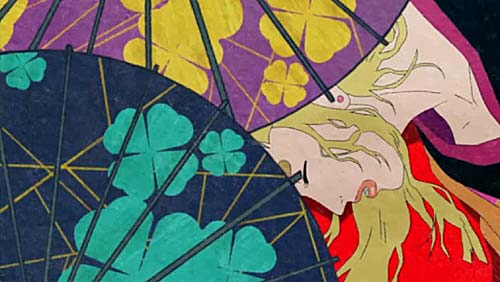
I will withhold comments on the merits of Mononoke until I’ve watched a few more episodes and have seen whether the payoff of the horror story is worth the buildup. Instead, here are some screen captures illustrating the novelties of this moving wood-block print. Note the off-center and unbalanced compositions, eccentric angles and busy detail contrasting with empty space.

Update: Wabi Sabi has a weblog devoted to Mononoke. (Beware of spoilers.)

Continue reading “Form, truth and regret”

Pink Supervisor

szs07.jpg

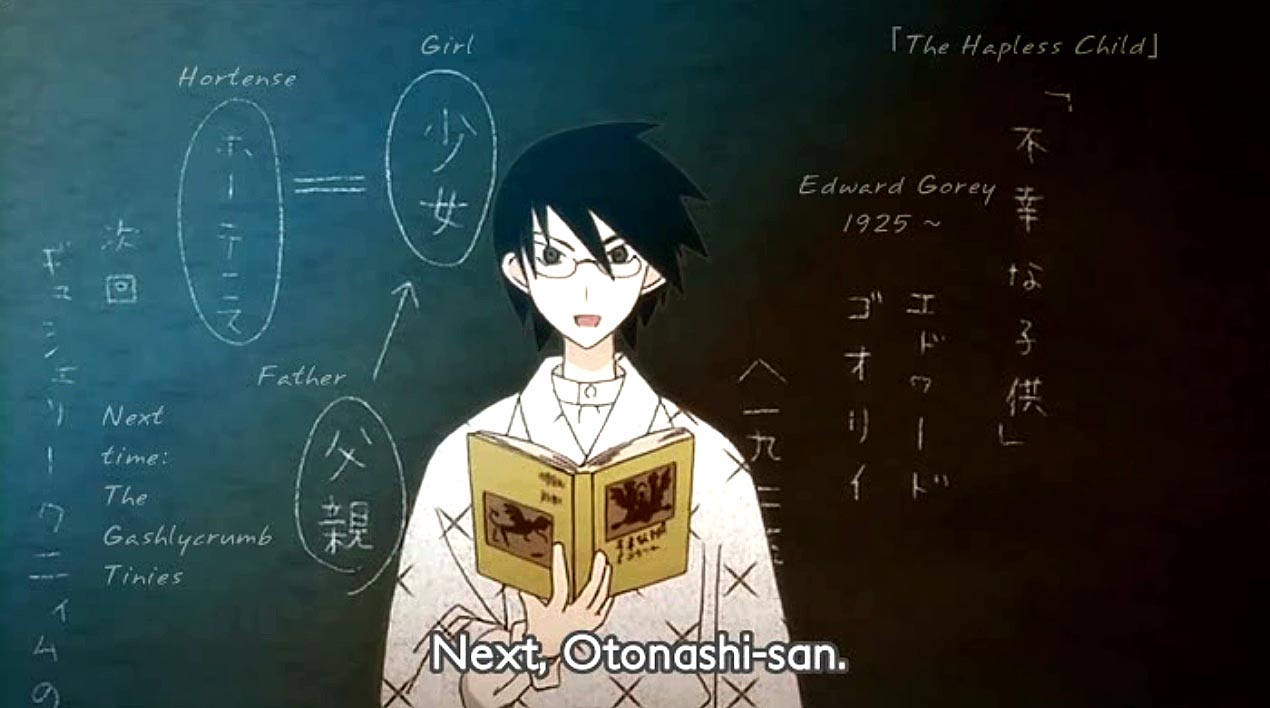
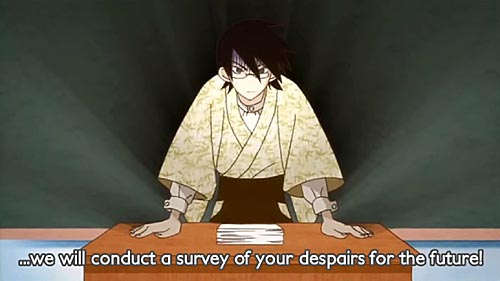
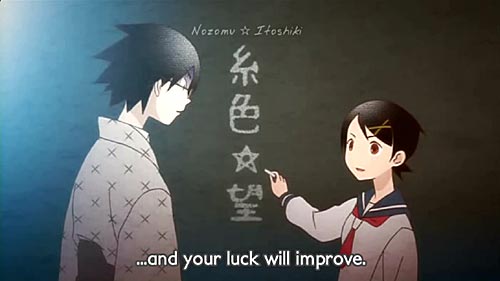
In Sayonara Zetsubou Sensei, or So Long, Mr. Despair, the pessimistic teacher Nozomu Itoshiki, who begins each episode with a suicide attempt, discovers the implacably optimistic girl Fuura Kafuka (does that name sound familiar?) in his class. Her classmates through the second episode include a hikikomori, an obsessive-compulsive perfectionist, a girl who communicates only through text messaging, and a stalker; undoubtedly there will be many other healthy-minded young people to meet in the remaining ten episodes of this grim farce.

The opening is the cheapest I’ve seen, just text with do-it-yourself music. Overall, I would describe the production as economical, if occasionally elegant in its low-budget way. It suits the one-dimensional characters and absurd stories well. The show is noteworthy for its graffiti: the chalkboard features comments and wisecracks from Koji Kumeta, the artist responsible for the manga on which the anime is based. There are also jokes for otaku, though the show doesn’t depend on them the way Lucky Star and Hayate do.

Sayonara Zetsubou Sensei is obviously not for everyone. I’ve uploaded the first eight seconds of the first episode to my video weblog. If you find it amusing, you might want to check out the series.

szs05.jpg

Update: Astro is also watching Sayonara Zetsubou Sensei, and he has many more screen captures. (I would guess that the guy whose face turns up in all the odd places is Kumeta.)

Update II: It occurs to me that SZS is anime as Edward Gorey would have done it.

*****

This is likely my last substantive post for a while. I picked up Harry Potter #7 yesterday (I want to see for myself what happens before anyone spoils it for me), which will probably take care of the rest of today. Tomorrow my New Toy is scheduled to arrive, and that will occupy all my free time for a week or two or three. I’ll be back eventually, and perhaps by then there will be fresh episodes of Denno Coil, Oh! Edo Rocket and maybe even Master of Epic waiting for me.

Cold fuzzies

potemayo02.jpg

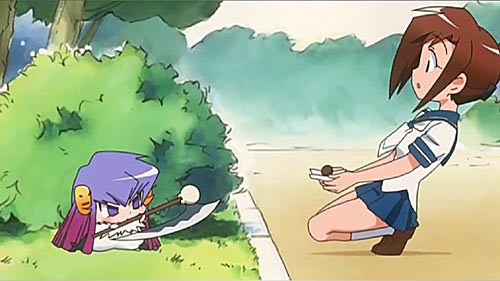
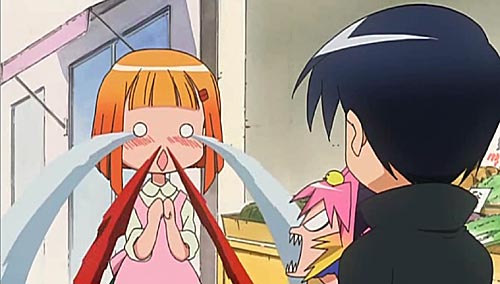
Reaction to Potemayo: not enough Guchuko (above, left), too much Mikan (below). I could have done without the Brokeback Mountain reference, too. And the boys in skirts. And the incontinent chibi. Never mind.

potemayo03.jpg

By the way, Guchuko indeed wields an axe, not a scythe. This is a scythe:

gothhotaru.jpg

(Goth Hotaru via Ken.)

Post script: I probably am being a little unfair to Potemayo. The central character, Sunao, is quiet and level-headed, something I appreciate in anime as well as in real life. Although there is a definite whiff of shounen-ai, one of the boys involved is a gonk; i.e., the point is not titillation.

Nevertheless, I wonder just who the target audience is. Potemayo and Guchuko — I expect that the plushies are already heading to market — will likely fascinate pre-literate fans of Binchou-tan, but the satirical aspects of the show will go over their heads. Those who can spot the subverted tropes will likely suffer from a kawaii overdose from the title character/thing. I’m mildly curious to see if any explanation is eventually offered for the chibis’ presence in this universe, but there is a limit to how much cute (or Mikan) my system will tolerate.

Relics of a less-sensitive past

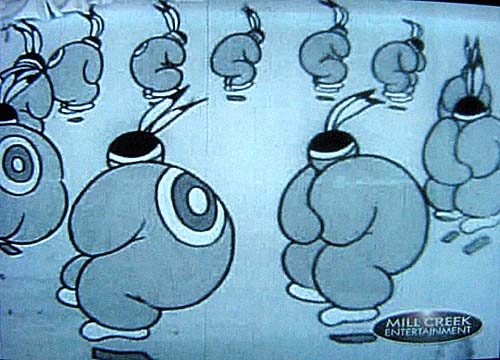
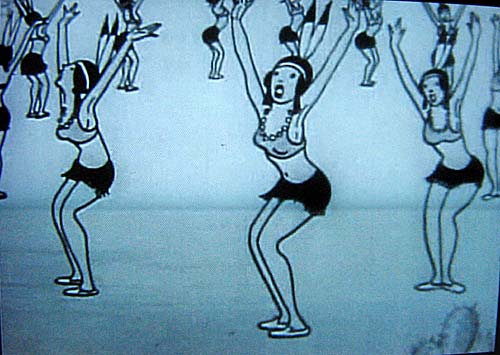
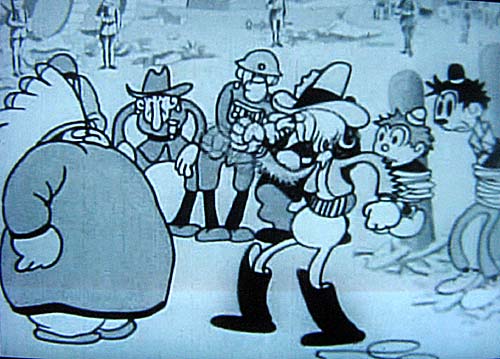
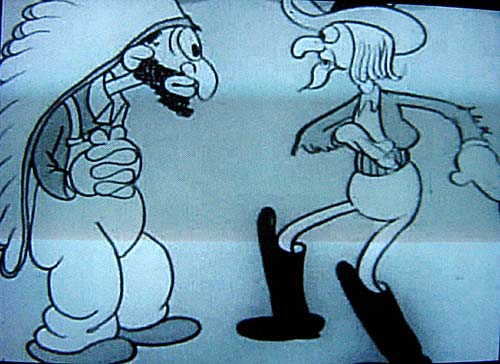
At WalMart today I spotted a collection of 150 Cartoon Classics in the $5 DVD bin. It’s, um, educational. Here are two before-and-after pairs of screen captures from “Redskin Blues,” a Tom and Jerry cartoon from 1932:

redskinblues01.jpg

redskinblues03.jpg

redskinblues04.jpg

redskinblues05.jpg

(Sorry about the quality. The DVD’s menus don’t work in VLC, and the Apple DVD player won’t allow screen grabs (thank you very much, Steve Jobs), so I had to snap the monitor screen with my toy camera.)

Testing, testing …

I haven’t been able to get the mp3 player that Astro uses to work, so I’m experimenting with the 1 Bit Audio Player. Here’s a piece from the Denno Coil soundtrack. There should be a little speaker icon after the link. Click on it to hear the tune. If you don’t see it, or if the music doesn’t play, please let me know.

Kodomo no Asobi

Here’s another possibility:

[mp3]http://tancos.net/audio/09-Kodomo-no-Asobi.mp3[/mp3]

Rocketeering

oedob02.jpg

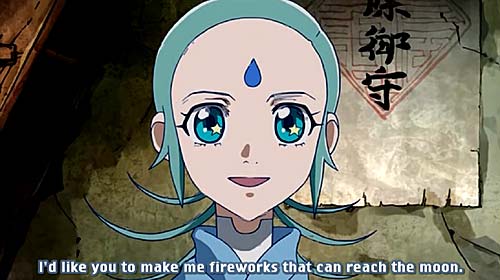
In the summer of 1842, anything that’s fun is illegal in Edo. This includes all forms of entertainment, technological innovations and, in particular, fireworks. The policeman Akai assiduously enforces the law with a particular emphasis on the Furai terrace house, whose inhabitants include the fireworks artisan Seikichi and his mathematician brother Shunpei. One day, after an unpleasant encounter with Akai, Seikichi returns to his room to find a strange, pretty young woman with stars in her eyes (literally) and blue hair who tells him to call her “Sora.” She has a modest request for him: can he make a rocket that will go to the moon?

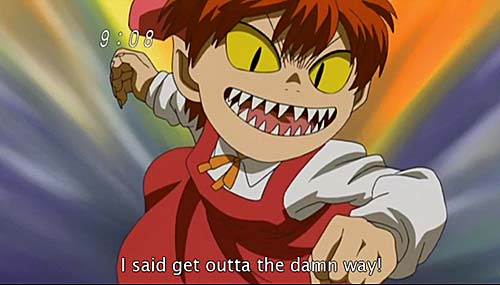
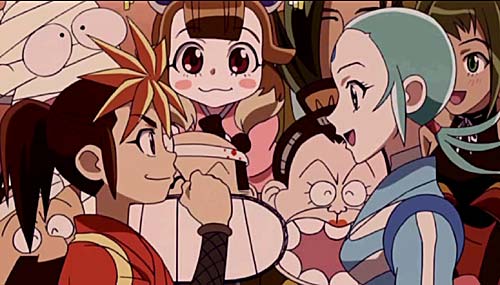
Oh! Edo Rocket is a collection of disparate elements, starting with the character art. There are at least three distinct styles represented. Seikichi, Shunpei and Sora have classic anime big eyes and small (but definite) noses. (Their mouths are larger than is standard nowadays, though. Seikichi’s is downright big.) Akai, the locksmith Ginjiro and other older characters have normal-sized eyes and relatively realistic faces, and they are considerably taller than Seikichi. Finally, there’s a collection of cartoony grotesques who could have stepped out of a Jay Ward production. These all are as short as Boris Badenov, barely reaching Ginjiro’s knee, with oversized heads. (I posted a portrait gallery earlier.)
oedob09.jpg

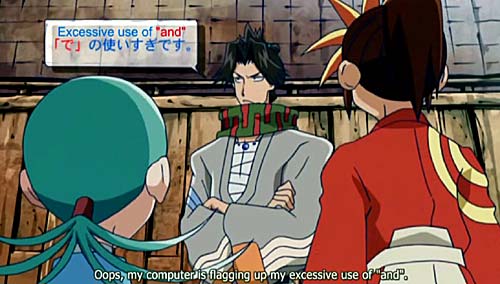
In addition to these, there are strange creatures lurking about. One of these is a pale “sky beast,” apparently intelligent, and capable of zapping its enemies with electrical discharges. The magistrate Torii and his secret police pursue the creature, but as of episode two they have yet to capture it.
oedob05.jpg

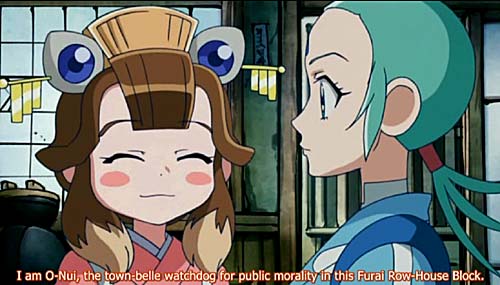
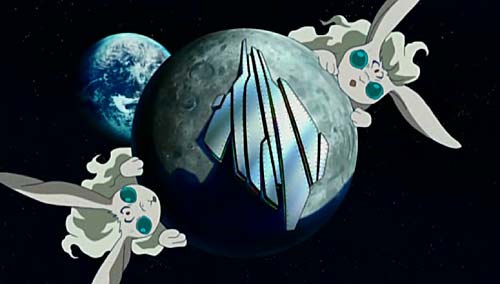
Other elements include a jazz soundtrack, frequent anachronisms and breaks in the fourth wall. There’s a self-pitying effeminate bishounen whom nobody notices. There aren’t any meganekko or nekomimi so far, but there is Onui, the “watchdog for public morality,” who is distinctly puppyish. There are giant rabbits on the moon.
oedob07.jpg

Oh! Edo Rocket is mostly farce, but there’s menace under the comedy. The inventor Shinsa is hauled off to jail at the end of the first episode. He returns in the second, covered from head to toe with bandages because he refused to inform on Seikichi. The heavily armored secret police are absurd — one travels by turning cartwheels so quickly that he is a blur — but they are also scary. The regular police seem as competent as the Keystone Cops, but Akai is observant enough to be dangerous.

Whether the show’s creators can pull all these heterogenous elements into a unified whole remains to be seen. A stage play, a novel and an earlier television series preceeded the anime, so presumably the writers have some idea of where they’re going with the story. There’s nothing else much like it, so I’ll probably continue to follow it.

oedob03.jpg