A young person’s guide to cyberspace

denno12.jpg

Yuko, newly arrived in Daikoku City with her impulsive little sister Kyoko, loses her dog Densuke when it chases an “illegal” — a sort of computer virus — through a hole in a fence into an “obsolete” cyberspace. Fumie’s business is retrieving lost cyberpets, and Yuko hires her to rescue Densuke. It’s a more difficult job than they anticipate.

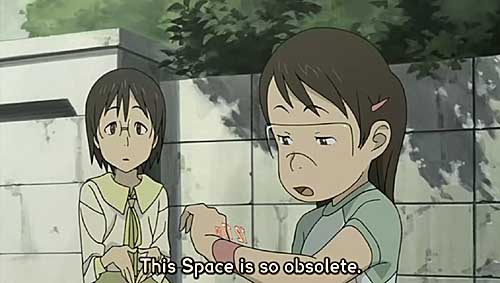
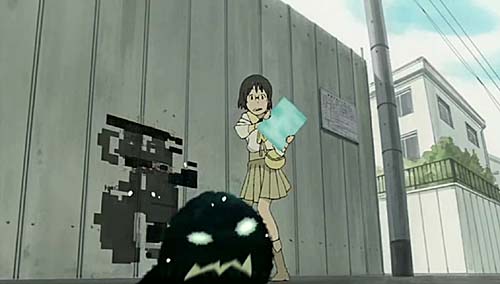
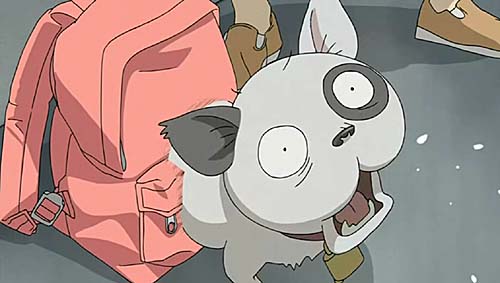
Episode one of Denno Coil is the first episode of any of this season’s series that I watched a second time, which automatically makes it the coolest show currently being broadcast. In some respects, it really does seem like Serial Experiments Lain retold for youngsters. Virtual spaces are coincident with the everyday world, and one can open holes to the cyberspaces with “bug” spray. Children have cyberpets that look and behave like real dogs and cats but are visible only to those who wear special glasses. It is possible to pick up and hold these pets, and they can freely pass through the holes into cyberspaces. They don’t like it when you drop a backpack on/through them. Numerous small floating spheres constantly monitor Daikoku City for cybernetic breaches, blasting suspicious areas with a sort of ray.
denno10.jpg

The first episode is very promising. The characters have distinct, non-cliche personalities, and the Denno Coil universe is the most interesting I’ve come across recently. Whether Denno Coil remains cool depends in part in how carefully and consistently director and writer Mitsuo Iso works out the logic of the intersecting real and virtual worlds. It also depends on whether he has twenty-six episodes’ worth of story to tell. The character designs are simplified but serviceable (though the characters who wear visors instead of glasses look like they have pig noses), and the art and the animation are adequate. The background music sounds interesting when I’m aware of it.
denno06.jpg

Truth in advertising

Let’s be brazen:

starsbootleg500.png

The offense is slightly mitigated by the fact that the fifth season never was licensed and thus there is no legitimate region 1 release. Still, usually it’s the “marketplace” dealers who sell bootlegs, not Amazon.com itself.

Update (5/22/07): Sailor Stars is “currently not available,” and the link above returns a 404.

Notes

murder01.jpg

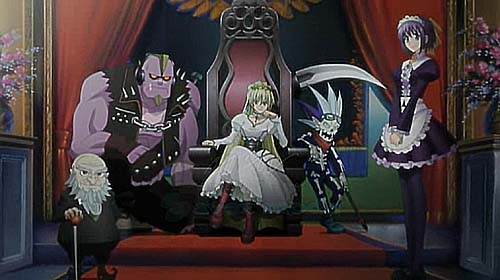
According to historical costumers, a properly-fitted corset is quite comfortable. Evidentally, in Foreland the craft of corsetry has sadly declined.

After the over-the-top first episode, the second episode of Murder Princess is a bit of a let-down as the former bounty hunter ((What is it with bounty hunters, anyway? I would have thought that Cowboy Bebop adequately covered the subject, but they keep turning up everywhere. Half the characters in El Cazador are bounty hunters.)) discovers the challenges of palace life. It’s still quite watchable, though, and it’s hard to dislike a series in which the good guys look like this:

murder02.jpg

Continue reading “Notes”

Grrr

You can legally download the first episode of Death Note for $2, which is not a bad deal, assuming that there is no limit on how many times you can play the file. However, as Astro discovered, if you’re on a Mac, you’re out of luck. You can only watch the show on a Windows machine. This is not mentioned on the download page; you have to do some clicking in the “support” menus to discover this. It looks like I’m going to wait a few months, or years, for the DVDs. I wonder if Viz will stick a mandatory Naruto trailer at the begining of the Death Note discs, as they do with Hikaru no Go.

Children’s theatre of the absurd

aniyoko06.jpg

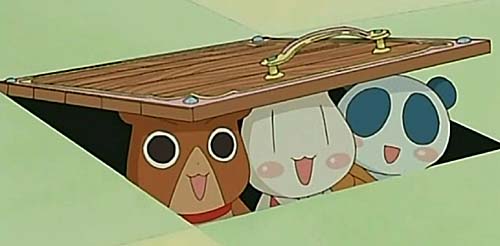
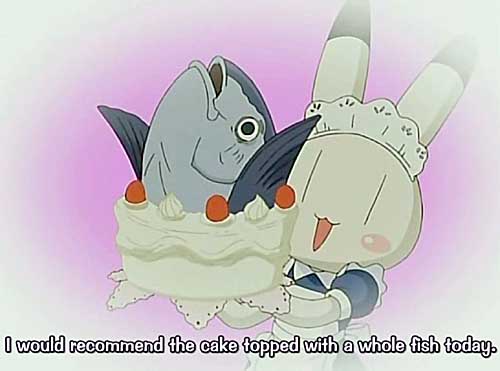
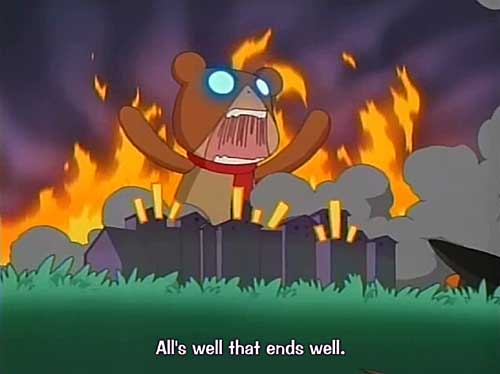
There’s a mysterious door in the floor of five-year-old Ami’s room in her family’s new home. It leads to Animal Yokocho, or AniYoko, a parallel universe inhabited by talking animals. Three of the animals pop out of the door every day to play with Ami: Kenta, the high-strung bear; Issa, the gentle panda; and, Iyo, the playful, deranged rabbit. They do things differently in AniYoko:

aniyoko04.jpg
Continue reading “Children’s theatre of the absurd”

Fireworks

rocketgirlsb08.jpg

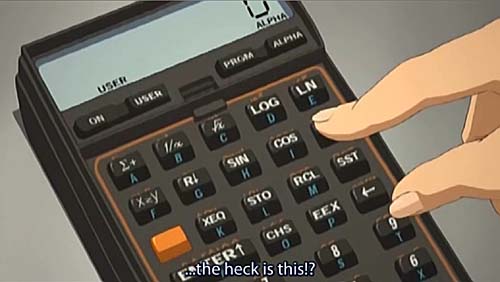
I could complain about the manifold implausibilites of Rocket Girls, but it would be pointless. How can you expect logic in a universe where a space agency drafts random high school girls to be astronauts merely because they’re lightweight? Instead, it’s better to focus on the incidental pleasures, such as classic calculators

rocketgirlsb01.jpg

or cigarette lighters

rocketgirls10.jpg

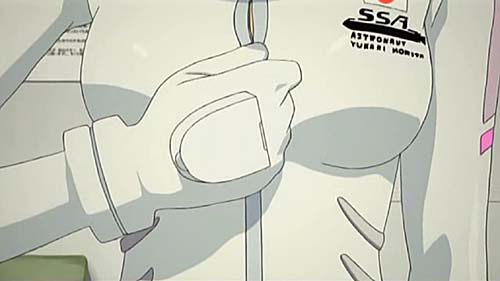
or girls wearing skin-tight space suits. (Never mind that the suits are basically three millimeters of silicone rubber, and the story is set in the tropics. Heatstroke doesn’t happen in anime.)

rocketgirls09.jpg

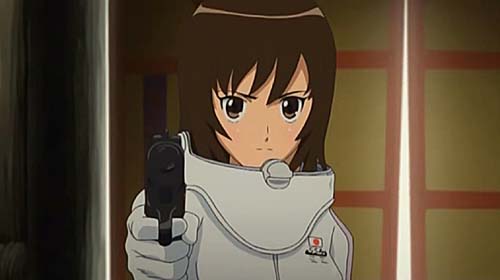
The story zips right along, and there’s no time for teen angst. Yukari, spending her vacation in the Solomon Islands looking for her father who disappeared seventeen years ago, is variously bewildered, shocked, appalled, outraged, exasperated, disgusted and just plain angry as she learns just what her “part-time job” entails and discovers a few things about her family. If Yukari really had sense, she would run away from all these crazy people as fast as she could, but then there would be no anime. She’s soon joined by Matsuri, a native islander, and one of Yukari’s classmates from Japan should arrive on the island shortly.

rocketgirlsb06.jpg

Despite all the nonsense and the bad computer animation, Rocket Girls is enjoyable. It’s partly because it doesn’t take itself terribly seriously, and partly because, although the show gets the details wrong, it gets the story right. The people who made Rocket Girls, I think, really do want to go into space.

Toki wo Kakeru Shoujo

I need to watch it again to make sure that there aren’t any paradoxes left dangling and that the writers didn’t cheat at the end, but one thing is clear: it is every bit as good as it is said to be. I doubt that I’ll see a better movie this year. The story is interesting and the central characters are three-dimensional. The production may not be as glossy as a Studio Ghibli epic, but it’s more than adequate, and the script and the acting are first-rate. I will be astonished (and appalled) if TokiKake isn’t quickly licensed, and I hope that whoever does bring it over makes an effort to market it to all audiences, not just anime fans.

Wabi Sabi comments on some of the motifs here (spoilers).

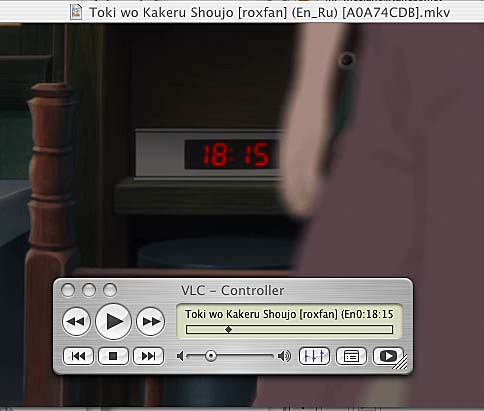
Here’s a curiosity I noticed. I wonder if it was intentional.

1815.jpg

Now would someone please translate the book.

*****

It turns out that TokiKake is not an adaptation of the novel by Yasutaka Tsutsui but is a “continuation” of it, set twenty years later. The protagonist of the novel appears in the movie as “Aunt Witch.”

Here’s Yasutaka Tsutsui’s site. It includes a profile that I hope is misleadingly pretentious and English translations of some of his short stories.

Practical details

panchanne01.jpg

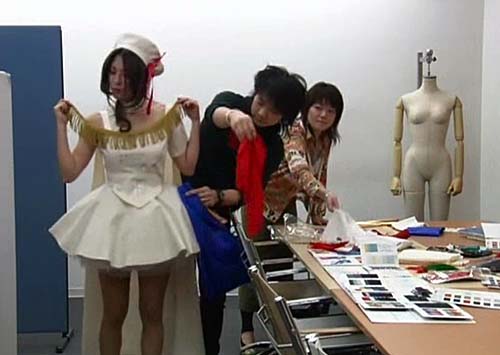
Bishoujo Celeb Panchanne is a live-action mahou shoujo spoof in which a former magical girl, now a happily married mother, is persuaded by a rather seedy kami-sama to wear the short skirt again. I’ve only seen the raw for the first episode, so I don’t know what the silly/stupid ratio is, but it looks quite cheesy, as Pixy observed. It’s also very low budget: the alien space ship looks curiously like the device I use to steam peas and corn. It does feature one element of realism missing from every other mahou shoujo show I’ve seen: we get to see Panchanne’s costume designed and constructed. ((Cardcaptor Sakura is a special case, and I don’t think we ever actually see Tomoyo sewing.)) (She still undergoes the usual magical transformation when it’s time to face the monster of the week.)

Silliness

wellber01.jpg

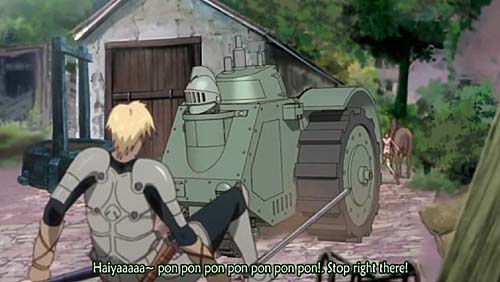
Ludicrous though it is as Shakespeare, if you ignore the characters’ names, Romeo x Juliet becomes a generic fantasy action show, a bit slicker than most but otherwise of no particular distinction. If it’s something truly ridiculous you want, I recommend Sisters of Wellber. In the first episode we have swords, guns, sword-guns, plate armor, a fairy, cigarettes, facial markings, a guy named Galahad, artificial intelligence and a tank that talks too much. There’s also mention of a “Killer Bee Man.” This isn’t schizotech; this is just plain silly. I suppose it’s part of the writers’ strategy: if anything can happen, you don’t have to worry about consistency. What’s frustrating is that there might be a decent story about interesting characters here — the principals are a princess who may or may not have killed a prince from a different kingdom, and the thief who becomes her protector — but it’s lost under all the senseless gimmicks.

Movies and dreams

Here’s an interview with Satoshi Kon. There’s nothing particularly startling or revelatory there, but one of my favorite writers does get a mention:

As far as Phillip K. Dick is concerned, I haven’t read all of his works but I have read several. He is one of the authors that I prefer to read and it is also similar to the Kurt Vonnegut situation in that before I read the novel I saw the movie Blade Runner. I am very interested in the nightmare image. That is the influence I have from him which I have been saying that quite a bit in my interviews. Last year at the Hawaii Film Festival that was held, and the small synopsis they had in the program with Paprika said is was like a collision of Hello Kitty and Phillip K. Dick. I felt that was correct.

Awakenings

Very quick first impression: I just watched the first episode of Toward the Terra. It’s potentially first-rate, but I’m reminded strongly of RahXephon. This is not necessarily bad. The first half of RahXephon had some serious flaws ((The most annoying was the profound incuriosity of the protagonist, who never asked the obvious questions.)) but was quite watchable, even with the damned mecha. It did eventually collapse into pretentious twaddle, though. I hope the people behind Toward the Terra have thought their story through.

Wabi Sabi has begun a weblog devoted to Toward the Terra that might be a useful resource.

The closing song is just enough like Pachelbel’s “Canon” to be seriously irritating.

Current viewing

Some comments on what I’ve recently watched.

Claymore — The first episode features the grossest scene I’ve endured since the first Alien movie. There isn’t anything as grotesque in the second episode, but it’s no milder. Houko Kuwashima departs from her characteristic role as an emotionless girl by playing an emotionless woman (well, half-woman). ((Kuwashima is a versatile actress, but about half her roles are silent, withdrawn characters, notably Kirika Yuumura. She does them well, but I like her better when she plays vivacious women such as Shuurei in Saiunkoku Monogatari.)) Despite my distate for gore and horror, I’m curious to see what kind of story emerges in the series. I’ll continue watching as long as it doesn’t try too hard to gross me out.

El Cazador de la Bruja — Thus far, the most interesting show of the spring, and I definitely will be following it. The challenge for me will be to not constantly compare it to Noir. There are many similarities — it’s the third of Koichi Mashimo’s informal girls-with-guns trilogy — but Ryoe Tsukimura is not involved this time and I don’t expect the overwhelming intensity of the earlier series. What I do expect is a complicated plot involving conspiracies within conspiracies, and a lighter, occasionally humorous tone in this tale of Maxwell’s Demon in Latin America. I hope Mashimo can pull it off without too egregiously violating the laws of physics and probability.

Hayate no Gotoku, or Hayate, the Combat Butler — The English title is the best part of the show. The series itself is lightweight, formulaic comedy, entertaining and nothing more. It’s not good enough to pay money for should it be licensed, so I’ll probably skip the rest of it.

Kami-chama Karin — I think of Koge Donbo as the cheerful Japanese counterpart of Margaret Keane. Her art is off the scale on the kawaii meter. Unfortunately, she’s not as good a storyteller as she is an artist. Kami-chama Karin is her idea of a mahou shoujo story. The principals are cute, but I get very irritated with them. Novice goddess Karin doesn’t ask the questions she should, and Kazune, who should be her coach and mentor, is more likely to lose his temper than explain what she needs to know. If you need a kawaii fix, watch Sugar again instead.

Murder Princess is potentially good, lurid fun, and I’m impatiently waiting for the second episode. Monster Princess, on the other hand, is just trashy.

Grey and green

Kansas, according to L. Frank Baum:

When Dorothy stood in the doorway and looked around, she could see nothing but the great gray prairie on every side. Not a tree nor a house broke the broad sweep of flat country that reached to the edge of the sky in all directions. The sun had baked the plowed land into a gray mass, with little cracks running through it. Even the grass was not green, for the sun had burned the tops of the long blades until they were the same gray color to be seen everywhere. Once the house had been painted, but the sun blistered the paint and the rains washed it away, and now the house was as dull and gray as everything else.

When Aunt Em came there to live she was a young, pretty wife. The sun and wind had changed her, too. They had taken the sparkle from her eyes and left them a sober gray; they had taken the red from her cheeks and lips, and they were gray also. She was thin and gaunt, and never smiled now. When Dorothy, who was an orphan, first came to her, Aunt Em had been so startled by the child’s laughter that she would scream and press her hand upon her heart whenever Dorothy’s merry voice reached her ears; and she still looked at the little girl with wonder that she could find anything to laugh at.

Uncle Henry never laughed. He worked hard from morning till night and did not know what joy was. He was gray also, from his long beard to his rough boots, and he looked stern and solemn, and rarely spoke.

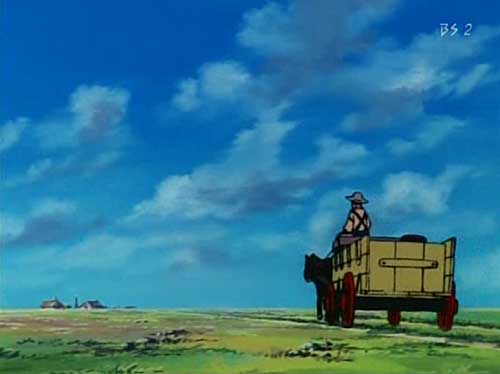
Kansas, according to Oz no Mahou Tsukai:

oz04.jpg

I’ve lived in Kansas for the larger portion of my life, and I’ve never seen Baum’s grey Kansas. During tornado season (March through June), it’s mostly green. Although joyless grey people do exist in the plains states, they can be found anywhere. They’re not specifically prairie phenomena.

Here is a more representative Kansas farm couple:

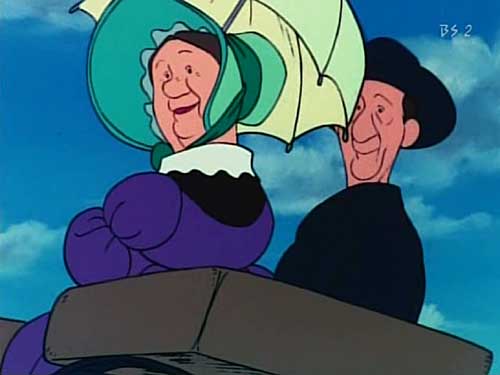
oz05.jpg

Only the first episode of Oz no Mahou Tsukai (1986) has been subtitled. It’s watchable but not outstanding. If a group decides to fansub the remaining 51 episodes, I’ll probably download them for my nephews and nieces, but if they remain untranslated, it will be no great loss.

Technical difficulties …

duckamuck03.jpg

… have finally been resolved, I hope.

Addendum: Here’s AN Hosting’s story:

As our datacenter air conditioners were forced to work harder due to the temperature increases in Chicago it overdrew power on our datacenters circuits, a breaker which was anticipated to be able to support the load was tripped. We have electrical and cooling specialists on site, however, due to the sudden loss of power your server was rebooted and we are currently working to bring it back online.

I bet summer is going to be fun. This is strike two. Do I wait for the strike three, or do I find a different host now? (If I do move to a different host, I should be able to keep the same url, so you won’t have to change your bookmarks again.)

A few notes

Between banging out old tunes on the dulcimer and fixing my bike, I did find time to watch a few odds and ends this week.

Because of Pete’s advocacy, I watched the first two episodes of Manabi Straight again. Maybe I will view the rest, after all. The girls still look way too young, but you become inured to that, and while they act younger than high school students should, so do most high school students. I don’t know that I will like the show as much as Pete does, but I can say that it is more genuinely funny than Lucky Star.

I came across a subtitled “screener” of Paprika. I hope it gets a proper theatrical release in America, because this is one movie you definitely want to see on the big screen if at all possible. It’s a spectacular trip. How good it is, I haven’t decided. My snap judgment is that it’s very good, but the whole is less than the sum of its parts. Some of those parts are amazing, though, and Paprika is never less than entertaining at any time.

Both Paprika and Toki wo Kakeru Shoujo are based on stories by Yasutaka Tsutsui. I’m curious about him, so my most recent Amazon.com order included Salmonella Men on Planet Porno. It will give me something to read while I’m waiting for the movies. (Nick will be pleased to learn that I also ordered The Twelve Kingdoms: Sea of Shadow.)