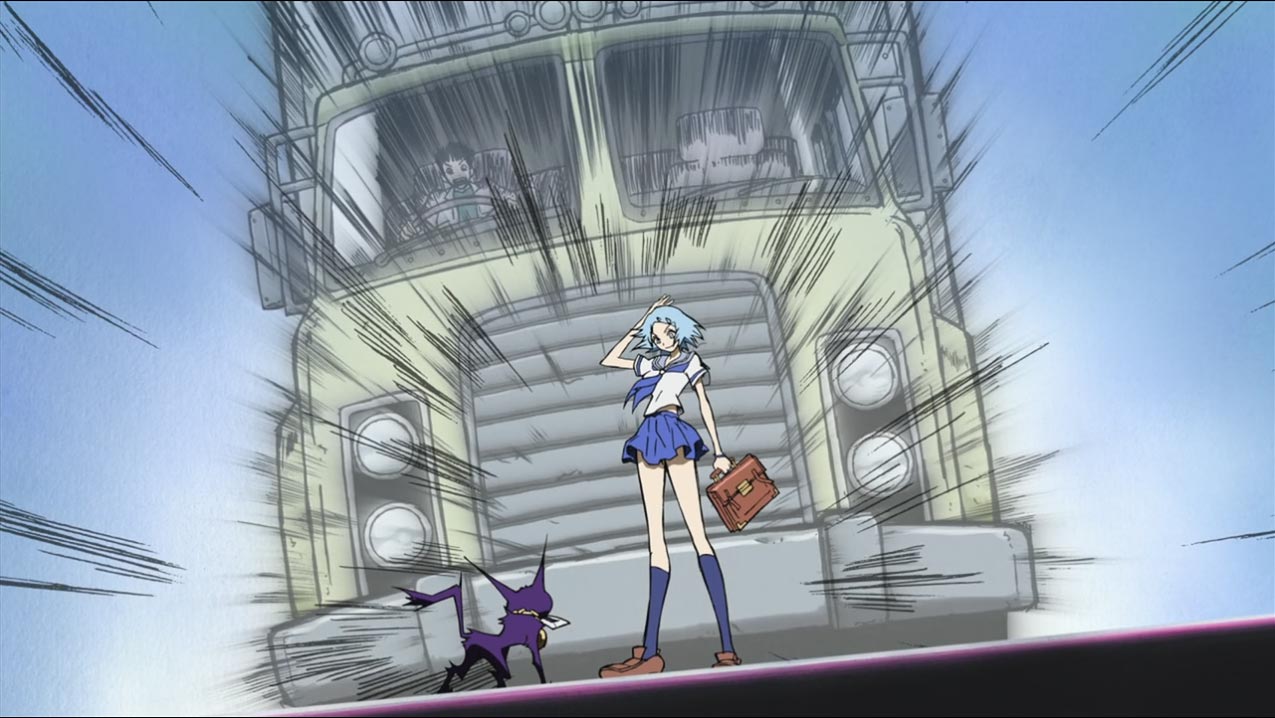
Of all the mysteries in Mouretsu Pirates, the most puzzling, and the least likely to be satisfactorily explained, are the Sailor Moon shout-outs. This Princess Serenity is anything but a ditzy airhead.
By the way, it is impossible to watch just one episode of Shingu.
82 years ago today, Elm Farm Ollie, also known as Nellie Jay and Sky Queen, became the first cow to fly in an airplane, and also the first cow to be milked in mid-air.
Crunchyroll began streaming Mahou Shoujo Madoka Magica today, so I watched the first episode during lunch. I was curious to see how it looked at 1080. I took several screencaps; click on them to see them full-size. They look nice, but they’re not razor-sharp. I would guess that the video was upscaled from 720. (The monitor screen is 1920 x 1200, hence the letterboxing. (The images from Madoka’s dream were letterboxed to begin with.))
Real life keeps getting in the way, but I make time every Saturday to watch Mouretsu Pirates. So what if the premise is unlikely and that there numerous minor details to nitpick? As long as the characters are interesting and the story is good, I don’t care that miniskirts aren’t suited to zero gravity. I think the pacing is fine. Tatsuo Sato knows exactly what he is doing. Constant action is boring. I’d rather get to know the characters and situation before the battles start. I enjoy spending time with Marika, and I look forward to 20 more weekends with her and her crew.
I enjoy the soundtrack, too, and I hope it’s licensed. I apparently am in the minority on this point, but I even like the opening theme, despite the singers. It would be much better with a less cluttered arrangement — ideally, just drums, bass and Marty Friedman — and a singer who can properly belt out the tune. Can Bruce Dickinson sing Japanese?
Sato makes anime that is more complex than it at first seems and which ultimately mostly makes sense, e.g., Shingu. There’s already much speculation on the history of piracy and related matters in Marika’s universe at Steven’s place.
Just wondering: One of the spaceships is called the “Odette II.” Will there be an “Odile”?
Update: Here’s the “sailing” theme.
[audio:http://tancos.net/audio/PirateTheme.mp3]
Update II: Steven calls the tune “Odette II.” You can download a clean version from his site.
Etna is doing her thing again. You can watch the show though numerous webcams, such as this or those here. You can listen to the explosions here as well as see them when the camera is working and the server isn’t overburdened.
Update: the show is over. You can see pictures here and some videos of the eruption here. If you’re lucky, you’ll also see a cheesy Italian commercial.
There are three pages to the score for Terry Riley‘s In C. Two of the pages are performance directions; the actual music all fits on a single page. It consists of 53 numbered phrases ranging in length from two sixteenth notes to 32 quarter notes. The performer plays each phrase in sequence, repeating it as many times as he wishes, before moving on to the next phrase. Riley suggests a group of about 35 musicians. Performances normally run between 45 and 90 minutes, according to Riley.
Although I’ve occasionally read about In C — it’s perhaps the first example of musical “minimalism” — and I’ve looked at the score, I’ve never actually heard it. A few days ago, I heard Riley’s A Rainbow in Curved Air for the first time in decades (not counting its use in The Hitchhiker’s Guide to the Galaxy radio program).1 It was more engaging than I remembered, and it occurred to be that I didn’t need to round up 35 musical friends to get an idea of what In C sounded like. I could just launch Logic and sequence as many voices as I wanted. Which I did.
This is a stripped-down, streamlined version. It’s a little over eleven minutes long, and there are only five voices — six, if you count the “pulse.” I didn’t plan it out beyond shifting loops nicely out of phase. It probably doesn’t truly represent what In C should be, but it might suggest how the music works. I likely will revise and expand this arrangement sometime soon. You can download the score here if you want to follow along or organize your own performances. There’s also a 50-minute orchestral “realization” of In C at the site — unfortunately, using what sounds like an undistinguished general midi soundset.
You can imagine Mikuru Asahina playing the repeated high C eighth notes if you wish. Or Zooey Deschanel.
Update: Uploaded a new version with additional voices and a few tweaks.
Here’s a curiosity from 1997 I ran across today on YouTube. It’s no surprise that it’s a Studio 4°C production, but there are some noteworthy names in the credits, e.g., Yoko Kanno and Masaaki Yuasa.
Visitors here, reading posts such as this, might assume I listen only to Japanese music. That’s not quite true. I listen also to Finnish music. For instance, Gjallarhorn:
This weekend I got a months-long domestic mess straightened out, and my place is finally, once again, my place. I can listen to ear-melting music without headphones and watch Divergence Eve without people looking over my shoulder. It’s good to be alone.
Suppose the translators responsible for The New American Bibletook on Shakespeare:
Existence or its opposite? That’s what I am asking myself.
Whether it be more or less dignified to put up with
The barbs and darts of brash Luck, or to use weapons
Against distress’s oceans, to stop them from happening.
There supposedly is a genre of iyashikei, or “healing,” anime, such as Aria or Ikoku Meiro no Croisee. I find most such productions irritatingly bland, rather than soothing or refreshing. ((The only example of the genre I find rewatchable is Someday’s Dreamers, which has a serious story underlying all the niceness.)) If you seek therapeutic anime, the works of Tatsuo Sato are much more effective:
A rewatch of Nadesico helped me get through the first few days of living with a broken arm, and Shingu was good for a flu and high fever.
Update: I just watched the second episode of Mouretsu Pirates. It looks like it’s going to be at least as good as Nadesico. Whether it approaches the level of Shingu remains to be seen.
“You don’t have to rely on a healthy body image or self-respect any more”:
I don’t know if you can “cook a tasty chicken on lava”, but I know you can cook a steak of meat on an Hawaiian lava flow! I did it! You just lay a sheet of aluminium on the lava; you spread some some oil on the steak, possibly with some herbs. Then, you put the steak on the aluminium sheet and let it broil a few tens of seconds on each side. I can assure you it is delicious, all the more with a glass of Californian wine! I’m French; I know what good cooking means!!
I watched the first episode of Mouretsu Pirates twice in two days. The last series I did that for was Madoka a year ago. Pirates has a lot in its favor, including:
A meganekko with a hime haircut and a sailor suit.
A bunny, a ducky and a pink bobblehead pig.
An absence of in-your-face fanservice. ((No surprise, given that Sato’s Shingu featured an outstanding example of anti-fanservice.))
There are a few negatives, e.g., green lipstick, skinny ties and really bad haircuts.
The positives greatly outweigh the negatives, and Mouretsu Pirates looks like, at the very least, a fun show. With Sato at the helm, there’s a good chance that the series will be a satisfyingly complex story and not just an excuse to put pirate hats on pretty girls.
*****
A bit of music:
It’s not just for humans.
If French is the language of love, what is German the language of?
2011 is over. Good riddance. It was a thoroughly crummy year for me, ((2011 was a good yearfor volcanoes.)) and I am not going to compile any retrospective posts. If you want to know about the year in anime, see Ubu’s recaps here and here.
Pop music with a high-gloss finish: Tokyo Incidents, featuring Shiina Ringo.
I’ve also been listening to some “Tokyo virginity pop,” as Urbangarde labels their music. Imagine Hatsune Miku as a real singer in an avante garde-ish band. I don’t like any of their videos — the visuals range from pretentious and silly to pretentious and distasteful (I wonder what percentage of their operating budget goes toward fake blood) — so I’ll just refer you to their website. There are links to videos there; the music sounds better if don’t actually watch the videos but only listen.
I found time to watch the first two episodes of Mawaru Penguindrum, and, well, I’m not at all surprised that its mastermind was earlier responsible for Utena. It starts off as a shameless tearjerker. By the end of the second episode it’s deep in WTF territory. It’s currently getting high praise around the otakusphere, but I’m skeptical that it’s better than Madoka, as some claim. I suppose I’ll have to watch the rest of it and see.
For no good reason, I downloaded a curiosity called “Ravex in Tezuka World.” I should have bailed out when I saw this
but I foolishly watched the whole thing. The planet of Reearth, whose denizens are escapees from Osamu Tezuka’s various works, is threatened by Dark Silence. However, the cheesy dance music of the Ravex trio saves the day, with some assistance from an altered Astroboy.
Not even PrincePrincess Queen Sapphire can save this mess.
Steven found a nice set of Flash puzzles. Some are easy; others are trickier and require finesse to solve. Don’t click on the link unless you have at least a half-hour to spare.
By the way, you have four days left to figure out this year’s little number puzzle while it’s still timely. What is the next number in this sequence? It’s not 71.
23
27
31
39
43
47
55
59
63
(This is the American version. In other countries, the sequence is:
23
39
55
27
43
59
31
47
63
The solution is the same as for the American version.)
Balsa (Seirei no Moribito) is the most heroic character in anime according to visitors to this site, followed by Simon (Tengen Toppa Gurren-Lagann), Homura Akemi (Mahou Shoujo Madoka Magica), Kenshin Himura (Samurai X; Rurouni Kenshin) and Vash the Stampede (Trigun). Others receiving votes are Edward Elric (Fullmetal Alchemist), Nanoha Takamachi (Mahou Shoujo Lyrical Nanoha), Nausicäa (Nausicäa), Rem Saverem (Trigun), Togusa (Ghost in the Shell), Allen Schezar (Vision of Escaflowne), Yoshika Miyafuji (Strike Witches), Yoko (Tengen Toppa Gurren-Lagann), Alphonse Elric (Fullmetal Alchemist), Ashitaka (Princess Mononoke), Spike Spiegel (Cowboy Bebop) and Eboshi Gozen (Princess Mononoke).
There is a now poll up: which is the outstanding romantic couple in anime? I’m doing this one in two stages. Vote for up to three in the first round. The top ten will advance to the final round.
I regret that I had to disqualify a few of the nominees for not being old enough. In a few years Syaoran and Sakura, Hayama and Sana, and Haraken and Yasako will be good candidates, but ten and eleven is a little young for serious romance, no matter what CLAMP thinks.