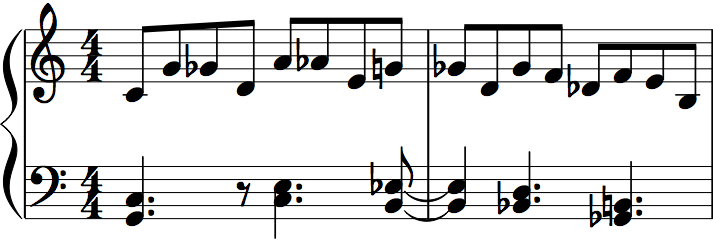
I condensed “Bad Apple” down to two strains in 32 measures, suitable for playing in jam sessions or for dances, which I’m posting in case anyone else might find it useful. It’s in E minor now, a much friendlier key for diatonic instruments than the E-flat minor of the score I worked from. It’s not obligatory to play it as written: fiddle with the rhythm and add a few triplets, and you have a perfectly fine hornpipe. I expect you could tease a strathspey out of it with a bit of ingenuity. For inspiration, see Floating Cloud. (Click to embiggenify, right-click to save to your disc.)
Update: “Bad Apple” as a strathspey and reel can be found here.
I found a complete performance of Balanchine‘s A Midsummer Night’s Dream. If you remember the play, you can follow the story pretty well, though Balanchine made many changes in adapting it. Even if you haven’t read Shakespeare, you can enjoy the spectacle, and there’s always the music.
Frederick Ashton also choreographed the play in The Dream. In his version, the transformed Bottom dances on pointe for added grotesquerie.
If you have a MIDI keyboard you can plug into your computer and a VST or AU host, here’s a very nice freebie you can play with. It’s based on the Oberheim OBseries of synthesizers. It works fine in Logic on my aging Mac laptop. I haven’t had time yet to do more than try some presets, but it sounds very ’80’s to my ear.
How long before “Bad Apple” surpasses “‘Sukiyaki‘” and “Sakura Sakura” as the best-known Japanese melody? And how does Touhou fandom compare with Broniedom? ((There are inevitably Touhou-MLP:FIM crossovers.))
Lately when I’m in the mood for loud, fast and not overly intellectual music, I listen to Onmyouza, a well-dressed “yokai” metal band. Here’s “組曲「鬼子母神」〜鬼拵ノ唄,” transliterated by Google as “Kumikyoku ‘kishimojin’ — oni Koshirae no uta.”
[audio:http://tancos.net/audio/oni Koshirae no uta.mp3]
One of the advantages of listening to music in languages you don’t know is that you can pretend that the words are literate and worth hearing. I foolishly became curious about Onmyouza’s lyrics and looked for translations. I found a video with subtitles of one of their other pieces, and I kinda wish I hadn’t. If you understand what the song above is about, please don’t tell me.
When I first saw this video, I immediately wanted the little green keyboard that Masaki Kurihara plays. It looked like I could carry it in a backpack on my bicycle or at the campgrounds at Winfield, and I would not need to find an electrical outlet or a USB port. After some searching, I determined that it was a Suzuki Andes 25F, a sort of panpipe with a keyboard. Unfortunately, the ones available for sale then were too expensive to consider. I recently checked again and found much better prices. The best was at a Japanese shop affiliated with Rakuten Global Market, which is where I ordered it. Placing the order was a bit complicated but not too tedious, and it arrived fairly quickly once it was shipped.
It has a two-octave range, from F to F. I frequently play in D, A and E, and a few more notes at the low end would have been extremely helpful. Still, there are plenty of tunes that fit well on it. The keys are smaller than regular piano keys. People with small fingers have an advantage; those with larger hands, like me, will find that it takes practice to avoid playing two notes simultaneously with one finger. The lower octave has a pleasant sound, but the upper octave gets shrill, and I avoid playing the highest notes. Unlike most flute-sounding instruments, you can play chords on it. Thirds sound good; fifths, triads and octaves can be unpleasant. Also, the more notes you play at once, the more breath it requires. Glissandos are easy.
The biggest problem is that there is no good way to hold it. There’s no handle on the instrument itself, no strap to slip your hand into. There is an indentation on the angled side that I think is intended for a hand hold, but it feels awkward and your arm soon gets tired. There’s a neck strap, but it isn’t secure. I’ll have to think about this and see what I can devise.
Here’s an obnoxious setting of an old fiddle tune, “June Apple.” It’s mainly an excuse to make funny noises with Razor. Beware: this is very bass-heavy.
Update: Uploaded a ever-so-slightly less cacophonous version. All the voices except the percussion now are Razor.
Stereo pictures from WWI. A couple of notes: stereograms made for hand-held viewers use the parallel method of viewing, not the crossed-eye. I.e., the right eye focuses on the right image, the left eye on the left. It is possible to free-fuse the images, though it is easier done than explained. Let your eyes relax and drift apart until the images of a well-defined region in the pictures, such a the bright sky through the roof in the above image pair, start to overlap. Focus on that region until the images snap together, and you should then be able to see the entire scene in perspective. (You’ll need to sit back at least two feet from the monitor if you want to see the full-size images at the link in stereo.)
Today is Tartan Day. Here are a few Scottish tunes: The Barren Rocks o’ Aden / Munro’s Rant (Angus Cumming, 1782) / Stirling Castle / Miss Kitty Gordon of Earlston’s Reel (Robert Riddell, 1787).
Here’s “Grace O’Malley” as she stands, this time with a proper virtual piano. I’m sick of her. I may return to this catastrophe later and do some severe pruning and rewriting, but right now I just want to work on something — anything — else.
I found a couple of free prepared pianosample libraries and thought I’d see what my current project would sound like as played by John Cage. This used to be an Irish tune.