Tune of the day #1

I don’t post all that much these days, and that’s not likely to change any time soon. Therefore, I thought I would start posting each day a piece of music that caught my ear, so that visitors will have something to listen to when there’s nothing new to read. Expect anything from Renaissance dances to Melt-Banana. No matter what your tastes are in music, there’ll be something to annoy you.

Can I keep this up indefinitely? Sure. Can you stand a year of it? We’ll see.

We’ll start with an orchestral arrangement of “Beware the Forest’s Mushrooms” from a Super Mario game, composed by Yoko Shimomura. While I have little interest in video games, I recently discovered that some game music is highly listenable, and Shimomura is one of the best composers. This particular piece reminds me of central European composers such as Dvorák and Smetana.

Miscellany

Noise comes in colors. There are white noise, pink noise, red noise, brown noise, blue noise, grey noise, etc. The various shades are most easily perceived by acousticians and sound engineers.

While wandering around an airport earlier this summer, I realized that there music playing throughout the building. It was light, watery jazzish stuff, difficult to pay attention to. There was a trumpet in the mix, but the sound was bland, not bold. The melodies were trivial and the chords hackneyed. It may very well have been AI slop. What I was hearing could be called “beige noise”: music intended to be ignored.

*****

Joseph Epstein on a biography he never wrote:

In my early thirties I signed on to write a biography of John Dos Passos, who was still alive. I wrote to Dos Passos to ask if I might have his cooperation in writing his biography. He replied instantly, saying that he would help me in any way he could, on the condition that I “put my liberal ideology in mothballs” and pledge never again to use the word “explicate.”

*****

Atomic Fungus shows how to talk to machines:

Mrs. Fungus was trying to get a tech on the phone, and was stuck at the recalcitrant AI prompt. After hearing her say, “I want to talk to an agent!” fifty-odd times, I took the phone from her.

Machine: “Do you want to try to restart your cable box now?”

Me: “NO! BIB GOBBLE WAGLE BAG GAG HANGLE!”

Whenever the clanker would ask me a yes/no question, I’d answer it, but then add random gobbledygook. And I kept making the tone angrier and angrier.

It gave up and shunted us to a human.

Mrs. Fungus: “How did you do that?”

The algorithm that translates what the user is saying into something the computer can understand has a limited capacity for literal nonsense. In theory, after a sufficient number of errors, it should crap out and send the caller to a human.

That was my theory. I’m glad it worked!

*****

A thousand years ago I discovered three records in the University of Dallas library that would determine much of my musical activity over the years to come: Augustin Anievas’ Chopin waltzes, the first disc of Isolde Ahlgrimm’s “Well-Tempered Clavier,” and Songs by Tom Lehrer1. Lehrer died recently. A few years ago he released his music into the public domain. You can find all the songs here.

*****

One of the places I passed through in Alaska, southeast of Fairbanks. There is culture in the wilderness.

Mw = 8.6 ± 0.2

From Izvestiya, Physics of the Solid Earth, July 23, 2025:

The epicenters of the August 17, 2024 earthquake and its strongest aftershocks fall in a shallow ring-shaped structure (Mt1 = 5.3), which supports the hypothesis of a preparation of a great earthquake in the South Kamchatka region. In the previous works, the correlation dependences of parameters Mt1 and Mt2 on the magnitudes Mw of large earthquakes have been constructed for the western Pacific (in the range Mw = 7.0–9.0). Using these dependencies, we estimated the magnitude of the great possible event in this region at Mw = 8.6 ± 0.2.

I.e., last week’s titanic Kamchatka earthquake had been accurately predicted about a week before it happened. However, there is a paywall; if you want to read anything beyond the abstract, it will cost you $39.95. Consequently, almost nobody saw this prediction.

Volcano Café:

And the bottom line: if you want to warn people about an impending disaster, don’t do it behind a paywall. Those paywalls are there to stop people from reading the work, and in this they are quite effective. You risk becoming a voice crying in the publishing wilderness.

Eye-crossing time

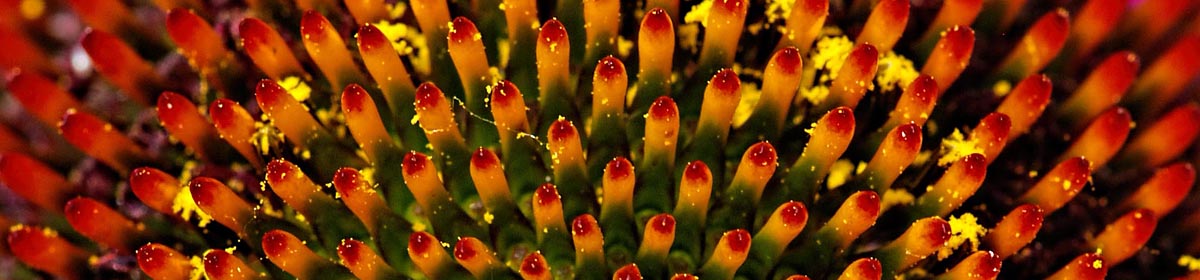
Rudbeckia subtomentosa

It’s been a while since I last posted any stereo pictures. Here are a few recent ones. These are “crossview” pairs, i.e., the right-eye image is on the left and vice versa. Cross your eyes so that you see three images, and focus on the middle one. When everything is properly aligned, the subject will pop into three dimensions. Once you can manage this with the small pictures, click on each to view it at a larger size. There’s a knack to it, but once you get it, it’s easy.

Continue reading “Eye-crossing time”

I don’t think we’re in Kansas anymore

From the University of Alaska at Fairbanks campus.

I spent the last week of June in Alaska visiting family. Circumstances precluded any long trips outside of Fairbanks, but I still found plenty of subjects for my camera. Disappointingly, the Alaska Range was generally concealed by haze and clouds. The above was as good a photograph as I was able to get, though I did spot Denali/Mt. McKinley once when I didn’t have the camera in my hands. It will probably take a week or two to go through all the hundreds of pictures I took. For now, here are some of the peonies and roses at the Georgeson Botanical Garden at the University of Alaska at Fairbanks, the most northerly botanical garden in the world. In Kansas, peony season season is long over, but in central Alaska it’s just starting. The roses are mostly hybrids of the very hardy Rosa rugosa.

Continue reading “I don’t think we’re in Kansas anymore”

Today’s quote: God’s language

Bonald:

I’m sufficiently annoyed to facetiously propose an alternative: that a proper Christian education should be centered on abstract algebra (groups, rings, vector spaces, etc). Reasons:

  • Deep exposure to math inclines students to the true philosophy: Platonism. Humanities pay too much attention to words, which inclines to nominalism.
  • Ability to manipulate people (rhetoric) has greater moral hazard than ability to manipulate things.
  • Unlike the classics, modern math has large contributions from Christians (Euler, Cauchy, Riemann, Cantor, etc).
  • Scientists and engineers are hard-working nerds. Writers and artists are bohemian degenerates.
  • Math does a better job than rhetoric or grammar in promoting clear thinking and rigorous reasoning. In math, one can’t win arguments by manipulating the meanings of words. True, classical students might study Euclid, which has the virtue of being proof-based. However, it lacks the breadth and profundity of modern mathematics, its training in abstraction, the recognition of identical structure in disparate systems, exposure to deep concepts like generators, homomorphisms, cosets, etc.
  • The level of memorization required for a Latin-based education is an unnecessary barrier that math-based education evades.
  • Math is God’s language.

Today’s quote, Prussian schooling edition

Joseph Moore:

Pity poor Horace Mann, Henry Bernard and other ‘educationists’ trying to sell modern schooling to such people. They had to convince such an educated population to hand over their children’s education to experts. Basically, the educators failed to convince Americans. Mann started pitching Prussian schooling, otherwise known as compulsory age-segregated classroom instruction, before 1837, but it took a dozen years and special circumstances to get the first school off the ground. That first school in 1848 in Boston snuck by because it targeted immigrants. ‘Real’ Americans didn’t send their kids there; those ‘real’ Americans became convinced that it was a good to use the state’s power to beat a little of the right kind of Jesus into the skulls of the Irish Papists kids that were showing up in Boston in large numbers at that time (the Irish Potato Famine began in 1845). From the very beginning down to this day, schooling is seen by the self-appointed Enlightened as a way to correct the moral defects – Catholicism back then, all the ‘bigotry’ and ‘hatred’ today (which of course includes Catholicism) – of the unwashed masses.

Today’s quote

Kate McMillan at normblog twenty years ago:

Norm: If you could have any three guests, past or present, to dinner who would they be?

Kate: From the present – the American writer and conservative ‘hawk’ Mark Helprin, and rocker Ted Nugent. Helprin is on a lot of shortlists as ‘world’s greatest living writer’, but that’s not the only reason I’d invite him. I figure that given a few drinks, he could help me convince Nugent to beat the crap out of the third guest I’d invite – Pierre Elliott Trudeau, the socialist Canadian Prime Minister who set into motion the intellectual, military and political decay of a once proud nation.

Western colors

Penstemon “Blue Lips”

The Great Penstemon Experiment is returning some preliminary results. While there are penstemons native to every state except Hawaii, species from the eastern half of the country tend to be white or lavender — nice, but generally not brilliant. Out west, however, they’re much more eye-catching, with many blues and reds. I’ve started a number of these from seed and purchased a few plants, focusing on species said to be “easy” or “adaptable.” The following all survived a full year in Kansas and are blooming now.

Continue reading “Western colors”

Springtime blues

Penstemon mensarum

Last year’s experiments are starting to bloom. The Penstemons native to Kansas are fine plants, but if you want the vivid blues that the genus is legendary for, you need to look to the arid west. The very blue P. mensarum is found only in a small region in Colorado. Fortunately, it is easy from stratified seed, and the plants seem perfectly happy in Kansas.

Continue reading “Springtime blues”