Sometimes I answer that if I have something I want to say that is too difficult for adults to swallow, then I will write it in a book for children. This is usually good for a slightly startled laugh, but it’s perfectly true. Children still haven’t closed themselves off with fear of the unknown, fear of revolution, or the scramble for security. They are still familiar with the inborn vocabulary of myth.
October skies and heavy weather

When the weather is clear, you have a good chance of seeing a bright, possibly naked-eye comet this month.
Update (10/11/24): Where to look. Some hints for finding it.

*****

Weather websites such as Weather Underground (a distasteful name for a useful site) extensively cover Atlantic hurricanes but rarely notice when anything happens elsewhere on the planet. I find Zoom Earth helpful to track storms around the world, such as Typhoon Krathon, which is currently inundating Taiwan.
Dungeon maintenance
Where do the monsters in RPG dungeons come from? Who restocks the treasure chests? Who makes the treasures? What happens to the dead bodies? Who operates the dungeons? How do they fit in the regional economy? Clay, a young woman and formidable adventurer, finds out in the anime Dungeon People1.
When Clay fights a minotaur on the ninth of the ten levels of the Antomurg dungeon, a wall collapses, revealing an ordinary bedroom. The dungeon’s administrator comes to assess the damage.


That administrator, Beilleheila Langdass, a.k.a. “Belle,” the puissant final boss of the climactic tenth level, is a little girl, perhaps eleven years old, with soft pink robes and baby blue hair. She’s been looking for help with the dungeon, and Clay is exactly what she wants. After a bit of sparring, Clay accepts the job.

Clay spends much of Dungeon People learning the operations of the dungeon, and working with Belle and with Rangard, the dwarf who makes the treasures and other items associated with the dungeon. The odd-numbered episodes usually feature some combat, such as when Belle and Clay terminate the occasional psychopath or renegotiate a contract with the local king. However, the show mostly focuses on the practical side of running a dungeon: replenishing treasure chests, interviewing potential monster employees, propagating goblins, replacing magical hardware, etc., as Clay learns to be Belle’s friend. The art is like illustrations in a children’s book, appropriate to the pleasant, occasionally bloody story, and the animation is adequate. “Warm and fuzzy with a side of murder” is how J Greely sums it up.
The twelve episodes leave many questions unanswered. There’s little information on the fate of Clay’s father, who entered the Antomurg dungeon some years back and hasn’t been seen since. Belle looks and acts like a little girl, but who, or what, is she really? Where do dungeons come from? Few people watched Dungeon People — aside from me, the only ones I know of are J Greely and Peter S, plus a handful at the AnimeSuki forum2 — and I don’t expect a second season with answers.
More screenshots beneath the fold.
*****
I cancelled Crunchyroll, as I mentioned earlier, and I haven’t seen any more of The Elusive Samurai. I have no great desire to pick it up again, though it does seem very popular if the amount of fan art at Pixiv is an indication. I hope to see the Mononoke movie sometime soon, and I might consider paying for Crunchyroll again when the next seasons of Frieren at the Funeral and The Apothecary’s Diary are out. Otherwise I have little interest in current anime.
Additional garden notes

Grasshoppers have been a plague, as usual. The only control I have found that works at all is the orb weaver spider. I observed one in my garden wrap up two grasshoppers almost as large as itself in five minutes.
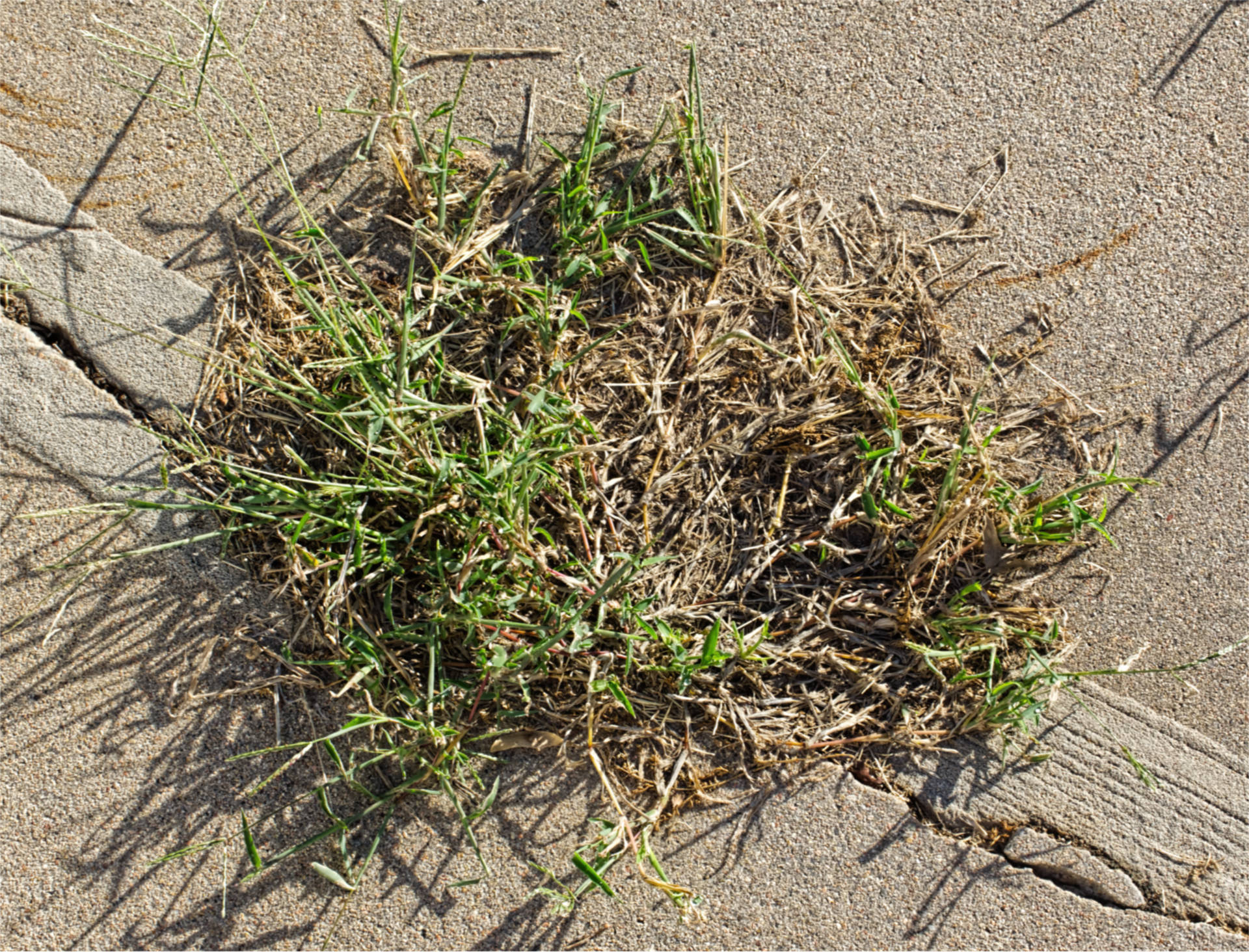
Roundup is no longer Roundup. It used to contain glyphosate, and it was the best chemical solution for most weeds, particularly invasive, difficult-to-dig-out grasses like bermuda.3 However, it’s been reformulated without glyphosate, and it no longer reliably kills weeds. I sprayed the above plant above three weeks before I took the picture. With the old Roundup it would have been completely dead and ready to scrape off the pavement. With the new, disimproved formula, it looks uglier than it did before but is still vigorously growing. I checked every herbicide at Home Despot; not one of them contains glyphosate any more.
Sleep, creep, leap: the conventional wisdom is that growing perennials from seed to bloom takes three years. The first year they produce just a few leaves and concentrate on developing their roots; the second year there is more top growth but most of the action still takes place underground; the third year they’re ready to put on a show. I find that this may be true of some, but most are quicker. I’m still waiting for the Baptisias, Asclepias and the rest of the Silphiums that I started last year, but all the Penstemons bloomed this year. Quite a few bloomed well their first year, e.g. Helianthus, Aster Symphyotrichum, Dianthus, Rudbeckia, Echinacea.

I spotted the above while reviewing Monty Python recently. The yellow flowers look like Mentzelia, possibly M. lindleyi — a plant of the American west, and not something I would have expected from a bunch of silly Brits (and an expatriate American).
Gardening year in review

The enormous clump of Helianthus maximiliani, seven feet tall, has just started blooming, and the much smaller Tricyrtis will follow in a few days. Otherwise, the garden is pretty much done for the year. This is as good a time as any to look back and see what did well and what didn’t, and what did too well.
Sort of a musical challenge
Show me your playlist, and I can already envision how you live.
Okay. Here is some music I recently listened to.
Now tell me how I live.
Tune of the day, automotive edition
A song for a young man of Robbo’s acquaintance:
Today’s quote: the pedant as hero
The only time I have been able to impose my pedantry upon a group larger than a room of 15 or 20 students was during the time (chiefly the 1970s and ’80s) when I edited the American Scholar, the intellectual quarterly of Phi Beta Kappa. First day on the job, I outlawed from the magazine’s pages a number of words or phrases popular at the time. Among them were “input” and “feedback,” which together always sounded to me a linguistic version of peristalsis. “Charisma” was not permitted to apply to anyone of lesser stature or influence than Gandhi or Jesus. “Lifestyle” was strictly verboten, so, too, weasel words such as “arguably” or “interestingly.” “Author” used as a verb, poof!, was gone; “supportive” was never allowed in the game. “Intriguing” was permitted only if it referred to spying or diplomacy, and “impact” exclusively to car crashes and dentistry. “Caring,” “sharing,” “growing,” “parenting,” “learning experience,” and other psychobabble words were excluded.
Today’s quote: Weirdos
Great thinkers are often great weirdos; since every constellation of traits now constitutes a bona fide “identity” deserving federal protection and universal huzzahs, the weirdos ought to get into the act…. During Weirdo Appreciation Month, we’d celebrate novelist Marcell Proust (who lived in a cork-lined room), pianist Glenn Gould (who reflexively sang along to whatever Bach keyboard work he was playing), and literary Swiss Army Knife Samuel Johnson (an immense, lumbering figure who, owing to what would today be diagnosed as OCD, Tourette’s, and God knows what else, would alarm the uninitiated with his bizarre gesticulations and involuntary bird-noises). Mathematicians would be robustly represented, including Paul Erdös, who was challenged by a colleague to abstain from chemical stimulants for one month; upon successfully meeting the challenge, Erdös famously said to his colleague: “You’ve set mathematics back a month.”
Today’s quote: At the circus in clown world
In the present election, we have to choose between a confidence man and a courtesan, two types the American people warmly approve as less obese reflections of themselves. Trump’s talent is the power to embolden nervous investors and make them sign checks they would not sign if they were not under the spell of Trump. Harris’s talent is the power to do whatever she is told to do while cluelessly enjoying dumb luck.
A hundred and more years ago, Trump and Harris might have been working together in a sideshow of a travelling circus, Trump outside the tent persuading the yokels to part with a quarter to take an edifying gander at the Queen of Sheba, Harris inside the tent beguiling the yokels with phony-exotic allure.
*****
I myself am still more likely to write in Dave Barry for his stand on plumbing issues5, though I am considering Vincent D. Furnier for his policy on school reform.
Today’s quote
The American Lytton Strachey is probably H.L. Mencken his own self, and he’s a very late, very poor imitation (in that sense; I’m not sure if calling him “the American Strachey” is an insult to Mencken, or Strachey, but frankly I hope it’s an insult to both).
You don’t need an infinite number of monkeys
Six are enough, if you have the time. See R.A. Lafferty. And also Russell Maloney.
(Via Pixy.)
For more STEM literature, see A Stress Analysis of a Strapless Evening Gown.
Live from Iceland

Alternate history: 1865
Steve Sailer this week wrote about American presidents and alcohol, which reminded me of this old favorite.
If Grant Had Been Drinking at Appomattox
By James Thurber
(“Scribner’s” magazine is publishing a series of three articles: “If Booth Had Missed Lincoln,” “If Lee Had Won the Battle of Gettysburg,” and “If Napoleon Had Escaped to America.” This is the fourth.)

The morning of the ninth of April, 1865, dawned beautifully. General Meade was up with the first streaks of crimson in the sky. General Hooker and General Burnside were up and had breakfasted, by a quarter after eight. The day continued beautiful. It drew on toward eleven o’clock. General Ulysses S. Grant was still not up. He was asleep in his famous old navy hammock, swung high above the floor of his headquarters’ bedroom. Headquarters was distressingly disarranged: papers were strewn on the floor; confidential notes from spies scurried here and there in the breeze from an open window; the dregs of an overturned bottle of wine flowed pinkly across an important military map.
Sunday morning observation
I have yet to hear a sermon that was too short.
Today’s quote: tribalism
In a way, I do envy the people who are experiencing tribal joys around the election. To go into raptures over a candidate together with everybody “on your side” must be pleasant.
But then I think nah, I’d rather have my brain all to myself and enjoy it in a lonesome fashion.
Related: Cthulhu for America.
Update: Or Sauron.
Farewell to the button-down mind
Today’s puzzle
Here’s the conclusion of an article that I came across today.
After thoroughly examining and analyzing the distinct patterns detailed above, it is evident that each sequence forms unique combinations which can be utilized in various areas such as music creation, coding systems, or solving mathematical problems, among other applications.
The flexibility and diverse range of combinations reflect the broad applicability these sequences may possess.
This study underscores the cardinal role of permutations in numerous fields, bringing to light the profound connections and impacts these numerical sequences hold within our daily lives.
Ultimately, this highlights the significance of such distinctive patterns and their expansive potential in fostering innovative solutions and breakthroughs.
Can you guess the subject of this article? Read it here.
Today’s quote: TDS
Donald Trump is no saint yet, certainly; but he has the curious quality that many saints have, of revealing serious hatred problems deep in people’s hearts, even when those people have always seemed good or normal. Some of these “good” people go stark raving mad when exposed to someone sweet, kind, and gentle, possibly because they suddenly feel inferior somehow, or feel disturbed in their view of what is possible for a human to do and be.
Trump Derangement Syndrome has a similar quality, where something innocuous or funny done by Trump suddenly works like splashing holy water on a vampire, shrieks and all. I have seen it with a member of my own family, and still don’t understand it.
Today’s quote, bourgeois edition
David Stove, via William M. Briggs:
… if you write down the names of a hundred people who have done something that matters in science or literature or any other branch of culture, you will find that two at most of the hundred come from the most privileged part of the social scale, and one at most from the least privileged…
This is an extremely simple statistic, and one which is very easily verified: anyone who is prepared to take a small amount of trouble can satisfy themselves as to the fact. Yet it is of the greatest importance. If it were attended to, it would be enough on its own to silence forever revolutionary or bohemian ranting about “bourgeois culture”; for it proves that culture is everywhere, and always has been, a middle-class monopoly.