
My neighbors decided that I didn’t need any sleep this weekend. Consequently, my mind is too fuzzy to focus on the posts I have planned. Instead, here’s another batch of miscellaneous nonsense.
Trivia that matter

My neighbors decided that I didn’t need any sleep this weekend. Consequently, my mind is too fuzzy to focus on the posts I have planned. Instead, here’s another batch of miscellaneous nonsense.

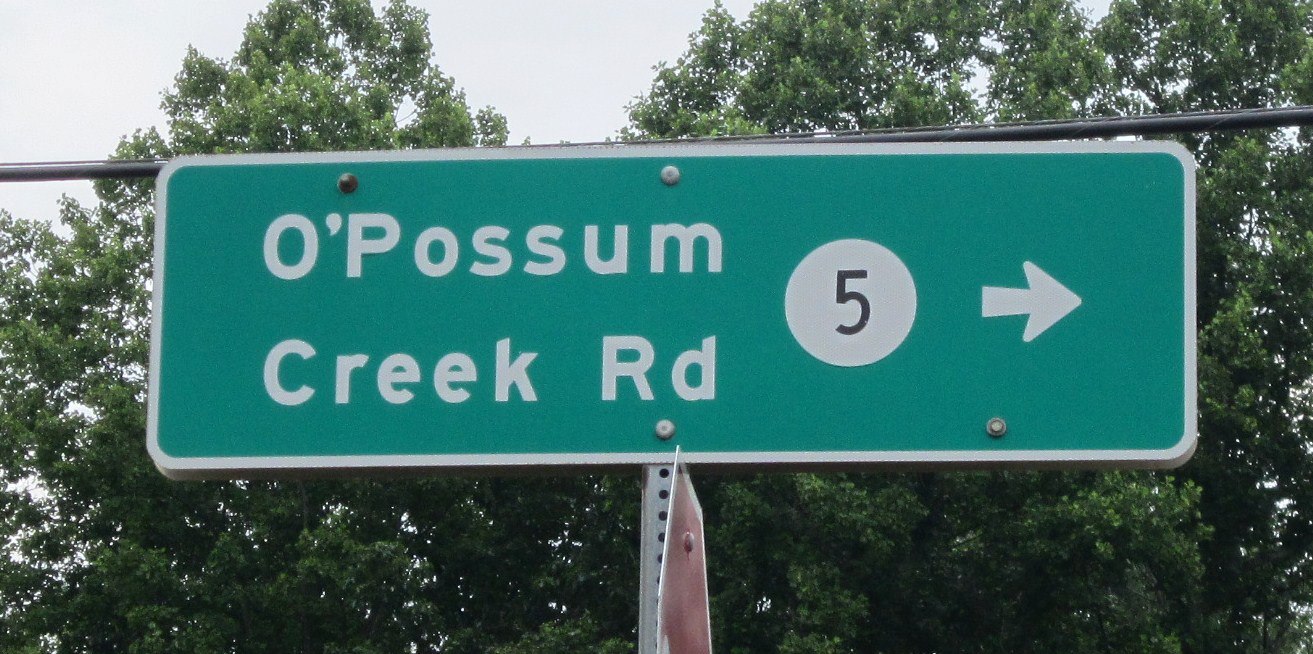
The Federal Highway Administration doesn’t approve of apostrophes on road signs.
However, apostrophes can be found in the wilds of West Virginia. A friend spotted one this past weekend:
It’s taken years, but Miku is at last coming to the Mac.
What can you say about nothing? Quite a bit, actually.
Orwell is not the only writer who comes to mind when I read the news these days.
Iwo Jima, one of the less hospitable places on earth, might not be around much longer. Also, Kyushu is an exceptionally violent place, geologically speaking.
Anthony Weiner and his ilk would do well to consider the example of John Profumo.
I was taken particularly aback by the first five minutes of the film [Pacific Rim]. It shows very neatly and succinctly how we in the First World do have this knack for turning even the worst catastrophes, the most vicious wars, the most horrific losses of life, into forms of entertainment. Call it our penchant for commercializing everything, or a neat psychological trick for distancing ourselves emotionally and psychologically from the evils of this world, we can turn even global genocide into a game show, a video game, or a set of collectibles.
Norman is said to have his eyes on the Tory leadership; like Disraeli before him, he climbs the greasy pole with pen in hand. A product of Eton and Oxford, and a Ph.D. in philosophy, he combines politics and scholarship in a manner more common in Westminster than Washington. Boris Johnson, mayor of London and a rival in the race for Downing Street, dashes off witty works of popular history with ease; the Foreign Secretary, William Hague, has authored polished biographies of Pitt and Wilberforce. There is no equivalent in America; books by politicians here are almost invariably bland, ghostwritten policy tracts or memoirs. This impoverishes our politics—historical ignorance and inarticulacy preclude statesmanship. ((But is there any statemanship in England today?))
Ace:
Al Sharpton will interview Rachel Jeantel tonight.
The closed captioning guy just hanged himself. He left this note: “Avenge me.”
Bonus quote — Avatar:
You guys are thinking too small. For that kind of capital, robot catgirl maids could be a reality!
Matthew Walther on Dan Savage:
Savage has probably written more books than he’s read, so one cannot fully fault him for his prose’s shortcomings.
… and I could use a little silliness right now.

When I read Dusty Sage’s comments on Equestria Girls, it occurred to me that there might be another bipedal variation on the Pony theme extant. And indeed there is. Is there ever.
There is an anime music tournament in the works, and the organizers seek your nominations. The following are what I came up with during breakfast this morning. There’s a lot of Susumu Hirasawa, Masumi Itou, Yuki Kajiura and Yoko Kanno. It’s not by accident.
Haibane Renmei — “Free Bird”
Paprika — “Mediational Field”
Azumanga Daioh — “Soramimi Cake”
Noir — “Salva Nos”
Mahou Shoujo Madoka Magica — “Sis Puella Magica”
Jinrui wa Suitai Shimashita — “Yume no Naka no Watashi no Yume”
Macross Plus — “Voices”
Paranoia Agent — “Yume no Shima Shinen Kouen”
Bakumatsu Kikansetsu Irohanihoheto — “Kouya Ruten”
Ghost in the Shell SAC — “Lithium Flower”
Shin Sekai Yori — “Wareta Ringo”
Ghost in the Shell SAC — “Inner Universe”
Paranoia Agent — “Shiroi Oka – Maromi no Theme”
Pumpkin Scissors — “Mercury Go”
Level E — “Cold Finger Girl”
Inevitably, I forgot a favorite: “Poltergeist,” from Ghost Hound.
***
No one ever visits my photo gallery. I decided to open a Flickr account, so even more people can ignore my pictures. It seems I timed it just right — the Flickr page sure looks pretty, but I have to wait for it to load completely twice before I can do anything there. I joined a few Flickr groups and, again, I timed it just right. It seems that Wichita photographers hang out at Facebook nowadays. Although I do have a Facebook account to keep tabs on family and friends, as a policy I post virtually nothing there. That’s not going to change.
***
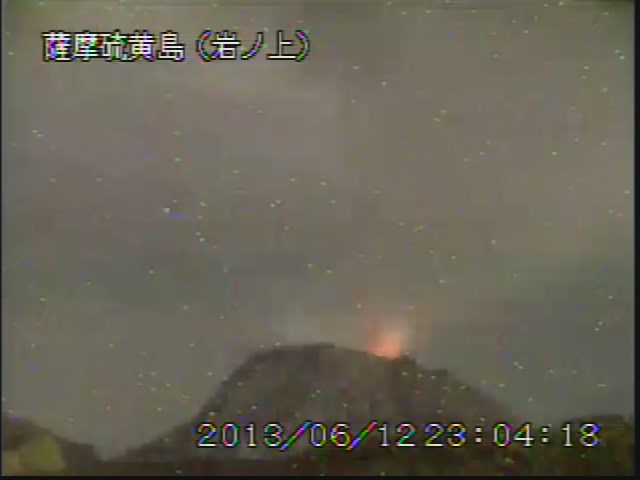
Satsuma-jima, not far from Kyushu, has been a bit feisty lately. I grabbed the picture above from the JMA webcam (third from the bottom of the list) this morning.
Discovered while browsing in Wikipedia:
[Graham] Greene’s film review of Wee Willie Winkie, featuring nine-year-old Shirley Temple, cost the [Night and Day] magazine a lost libel lawsuit. Greene’s review stated that Temple displayed “a dubious coquetry” which appealed to “middle-aged men and clergymen”.[16] It is now considered one of the first criticisms of the sexualisation of children for entertainment.
It may be just as well that he didn’t live to see moe-licious anime.
During my youth, I was sent to four grade schools and three high schools, public and parochial, where I spent most of my time feigning attention and wishing I could go off by myself and read and explore all day. I eventually realized that the purpose of these schools had nothing to do with learning. They existed to keep me under close supervision and out of my parents’ hair during the day; any real education that might happen was incidental. The American school systems, public and private, are the greatest achievements in day care in the history of civilization.
I’m not the first person to observe that. In 1972, John Holt wrote that
society demands of schools, among other things, that they be a place where, for many hours of the day, many days of the year, children or young people can be shut up and so got out of everyone else’s way. Mom doesn’t want them hanging around the house, the citizens do not want them out in the streets, and workers do not want them in the labor force. What then do we do with them? How do we get rid of them? We put them in schools. That is an important part of what schools are for. They are a kind of day jail for kids.
(Via Joe Carter.)
In the 30s, serious intellectuals traveled to the Soviet Union to hail it as the future of humanity. In the 60s and 70s, writers, actors & other assorted glitterati went to Cuba to be schmoozed by El Jefe. And now North Korea has hauled in…a retired basketball player with a penchant for shock publicity. The quality of useful idiots is on a definite downward trajectory.
A couple of noteworthy post titles:
Proposition: “The collective national IQ peaked in 1967, and has eroded since.”
From the comments:
I read a study years ago claiming that, since the Late Victorian era, the average written sentence loses five words per decade. ((Um, just how long was the average sentence in late Victorian times?)) I cannot claim to know the methodology of the study, but if it’s true, we may all be communicating in grunts, soon. Actually, some of the teens I hear on cell phones seemed to have reached that stage.
Another study I read claimed that, in the late sixties, early 70’s, one needed a vocabulary of about ten thousand words to comprehend a television news show, or to read a newspaper. In the eighties and nineties, it was five thousand.
Ignorance of Botany Is Ignorance of Literature
*****
Wonderduck is giving Vividred Operation a close look — a very close look, from a variety of viewpoints, from many low camera angles. Better him than me. Can you guess what is a vivid shade of red? Hint: think Strike Witches.
Izu Oshima, by the way, is a real place and a frequently active volcano — sometimes spectacularly so. If Oshima gets feisty during the course of the series, Vividred might be worth watching after all.
Some fireworks for your New Year’s celebration (best appreciated in full-screen mode):
More fireworks, this time from Kamchatka (below the fold, because of goddam autoplay music (fortunately, you can turn it off)):
The astounding thing about all the quackeries, fads, and movements of the past hundred years in America is that they were first accepted by superior people, by men and women of education, intelligence, breeding, wealth, and experience. Only after the upper classes had approved, the masses accepted each new thing.
—Gilbert Seldes, The Stammering Century (1928)
Perhaps it’s not that astounding; I long ago observed that high intelligence is not necessarily associated with common sense.
… while a massive philosophical gulf separates J.R.R. Tolkien and Hayao Miyazaki, their works both come from a strange and unmodern place, and speak to the part of us which is unmodern and strange; which is to say the human part of us.
Gilbert Seldes in 1928, quoted by Helen Rittelmeyer:
In the middle of the nineteenth century, the word “reformer” meant one who wanted to give liberty to others; today it means, briefly, one who wants to take liberty away. The change in meaning is accompanied by a change in method. There is a dislocation of the center of fear. Laws, lobbies, censors, and spies have displaced God as the object of awe and veneration, sometimes even as the object of faith. The great social and religious movements of the middle of the last century were based on the belief that man could be made perfect. The current belief is that machinery, including the machinery of government, can be made perfect. . . .
The typical zealot of 1800 was a man fanatically busy about salvation; in the 1840s he was as fanatically busy about improving himself; later he turned to uplifting his fellowmen and later still to interfering with their pleasures. . . .
Eighty years ago, [a reformer] withdrew from society, founded his own community, and preached Abstention. Today, he passes laws and cries, I forbid.
When engineers sleep,
catgirl breeding runs amuck;
Steven, get well soon.
(This is in reference to this news.)

I watched the final episode of Joshiraku before I left for the polling place this morning. That may have been a mistake; I couldn’t help seeing a political subtext that probably wasn’t actually there.

Not Red Reviews is posting the translator’s notes on this most idiosyncratically Japanese of shows: ((Sure, much of the show is obscure even after all the puns are explained, so why waste your time translating it? Oh, and you’ll never really fully understand medieval or ancient worldviews, either, so why read Chaucer or Homer?)) episode one, episode two, episode three, episode four, episode five, episode six, episode seven, episode eight, episode nine, episode ten. Update: episode eleven, episode twelve, episode thirteen.



A duck and a cuckoo from episode eleven of Joshiraku.
*****

You don’t need to attempt kanji for a memorable tattoo. A weak grasp of English is sufficient.
*****
An entertaining historical document is online: That Party at Lenny’s.
*****
Welcome to Crossover Hell. A related horror: another approach to Touhou Ponies.
I wonder: how does the world of Bronies compare with the Touhou universe?
*****

So salt and sugar are unnatural?
*****

Jinrui wa Suitai Shamashita was perhaps the best show of the summer. I did a little searching to see if Romeo Tanaka’s novels have been translated yet. As far as I can tell, there’s only one chapter available in English.
*****

(Bumper sticker courtesy of Borepatch.)
Last and least, some political notes. Although I am a member of the Wet Blanket Movement, I do have some interest in the Fringe Party. For those who believe that all people should have the right to vote, not just the living and the residents of Chicago cemeteries, Dr. Boli has yard signs you can download and print.


It’s a pity that Death Note is little-known outside of anime circles. The parallels between Light Yagami’s little black notebook and the Lightworker’s “kill list” deserve more attention.
(Via God and the Machine.)
*****

I’ve never read Eric Hobsbawm and I don’t plan to, but I can’t resist posting this picture (from The People’s Cube). Here are a couple of encomiums to the celebrated historian (the latter via Dale Price).
*****
Don’t read the comments on articles in online magazines. Just don’t.